

Published On: September 7, 2026
Updated On: September 22, 2026
Best Practices for Tracking Adjuster Licenses and Renewals

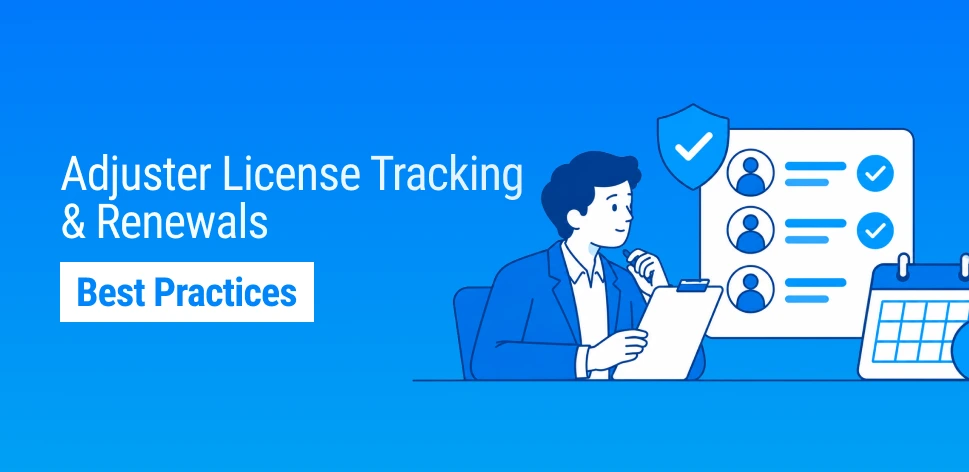
Adjuster license tracking involves monitoring and maintaining licensing status, renewals, and compliance requirements across multiple states and jurisdictions to help ensure claims can be handled without regulatory disruption.
Like producers, claims adjusters may be required to be licensed and, in some states, appointed to protect consumers and promote fair market practices. A missed renewal can cause an adjuster license to expire or become inactive, potentially preventing the adjuster from handling claims until the license is restored.
However, varying requirements by state and adjuster type, as well as fragmented visibility into adjuster licenses, limit the ability of firms and individuals to accurately track renewals and state regulatory compliance. In this blog, we will explore best practices that can help adjuster firms and their adjusters track independent, company/staff, and public adjuster licenses, including the multiple relevant requirements that must be met.
Key Takeaways
- Varying compliance requirements complicate multi-state adjuster license tracking.
- Unlicensed adjusting can have significant financial and regulatory consequences.
- Following best practices for adjuster license tracking can improve visibility, workflow, and compliance.
- Insurance license management software can enhance adjuster license tracking.
Why Is Multi-State Adjuster Licensing So Complex?
Many states license adjusters separately from insurance producers since they serve different legal and business functions. In fact, some states impose restrictions on individuals who hold or perform both producer and adjuster roles.
As with producer licensing, maintaining an adjuster license requires monitoring appointments, continuing education, renewals, and other requirements. However, as adjusters expand across states and encounter unique circumstances, shifting requirements complicate adjuster license tracking for individuals and business entities.
Tracking adjuster licenses across multiple states is primarily complicated by the fact that:
- Not all states license adjusters.
- Licensing requirements vary by adjuster type.
- Reciprocity rules differ by state.
- CE and renewal requirements are inconsistent.
How does this complicate multi-state adjuster license tracking? As adjusters and adjusting firms seek to acquire licenses in multiple states, they will have to answer these fundamental questions about adjuster licensing requirements:
- Does the state require adjuster licensing?
- Not every state licenses adjusters.
- Adjusters based in non-licensing states may need to choose a Designated Home State (DHS).
- A DHS may provide the basis for obtaining a resident adjuster license when the adjuster’s home state does not license adjusters.
- Which type of adjuster is being licensed?
- Independent and company/staff adjusters represent carriers.
- Public adjusters represent policyholders.
- Licensing requirements can vary by the type of insurance adjuster.
- Some states require separate licenses by adjuster type.
- Does the state recognize reciprocity for nonresident adjusters?
- Reciprocity, line of authority (LOA), and license type standards vary by state.
- Some states grant nonresident licenses based on the adjuster’s resident license and reciprocal agreements.
- Some states require additional exams, state-specific applications or documentation, even when reciprocity applies.
- Nonresident licensing depends on home state recognition rules.
- Are appointments, continuing education, renewals, and other standards required?
- Appointment requirements vary by state and carrier relationship.
- Continuing education (CE) requirements and renewal cycles differ by jurisdiction.
- Some states require ongoing reporting of licensing activity.
- The NAIC provides guidelines.
- State regulators have the authority to set their own licensing standards.
Other common adjuster licensing circumstances with their own requirements include emergency adjuster licensing, state-specific exemptions for certain situations or functions, such as attorneys, and some lines of authority. Together, these complex requirements limit clear visibility into adjuster licensing status for individuals and business entities, reducing the ability to renew licenses on time and increasing the chance of compliance violations.
The Cost of Unlicensed Adjusting: Florida
To protect consumer and insurer interests, claims adjusting is a strictly regulated part of the insurance industry. When individuals or business entities allow adjuster licenses to lapse, the regulatory and financial consequences can be significant.
Florida, with its high risk of hurricanes, has one of the highest employment levels for adjusters in the country. Recent state regulator activity has included hundreds of thousands of dollars in fines for unlicensed claims adjusting. For example, Florida regulators recently fined three property and casualty insurance companies $400,000, $150,000, and $50,000 respectively for using unlicensed claims adjusters, failing to follow appropriate regulatory procedures, and inadequate claims disclosures. That’s a total of $600,000 in fines for unlicensed or otherwise non-compliant claims adjusting.*
States vary in how they penalize unlicensed claims adjusting, with some imposing significant financial consequences for violations. Because independent and public adjusters may operate across multiple states, carefully navigating state regulations and maintaining valid adjuster licenses is essential to avoid fines and other regulatory penalties.
*Source: Merlin Law Group
Best Practices for Tracking Adjuster Licenses and Renewals
Using manual methods for tracking adjuster licenses reduces visibility, increases regulatory risk, and limits operational efficiency. Organizing adjuster information into spreadsheets, managing renewals with calendar reminders, and relying on siloed workflows for different aspects of the validation process ultimately keeps adjusting firms unaware of crucial compliance gaps.
Instead, individuals and entities can harness the following best practices for tracking adjuster licenses and renewals. These strategies can help boost efficiency, enhance visibility, and keep operations compliant:
- Workflow Automation
- Automate renewal workflows and license updates to reduce manual administrative burden.
- Trigger renewal workflows based on state-specific expiration rules and deadlines.
- Automatically update adjuster license records based on incoming regulatory changes.
- Centralized Tracking
- Maintain a single source of truth for all adjuster licensing data.
- Consolidate statuses, expiration dates, and state-specific renewal requirements in one location.
- Scale oversight across large populations of independent, company/staff, and public adjusters.
- Integrate with Regulatory Data
- Connect with available NIPR and state regulatory data sources to maintain current licensing information.
- Validate adjuster license statuses against regulatory records.
- Synchronize license updates across systems.
- Real-Time Alerts
- Automate notifications for upcoming license expirations and renewal deadlines.
- Flag status changes, inactive licenses, and regulatory actions in real-time.
- Escalate unresolved compliance issues before licenses lapse.
- Ongoing Monitoring
- Monitor adjuster license status and activity across jurisdictions.
- Monitor changes to state licensing requirements and regulations.
- Audit license statuses, continuing education, and renewal requirements on an ongoing basis.
- Compliance Reporting and Auditing
- Maintain audit-ready records for every adjuster license.
- Generate reports on license status, expirations, and compliance gaps across jurisdictions.
- Leverage dashboards to monitor compliance and support regulatory audits.
By following these best practices for adjuster license tracking, individuals and entities can better manage the complex regulations that affect licensing and appointment compliance for claims adjusters.
How Does Insurance License Management Software Enhance Adjuster License Tracking?
An insurance licensing management software platform can bring these best practices together in one platform, providing a solution that empowers compliance teams with greater visibility, efficiency, and scalability.
The following table summarizes the foundational impacts of innovative strategies and software features on adjuster license tracking operations and compliance:
| Best Practices | Software Feature | Impact on Adjuster License Tracking |
| Workflow Automation | Rule-Based License Renewal Orchestration | Improve Efficiency |
| Centralized Tracking | Adjuster Licensing Data Repository | Enhance Visibility & Reduce Data Fragmentation |
| Regulatory Data Integration | NIPR & State Licensing Data Sync Engine | Improve Accuracy |
| Real-Time Alerts | Event-Driven License Expiration & Escalations Engine | Prevent Missed Renewals |
| Ongoing Monitoring | Regulatory Change Detection & License Status Tracking System | Strengthen Compliance Oversight |
| Compliance Reporting & Auditing | Compliance Audit Trail & Evidence Management | Strengthen Audit Readiness |
Summary
As claims adjusters investigate losses, evaluate claims, and support the claims process, valid licensing provides an essential foundation for compliant adjusting activities. Although varying regulations by state and adjuster type can complicate compliance, following proven best practices for adjuster license tracking can empower compliance teams to avoid the significant financial consequences of unlicensed claims adjusting.
Insurance license management software helps adjusters and adjusting firms centralize relevant information, track changing regulations, monitor renewals and expiration deadlines, and respond quickly to compliance gaps. By keeping adjuster licenses valid, insurance organizations can help ensure their teams are prepared to respond to claims without unnecessary compliance delays or operational disruption.
FAQs
Q.1 What happens if an adjuster license expires?
Depending on state law, an expired adjuster license may prevent an adjuster from legally handling claims in that state. This may delay claims processing or expose the organization to regulatory penalties and financial consequences.
Q.2 What should be included in adjuster license tracking?
Effective adjuster license tracking should monitor license status, expiration dates, state-specific requirements, continuing education credits, lines of authority, and renewals.
Q.3 Can adjuster license tracking reduce operational delays?
Yes. Adjuster license tracking keeps licensing data accurate and up to date, so organizations can verify licensing status more efficiently before assigning adjusters to claims.
Q.4 What features should a modern adjuster license tracking system include?
Key features include automated renewals, NIPR integration, real-time alerts, centralized dashboards, compliance reporting, and continuous monitoring of regulatory changes.
Q.5 How do insurance companies track adjuster licenses across states?
Insurance companies may use centralized license management systems that integrate with available NIPR and state regulatory databases to consolidate license data, expiration dates, and compliance requirements in one place.
Q.6 What is required for multi-state adjuster licensing compliance?
Multi-state adjuster licensing compliance requires understanding whether a license is required in each state where an adjuster operates and meeting applicable state-specific requirements.
Allison is a Content Writer at Agenzee, creating blogs, case studies, social media content, and other value-driven materials to support overall marketing strategies and spur brand growth. Her storytelling expertise infuses her work with a clear, captivating voice that successfully drives conversion and engagement.
Educated in anthropology at Princeton University, Allison’s unique background in software solutions, fiction writing, ethnographic research, and tutoring gives her a unique perspective on the insurance licensing world, enabling her to pursue her mission: Making Agenzee the leader of insurance modernization.
Disclaimer: This post is for informational purposes only and does not constitute legal or compliance advice. Agenzee does not warrant the accuracy of and assumes no liability for reliance. Please consult regulators or professional advisors as needed. See our full disclaimer for details.
Subscribe
Stay Ahead with Agenzee Insights
Join our community to stay up-to-date on the latest news and strategies for license and appointment management
INDUSTRY INSIGHTS FOR INSURANCE AGENCIES, CARRIERS, AND MGAS
Similar Blogs
Read our blog to discover the latest industry insights and trends in license and appointment management.

let's catch up!
Schedule a Live 1-On-1
Demo of Agenzee!
Our insurtech experts would be thrilled to give you a personalized demo of how Agenzee can transform your compliance management processes.
Customers Opinions on Our Services and Products
What Our Customers Say
Find out why our customers are happy they chose Agenzee.