

Published On: July 21, 2026
Updated On: July 31, 2026
Insurance Agents vs. Adjusters: Roles, Responsibilities, and Why Both Matter

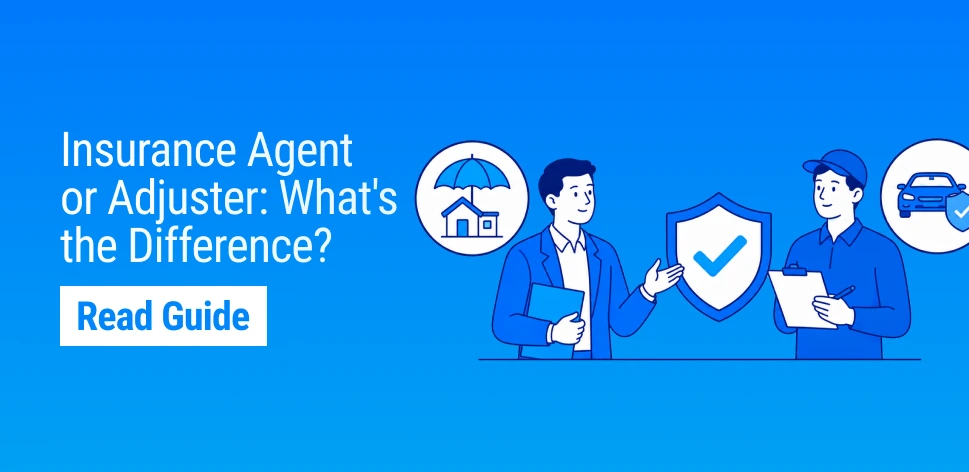
Insurance agents and adjusters perform different functions within the insurance process: Agents help customers obtain and maintain insurance coverage, while adjusters evaluate and manage claims after a loss occurs. Agents are primarily involved in insurance distribution, while adjusters are involved in claims management.
Definition – Insurance Agent
Agents contribute to the policy lifecycle by helping customers secure coverage, explaining policy terms, and assisting with policy-related administrative processes.
Definition – Insurance Claims Adjuster
Adjusters contribute to the claims lifecycle, becoming involved after the policyholder files a claim to seek reimbursement for a covered loss. Depending on the type of adjuster, an insurance adjuster may manage a claim on behalf of the insurer, while public adjusters represent the insured policyholder.
Agents and adjusters make unique contributions to the insurance industry and operate at different stages of the insurance process. This blog explores their differences to help customers, insurance carriers, agencies, adjusting firms, and other organizations make informed decisions to best suit their needs.
Key Takeaways
- Agents sell insurance policies while adjusters manage insurance claims.
- Agents and adjusters have different responsibilities.
- Customers and organizations interact with agents and adjusters at different points.
- Agents and adjusters can sometimes collaborate in the best interests of the policyholder.
- Agents and adjusters have different salary structures, earning potential, and expectations.
- Both agents and many adjusters require licensing, but requirements vary significantly by state and role.
- The insurance industry needs both agents and adjusters.
What Is the Difference Between an Insurance Agent and Adjuster?
The work of agents and adjusters centers on different moments in a policyholder’s insurance journey. Agents help customers choose, purchase, and maintain insurance coverage, often serving as a primary point of contact for policy-related questions. Adjusters become involved when a loss occurs, working to investigate claims, assess damages, and evaluate coverage under the policy.
The main differences between agents and adjusters are broken down in the following table:
| Agent | Adjuster | |
| Which part of insurance are they a part of? | Policy lifecycle | Claims lifecycle |
| What are the different types? | Independent or captive | Independent, company/staff, or public |
| What do they do? | Sell, distribute, and negotiate policies to the customer | Evaluate, manage, and assess claims for the policyholder or carrier |
| Who do they represent? | The insurer, the customer, or operates as an intermediary depending on the agency relationship and state regulations | The insurer or the insured, depending on the adjuster type |
| Who do they work for? | Insurance carriers, agencies, or self-employed | Insurance carriers, adjusting firms, or self-employed |
Essentially, agents work with insurance policies, while adjusters mainly work with insurance claims.
Definition – Insurance Policy An insurance policy is a legal contract detailing the terms of an agreement between the insurer and the insured. It describes what damages and losses may be covered under a policy.
Definition – Insurance Claim An insurance claim is filed by a policyholder to request reimbursement for a loss covered under an insurance policy. Insurers determine whether coverage applies and, when appropriate, provide payment based on the terms of the policy and the claim settlement.
While the responsibilities of agents and adjusters differ, they are equally important. Both agents and adjusters contribute to helping policyholders navigate the insurance process.
What are the Responsibilities of Agents vs. Adjusters?
Based on their different roles, agents and adjusters have different responsibilities within the insurance industry.
Agents are typically responsible for:
- Sales & Marketing: Generating leads and promoting insurance products.
- Customer Service: Providing advice to help customers choose and understand a policy.
- Policy Analysis: Explaining policy options and analyzing current insurance plans.
- Policy Management: Assisting with applications, paperwork, policy changes, and premium payments.
- Regulatory Compliance: Adhering to insurance regulations and licensing requirements.
- Carrier Representation: Following insurance company guidelines, underwriting requirements, and applicable appointment requirements.
Adjusters are typically responsible for:
- Claims Evaluation: Evaluating insurance claims against policies to determine coverage.
- Loss Investigation: Inspecting reported damages and gathering evidence to verify claim details.
- Damage Assessment: Estimating the extent of loss and determining claim value.
- Settlement Negotiation: Evaluating claims and communicating settlement recommendations or decisions based on policy coverage and applicable regulations.
- Claims Documentation: Maintaining records and preparing claim reports.
- Regulatory Compliance: Following claims-handling regulations and insurer procedures.
Carrying out these different responsibilities leads agents and adjusters to interact with customers and insurance organizations at different stages of the insurance process.
When Do Customers and Insurance Organizations Interact with Agents vs. Adjusters?
How and when agents and adjusters are encountered depends on whether an entity is an individual or a business and what they want to accomplish. Customers, insurance carriers, and other insurance organizations have different relationships with agents and adjusters.
| Insurance Entity | When Do They Interact With Agents? | When Do They Interact With Adjusters? |
| Customer | Buying and maintaining an insurance policy | Managing an insurance claim |
| Carrier | Appointing agents to sell their insurance policies | Assigning, reviewing, and managing insurance claims |
| Agency | Contracting with, supporting, and managing producer relationships | Assisting customers with claim-related questions and directing them to appropriate claims resources |
| Adjusting Firm | Limited direct interaction; may contact an agent only if additional policy context is needed | Employing adjusters and managing claim assignments |
Because agents and adjusters serve different roles, they interact with customers and insurance organizations at different points in insurance distribution and claims management. However, at times, agents and adjusters may communicate to better accomplish their respective responsibilities and ensure that insurers and policyholders receive the best possible service.
How Do Agents and Adjusters Collaborate?
Although agents and adjusters serve different functions, they may interact in limited circumstances during the claims process. Agents can assist policyholders by helping them understand their coverage, directing them to the appropriate claims resources, and supporting communication with the insurer. However, adjusters are responsible for investigating claims, evaluating coverage, and determining claim outcomes based on the policy and available information.
The following example demonstrates how agents and adjusters might work together throughout the policy and claims lifecycle:
- An agent sells an auto insurance policy to a customer.
- After being injured in a car accident, the policyholder files a claim with their insurer.
- The carrier assigns a company adjuster to investigate the claim, evaluate the damages, and determine coverage based on the terms of the policy.
- The policyholder receives a claim determination and settlement offer from the insurer.
- If the policyholder believes additional review is needed, they may hire a public adjuster to assist with documenting the loss and communicating with the insurer regarding the claim.
- The public adjuster reviews the damages, supporting documentation, and applicable policy provisions to help the policyholder understand their claim position.
- During the claims process, the policyholder may contact their agent with questions about their coverage, policy terms, or future insurance needs.
- The agent can help explain the policy coverage and direct the policyholder to the appropriate claims resources, while the adjuster and insurer continue handling the claim evaluation and settlement process.
As this example shows, agents and adjusters support policyholders at different stages of the insurance process. The agent helps customers understand their coverage options and policy details, while the adjuster evaluates the claim, investigates the loss, and manages the claim process. Although their responsibilities are separate, both roles are important in helping policyholders navigate their insurance experience.
How Much Do Agents and Adjusters Make?
While both roles are essential, earnings can vary for agents and adjusters depending on how much business they conduct. The US Bureau of Labor Statistics reports the following statistics about agent and adjuster income as of 2024:
| Agent | Adjuster | |
| Median Annual wage | $60,370 | $76,790 |
| Employment Growth Projection (2024 – 2034) | 4% growth | 5% decline* |
*Although insurance adjuster employment growth is predicted to decline slightly, job opportunities are expected to continue as experienced adjusters retire and positions become available through workforce turnover and seasonal opportunities.
Source: US Bureau of Labor Statistics, Insurance Sales Agents, Claims Adjusters
How Do Agents and Adjusters Get Paid?
Insurance agents can be paid through salaries, commissions, and bonuses after the negotiation of an insurance policy. Adjusters typically receive payments after claims are settled, and specific payments vary by type. While company adjusters are typically salaried employees, compensation for independent adjusters varies and may be based on carrier fee schedules, claim volume, or other contractual arrangements. Public adjusters commonly earn a percentage of the claim settlement, subject to state regulations.
Do Adjusters Get Paid More?
Adjusters may have greater earning opportunities during catastrophe events, while agents may have significant earning potential through commissions, renewals, and business growth. Experienced catastrophe adjusters may earn six-figure incomes during active disaster seasons, although earnings vary significantly based on deployment opportunities, licensing, and claim volume.
What’s the Difference Between Agent and Adjuster Licensing?
Before they can earn income, insurance agents and adjusters both need to be licensed to conduct business in a certain state. However, exact licensing requirements differ by role type and jurisdiction.
While agents generally obtain insurance producer licenses, some states require separate licenses for adjusters. Many states use NAIC guidelines and participate in reciprocity standards, while licensing applications and renewals are often processed through the National Insurance Producer Registry (NIPR).
| Licensing Requirement | Agent | Adjuster |
| Type of License | Producer License | Adjuster License (requirements vary) |
| License Classification | Lines of Authority (LOA) | Adjuster Type (Independent, Company/Staff, or Public) |
| Residency Status | Resident and non-resident licensing | Resident, non-resident, or designated home state (DHS) licensing |
| Reciprocity & Non-Resident Licensing |
Broad non-resident reciprocity (varies by state and line of authority)
|
Varies by state and adjuster type |
| Continuing Education, Renewals, & Pre-Licensing Education | Typically required | Varies by state and adjuster type |
| Appointments | Typically required | Generally not required |
| Examinations | Typically required | Varies by state and adjuster type |
These licensing differences also contribute to different compliance challenges. Navigating different state licensing standards, reciprocity rules, and designated home state requirements can make multi-state compliance significantly more complex for adjusters.
| Agent Licensing Compliance Challenges | Adjuster Licensing Compliance Challenges |
| Managing carrier appointments | Managing multi-state reciprocity |
| Tracking renewals and expirations | Determining which states require licenses |
| Monitoring continuing education | Monitoring varying adjuster classifications |
| Maintaining lines of authority | Maintaining DHS licenses |
As a whole, agent licensing focuses on sales authority and carrier appointments, while adjuster licensing focuses on claims authority, reciprocity, and state-specific licensing rules. Both agents and adjusters should verify requirements with state departments of insurance, as requirements vary greatly by state and jurisdiction. They can also explore our state insurance licensing guides to learn more about state-specific requirements.
Why the Insurance Industry Needs Agents and Adjusters
“Agents support the relationship. Adjusters interpret the contract. It doesn’t always make the outcome easier to accept, but it does make it easier to explain” — Chantal M. Roberts, Adjuster, CPCU, AIC, RPA, ITP.
Overall, insurance agents and adjusters are both crucial players in the insurance industry, playing key roles in insurance distribution, claims management, and customer support.
Agents market, sell, and negotiate insurance policies, while adjusters manage claims for insurers or policyholders. Additional differences between agents and adjusters include distinct responsibilities, unique relationships with insurance entities, and varying earning potential. However, despite these differences, agents and adjusters may need to collaborate, especially during the claims adjustment process.
Finally, while there are some fundamental licensing differences between agents and adjusters, they share one essential need in common: Maintaining accurate and active licensing records in order to conduct business. For agents, adjusters, and their employers, insurance license management software can help support work that forms the foundation of the insurance industry.
FAQs
Q.1 What does an insurance agent do?
Insurance agents sell, solicit, and negotiate insurance policies. They can also perform administrative duties and policy management.
Q.2 What does an insurance adjuster do?
Insurance adjusters manage claims for insurers or policyholders. They may work with agents and insurer representatives throughout the claims management process.
Q.3 Can an insurance agent help with a claim?
Yes. An insurance agent can help policyholders report claims and connect them with an appropriate claims adjuster. However, an agent is not authorized to investigate or settle claims.
Q.4 Who makes more money: Agents or adjusters?
While income can vary, adjusters may have greater earning potential due to their increased necessity during catastrophe events and other emergencies.
Q.5 Why does insurance need both agent and adjuster roles?
Agents are crucial for insurance distribution, and adjusters are crucial for claims management, two of the most foundational processes in insurance.
Q.6 Do agents and adjusters need the same insurance license?
No. Agents acquire producer licenses, while adjuster licensing varies depending on state and jurisdiction.
Allison is a Content Writer at Agenzee, creating blogs, case studies, social media content, and other value-driven materials to support overall marketing strategies and spur brand growth. Her storytelling expertise infuses her work with a clear, captivating voice that successfully drives conversion and engagement.
Educated in anthropology at Princeton University, Allison’s unique background in software solutions, fiction writing, ethnographic research, and tutoring gives her a unique perspective on the insurance licensing world, enabling her to pursue her mission: Making Agenzee the leader of insurance modernization.
Disclaimer: This post is for informational purposes only and does not constitute legal or compliance advice. Agenzee does not warrant the accuracy of and assumes no liability for reliance. Please consult regulators or professional advisors as needed. See our full disclaimer for details.
Subscribe
Stay Ahead with Agenzee Insights
Join our community to stay up-to-date on the latest news and strategies for license and appointment management
INDUSTRY INSIGHTS FOR INSURANCE AGENCIES, CARRIERS, AND MGAS
Similar Blogs
Read our blog to discover the latest industry insights and trends in license and appointment management.

let's catch up!
Schedule a Live 1-On-1
Demo of Agenzee!
Our insurtech experts would be thrilled to give you a personalized demo of how Agenzee can transform your compliance management processes.
Customers Opinions on Our Services and Products
What Our Customers Say
Find out why our customers are happy they chose Agenzee.