

Published On: August 31, 2026
Updated On: September 8, 2026
Understanding the Types of Insurance Adjusters: Licensing, Responsibilities and Use Cases

When property damage, accidents, or other losses occur, evaluating the claim and determining the appropriate amount of compensation can be a complex process for both insurers and policyholders. This is where adjusters, the insurance professionals who evaluate claims and help determine the financial responsibility of the insurer, come in. Their role is to make sure claims are addressed responsibly.
To regulate claims adjusting and protect consumers, state departments of insurance stipulate certain licensing requirements for adjusters. However, because responsibilities and licensing requirements vary by adjuster type and state, compliant adjuster licensing requires a thorough understanding of the differences between independent, staff, and public adjusters.
This blog offers a guide to three commonly recognized types of insurance adjusters, outlining the key differences to make managing adjuster licensing a little easier.
Key Takeaways
- Independent, staff, and public adjusters play distinct roles in the claims process.
- Licensing requirements vary by adjuster type and state.
- Multi-state adjuster licensing creates significant compliance challenges.
- Maintaining adjuster licensing compliance is essential to operational success and risk management.
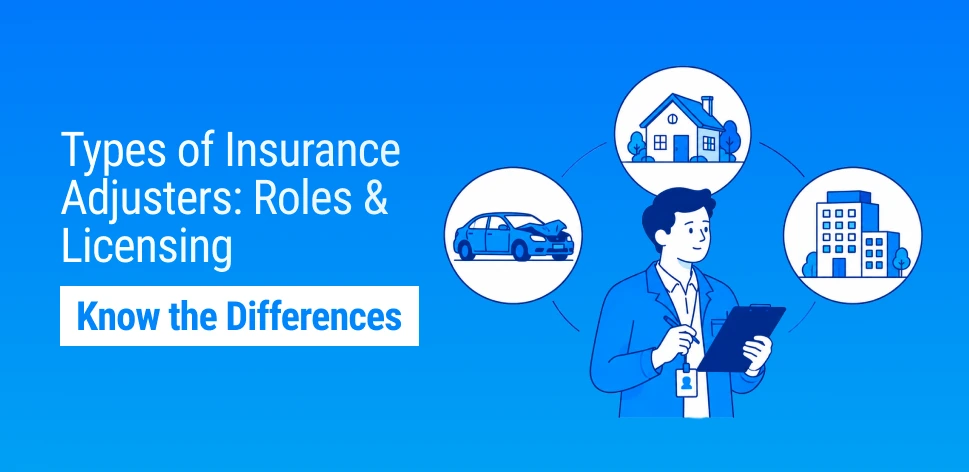
What is the Difference Between Independent, Staff, and Public Adjusters?
The NAIC lays out standard definitions, expectations, and licensing guidelines for adjusters, classifying them into three different types based on function, employee status, and who they represent: Independent, company/staff, or public adjuster. While each type of insurance adjuster handles claims for coverage under an insurance policy, their differences have important ramifications for licensing compliance.
Overview of Differences
| Adjuster Type | Independent | Company/Staff | Public |
| Who do they represent? | The Insurer | The Insurer | The Insured |
| What is their function? | Handles claims for multiple insurers | Handles claims for one insurer | Handles claims for policyholders |
| Who do they work for? | Generally contracted by insurers | One insurer or insurance company | Policyholders or a public adjusting firm |
| What is their employment status? | Contracted | Salaried | Contracted for a percentage of claim payout |
“An adjuster is a person who investigates claims, determines coverage, examines relevant documents, and inspects property damage. An adjuster may also determine the amount of a claim, loss or damage payable under an insurance contract or plan.” – “Adjusters,” NAIC State Licensing Handbook
What Are the Different Responsibilities of Independent, Staff, and Public Adjusters?
Each type of insurance adjuster handles claims. However, their business obligations and responsibilities differ based on their employment status and relationship either to the insurer or the insured.
- What is an independent adjuster? Independent adjusters are generally contracted by insurers or adjusting firms to handle claims on an insurer’s behalf. They investigate losses, inspect damaged property, interview claimants, estimate damages, and recommend settlement amounts.
- When are independent adjusters needed? Independent adjusters are used when insurers need additional claims-handling capacity. This most commonly occurs during catastrophic events, but temporary increases in claim volume, specialized claims needs, or geographic expansion can also create a need for independent adjusters. During those circumstances, independent adjusters supplement existing staff adjusters to help handle higher volumes of claims.
- What is a staff adjuster? Staff adjusters also handle claims for insurers. However, they are directly employed by the insurance carrier, and operate under the carrier’s internal procedures and authority structure. They manage claims, evaluate coverage, assess liability, and ensure compliance in accordance with company procedures and applicable requirements.
- When are staff adjusters needed? Staff adjusters make up an insurer’s day-to-day claims workforce. They oversee routine claims handling, end-to-end claim management, coverage evaluation, customer service, and more for an insurer. They provide deeper knowledge of company policies and procedures and support consistent claims-handling processes.
- What is a public adjuster? Public adjusters work exclusively for policyholders. They help document and value losses, prepare claims submissions, and negotiate settlements with insurers, advocating for the insured throughout. While they do not have the authority to authorize claim payments, they do have a contractual obligation to negotiate with the insurer or its claims representatives on behalf of the policyholder they are representing.
- When are public adjusters needed? Policyholders typically hire public adjusters when they need assistance preparing, documenting, and negotiating insurance claims with their insurers. Particularly complex or detailed claims may increase the need for a public adjuster.
While the functional differences between independent, staff, and public adjusters are relatively straightforward, the licensing requirements for each role are significantly more complex. State regulations can vary not only by jurisdiction but also by adjuster type, creating distinct compliance obligations for individuals, insurers, and adjusting firms.
How Can the Different Types of Insurance Adjusters Stay Compliant?
Adjuster licensing requirements share some similarities with producer licensing, but the specific requirements vary considerably by state and adjuster type. In many states that require adjuster licensing, the following categories may be used to determine licensing eligibility for independent, staff, or public adjusters:
- Prelicensing Coursework
- Experience in the Relevant Line of Authority
- License Exam
- Professional Experience or Designations
- Existing Licenses or Reciprocal Qualifications in Another State
- Criminal History
- Administrative Actions
- Judgments of Character and Financial Responsibility Requirements
In states that license adjusters, renewal and continuing education requirements vary by jurisdiction and license type. Some states require biennial renewal, while others use different renewal periods or requirements.
Additional licensing standards may target lines of authority, workers’ compensation, fingerprinting requirements, resident and nonresident status, or other categories. Overall, applicants should be prepared for the state to evaluate their background, experience, and other applicable licensing criteria.
Multi-State Complexity
Wide variances between states make adjuster licensing complex. While many states require adjuster licensing for one or more of the three types, not every state licenses adjusters.
The NAIC State Licensing Handbook identifies significant differences in the number of states licensing each adjuster category, including public, independent, and company adjusters. Because state requirements change, current licensing requirements should be verified with the applicable state insurance department.
Variations in Adjuster Licensing Requirements
Licensing requirements for independent, staff, and public adjusters vary by state and may differ with respect to reciprocity, designated home state, continuing education, appointments, and other regulatory standards. States may also provide exemptions from adjuster licensing for certain individuals, activities, or types of claims. These exemptions vary by jurisdiction and may apply to attorneys, certain employees, catastrophe-related activities, reinsurance claims, or other circumstances.
The table below outlines some of the most common licensing considerations and their impact on compliance management:
| Adjuster Licensing Consideration | Potential Impact on Compliance |
| Reciprocity | May affect eligibility for nonresident licensing and multi-state practice |
| Designated Home State (DHS) | May be required if an adjuster’s resident state does not issue licenses |
| Continuing Education | Varies by state and license type, requiring ongoing tracking across jurisdictions |
| Appointments | Insurer authorization requirements may apply in certain states and circumstances |
| Exemptions | Certain roles, activities, or professions may be excluded from licensing requirements |
| Examinations | May be required depending on state rules and reciprocity status |
These variations require insurers and adjusting firms to maintain ongoing visibility into state-specific requirements to ensure adjusters remain properly licensed across all relevant jurisdictions.
Residency status requirements further illustrate this complexity. Because some states do not license resident adjusters, an adjuster who resides in one of those states may need to obtain a Designated Home State (DHS) license in another jurisdiction to qualify for nonresident licensing elsewhere.
Depending on reciprocity agreements, both resident and nonresident adjusters may be required to satisfy additional examination, licensing, or continuing education obligations across multiple states.
Overall, adjuster licensing compliance is complicated by state-specific regulations, adjuster type requirements, and varying exemptions, all of which must be continuously monitored to avoid regulatory risk.
What Are the Most Common Use Cases for Insurance Adjusters?
The primary use cases for independent, staff, and public adjusters shift based on their responsibilities and who they represent. These differences create distinct licensing compliance challenges and operational risks.
| Adjuster Type | Primary Use Case | Compliance Challenge | Potential Operational Impact |
| Independent | Catastrophe deployment | Multi-state licensing, reciprocity, DHS requirements, emergency licensing | Delayed catastrophe response, reduced claims capacity |
| Staff | Daily claims management | Renewal tracking, multi-state compliance, onboarding requirements | Onboarding delays, reassigned claims, increased cycle times |
| Public | Consumer representation | UPPA risk, bonding, disclosure, state-specific requirements | Invalid contracts, reputational damage, consumer complaints |
Independent Adjusters: Catastrophe Deployment
In catastrophe-prone states like Florida, California, and Texas, catastrophic events such as hurricanes, wildfires, tornadoes, or floods can dramatically increase claims volume in only a few days. Using independent adjusters during emergencies helps insurers quickly scale claims operations without permanently expanding their staff.
However, because independent adjusters are often deployed rapidly across multiple states, insurers must work carefully to verify license status, reciprocal eligibility, DHS status where applicable, CE compliance, and state-specific emergency licensing requirements. Otherwise, they may face significant disruptions such as delayed catastrophe response, postponed claims assignments, and reduced claims-processing capacity.
When catastrophic events occur, insurers need immediate claims support, not operational delays resulting from licensing gaps.
Staff Adjuster: Daily Claims Management
Insurers use staff adjusters as their primary claims workforce. Staff adjusters handle claims within the authority granted by their insurer, helping maintain consistent claims handling and application of company procedures.
Maintaining compliance for staff adjusters requires insurers to monitor state-specific licensing requirements, renewal deadlines, and eligibility criteria across multiple jurisdictions. However, as claims teams grow and geographic coverage expands, ensuring that each adjuster is properly licensed becomes increasingly difficult, delaying onboarding, reducing claims capacity, and creating inconsistent claims handling practices.
During periods of high claim volume, insurers need efficient claims processing, not operational bottlenecks that force claims to be reassigned or delayed.
Public Adjusters: Consumer Representation
Public adjusters help policyholders document losses, prepare claim submissions, and negotiate settlements with insurers during the claims process. Additionally, because public adjusters directly represent consumers, states often impose additional licensing, bonding, disclosure, and consumer protection requirements.
Performing public adjusting without the required license can expose individuals and businesses to enforcement action and other legal consequences. For example, Florida law classifies certain unlicensed public adjusting activity as a third-degree felony. Public adjusting firms must carefully monitor licensing status and state-specific requirements to ensure adjusters are authorized in every jurisdiction.
When representing policyholders, public adjusting firms need compliant claims advocacy, not the invalid contracts, consumer complaints, and reputational damage that can result from licensing deficiencies.
While independent, staff, and public adjusters serve different roles, each presents unique licensing and compliance considerations. From catastrophe deployment and daily claims management to consumer representation, insurance organizations must maintain visibility into adjuster licensing requirements to avoid operational disruptions, regulatory scrutiny, and reputational risk.
Summary
Although they share similarities, the three types of insurance adjusters differ in their roles, responsibilities, and operational impact. Independent and staff adjusters both handle claims on behalf of insurance carriers. Staff adjusters are employed directly by an insurer, while independent adjusters are generally contracted by insurers or adjusting firms and may handle claims for multiple insurers. Public adjusters, in contrast, represent policyholders during the claims process. These distinctions contribute to different business and operational use cases.
While the need for compliant licensing is important across all adjuster types, maintaining compliance can be challenging due to varying state regulations and licensing standards. Not every state requires adjusters to be licensed, and among those that do, requirements for reciprocity, continuing education, appointments, and other obligations may differ significantly by jurisdiction and adjuster type.
Nonetheless, maintaining valid licensing remains essential for catastrophe response, day-to-day claims management, and responsible policyholder representation, some of the most common use cases for adjusters. Ultimately, a clear understanding of the different adjuster types and their respective responsibilities can help insurers and policyholders make informed decisions in alignment with their specific needs.
FAQs
Q.1 What is the difference between independent, staff, and public adjusters?
Independent and staff adjusters represent insurance carriers, while public adjusters represent policyholders. Independent adjusters can contract with multiple insurers, whereas staff adjusters work for a single carrier.
Q.2 Do the different types of adjusters need separate licenses?
Adjuster licensing requirements vary by state and adjuster type. Some states license independent and public adjusters but exempt company or staff adjusters, while others have different licensing classifications and requirements. Requirements may also vary based on residency, reciprocity, and the type of claims handled.
Q.3 How can the different types of insurance adjusters stay compliant?
Adjusters can maintain compliance by monitoring license renewals, continuing education requirements, reciprocity rules, and state-specific regulations. Organizations should verify requirements with the relevant state department of insurance for the most up-to-date information.
Q.4 What is the impact of adjuster licensing compliance on insurance operations?
Licensing compliance helps ensure uninterrupted claims handling, catastrophe response, and consumer representation. Licensing gaps can lead to operational delays, reduced claims capacity, regulatory scrutiny, and reputational risk.
Q.5 Why is adjuster licensing challenging for insurance organizations?
Adjuster licensing can be difficult to manage because organizations must track varying renewal schedules, continuing education requirements, reciprocity rules, and regulatory changes across multiple jurisdictions. This complexity increases significantly for insurers and adjusting firms operating in multiple states.
Allison is a Content Writer at Agenzee, creating blogs, case studies, social media content, and other value-driven materials to support overall marketing strategies and spur brand growth. Her storytelling expertise infuses her work with a clear, captivating voice that successfully drives conversion and engagement.
Educated in anthropology at Princeton University, Allison’s unique background in software solutions, fiction writing, ethnographic research, and tutoring gives her a unique perspective on the insurance licensing world, enabling her to pursue her mission: Making Agenzee the leader of insurance modernization.
Disclaimer: This post is for informational purposes only and does not constitute legal or compliance advice. Agenzee does not warrant the accuracy of and assumes no liability for reliance. Please consult regulators or professional advisors as needed. See our full disclaimer for details.
Subscribe
Stay Ahead with Agenzee Insights
Join our community to stay up-to-date on the latest news and strategies for license and appointment management
INDUSTRY INSIGHTS FOR INSURANCE AGENCIES, CARRIERS, AND MGAS
Similar Blogs
Read our blog to discover the latest industry insights and trends in license and appointment management.

let's catch up!
Schedule a Live 1-On-1
Demo of Agenzee!
Our insurtech experts would be thrilled to give you a personalized demo of how Agenzee can transform your compliance management processes.
Customers Opinions on Our Services and Products
What Our Customers Say
Find out why our customers are happy they chose Agenzee.