

Published On: August 13, 2026
Updated On: August 13, 2026
In-depth Guide to Insurance License Requirements by State [With Infographic]

Insurance license requirements vary by state, license type, resident status, line of authority, renewal cycle, continuing education requirement, fingerprinting rule, fee structure, and application process.
For solo producers, those differences can be confusing. For agencies, MGAs, insurance carriers, and compliance teams managing multi-state licensing, the state nuances can create significant administrative challenges.
For example, a producer who is ready to sell in one state may be missing CE in another, waiting on fingerprinting in a third, and approaching a renewal deadline somewhere else. Failing to meet state licensing requirements affects onboarding, renewals, appointments, compliance reviews, and audit readiness.
To help compare key producer licensing requirements, Agenzee created a free 50-state insurance licensing infographic that compares renewal cycles, CE hours, fingerprinting requirements, license fees, and other state-specific details at a glance.
What are Insurance License Requirements?
Insurance license requirements are the state-specific requirements an individual or business entity must satisfy to obtain and maintain an insurance producer license.
An insurance producer is someone licensed under state law to sell, solicit, or negotiate insurance. Producers must be licensed by every state in which they plan to sell insurance.
Insurance licensing requirements may include:
- Pre-licensing education
- State insurance exams
- License applications
- Fingerprinting
- Background checks
- Fees
- Continuing Education (CE)
- Renewal filings
- Appointment requirements
- Line of authority approvals
Because insurance producers must hold a valid license in every state where they do business, a producer’s resident license, non-resident licenses, lines of authority, renewal deadlines, CE requirements, and appointment obligations need to be organized.
Definition: Insurance Producer License
According to the NAIC and the NIPR, the term producer includes both individuals and business entities. An insurance producer license authorizes a producer to sell, solicit, or negotiate insurance products in a specific state. The license is issued and regulated at the state level, which means licensees must meet the requirements of each state where they conduct insurance business.
How Do I Get an Insurance Producer License?
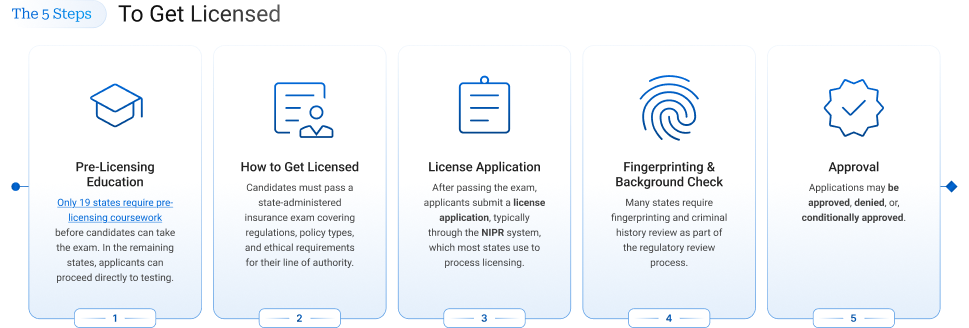
The licensing process typically includes five common steps, but the details vary by state. A typical workflow starts with pre-licensing education, then the exam, license application, fingerprinting and background check, and approval.
1. Complete Pre-Licensing Education, If Required
In some states candidates must complete pre-licensing coursework before taking the licensing exam. Other states allow applicants to take the licensing exam without official pre-licensing education. Approximately 40% of states have pre-licensing coursework.
If a producer is getting licensed in a state with pre-licensing education requirements, the process will take longer than it would in a state without the pre-licensing requirement.
2. Pass the State Insurance Exam
The next step for resident producers is to pass a state-administered insurance exam for the relevant license type and line of authority.
The exam tests knowledge of state insurance regulations, policy types, ethics, and product-specific rules. For example, a candidate applying for a property and casualty license may have different exam requirements than a candidate applying for life and health authority.
3. Submit the License Application
NIPR provides a centralized platform through which producers can apply for, renew, and manage licenses in most participating states. However, some states have their own state portals. For example, in Florida, resident applicants must apply through DICE.
The application process may be simple in one state and more complex in another, especially in states with application systems separate from the NIPR.
4. Complete Fingerprinting or Background Check Requirements
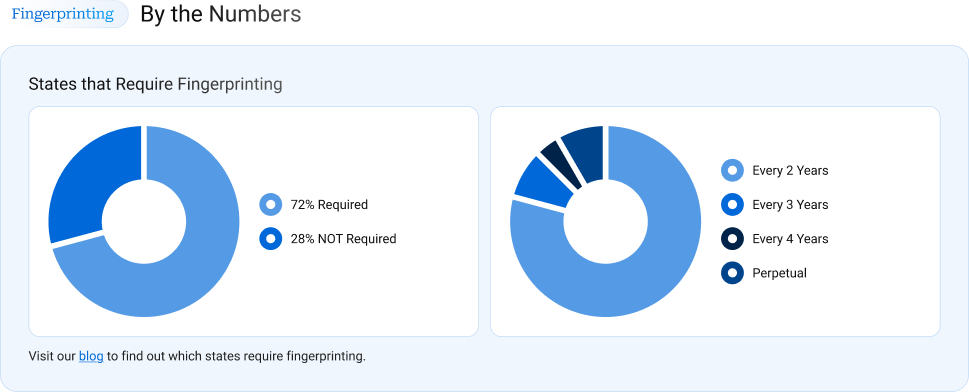
Many states require fingerprinting and/or background checks as part of the licensing review process. As of 2026, 72% of states require fingerprinting, while 28% did not.
Fingerprinting can affect onboarding time as a producer waits for fingerprint processing, background checks, and state approval.
5. Wait for State Approval
Applications may be approved, delayed pending additional information, or denied, depending on the state’s review process. Therefore, a producer should not be treated as until all the state licensing, appointment, and carrier specific requirements have been met.
What Are the Insurance License Renewal Requirements in My State?
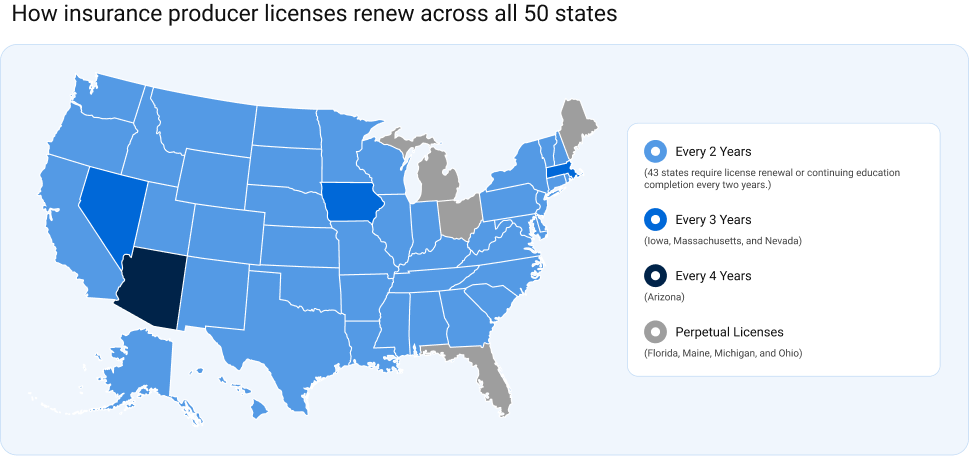
Most states use a two-year renewal cycle, but not all. Currently, most states renew producer licenses every two years, although renewal schedules vary. Continuing education requirements also differ by state. Iowa, Massachusetts, and Nevada renew every three years. Meanwhile, Arizona renews every four years. Florida, Maine, Michigan, and Ohio have perpetual licenses.
That variation creates a simple but important rule for licensing teams: never assume one renewal cycle applies across all states. If only one renewal date is tracked, obligations tied to another state may be missing.
Definition: License Renewal Cycle
A license renewal cycle is the recurring period when a producer must renew or maintain a license. Depending on the state, this may happen every two years, every three years, every four years, or under a perpetual license model that still requires ongoing compliance.
When Does an Insurance License Renew?
When a license renews depends on the state. States use several methods to determine renewal dates, including end of birth month, exact birthday, fixed calendar date, issue anniversary, and perpetual license status.
Two states using a two-year renewal cycle may calculate the deadline differently. One may base the renewal date on the producer’s birth month, while the other uses the license issue anniversary. Another state may use a fixed calendar date.
The risk is missing the sequence of steps that must happen before renewal, including CE completion, fee payment, appointment review, and state-specific documentation. When one of the steps is missed, a license could fall into a late renewal period or require reinstatement.
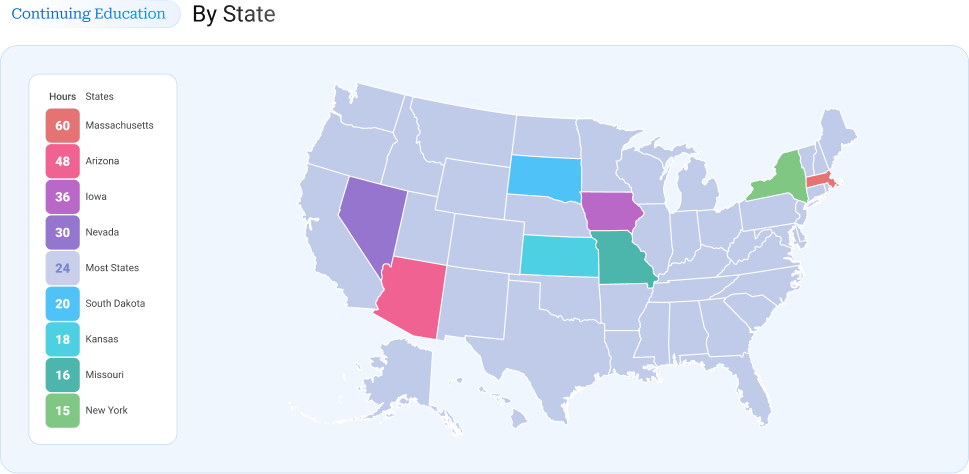
How Many CE Hours Do I Need by State?
Continuing Education (CE) requirements vary by state. Most states require CE as part of the license renewal process, which means CE tracking directly affects renewal readiness.
In North Carolina, producers must complete CE at least 60 days before license expiration. Late CE completion can trigger a late CE fee , which can escalate to a reinstatement fee.
Agenzee’s infographic shows how CE hour requirements can vary across states, from 15 to 60 hours per renewal . Most states require 24 credit hours of CE, including 3 hours of ethics. However, other states may have higher or lower requirements.
Definition: Continuing Education
Continuing education, or CE, refers to the coursework insurance producers must complete to maintain a license. CE requirements vary by state, license type, and line of authority.
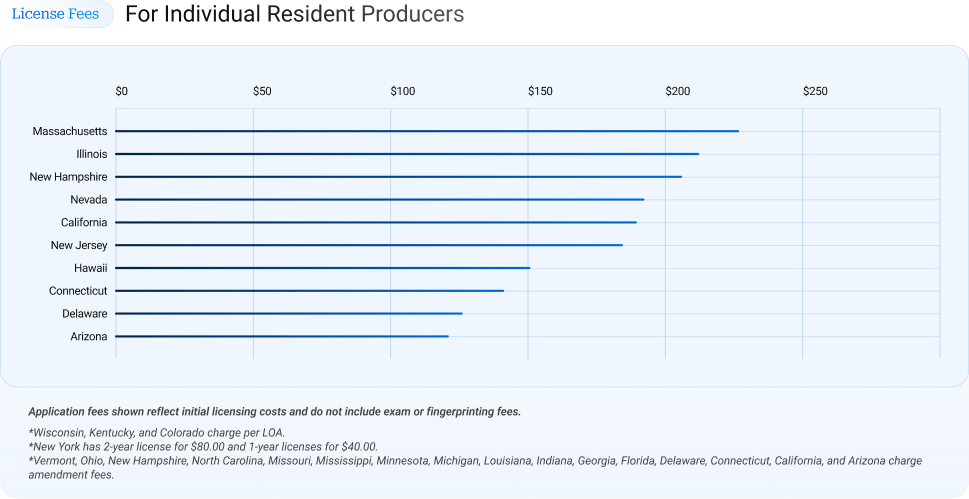
What are the Fees for an Insurance Producer License in My State?
License fees also vary widely across states, ranging from no fee in some states to more than $200 in others. In addition, each state has unique licensing fees. Depending on the state, total licensing costs may include but are not limited to the initial application, state license, NIPR transaction, exam, fingerprinting, per LOA, amendment, reinstatement, and state-specific surcharge (i.e., lead paint surcharge) fees.
Across a large producer population, fees can affect onboarding budgets, renewal planning, reimbursement policies, and the cost of fixing missed deadlines. Agenzee’s infographic includes a state-by-state chart of initial individual resident producer license fees as reference.
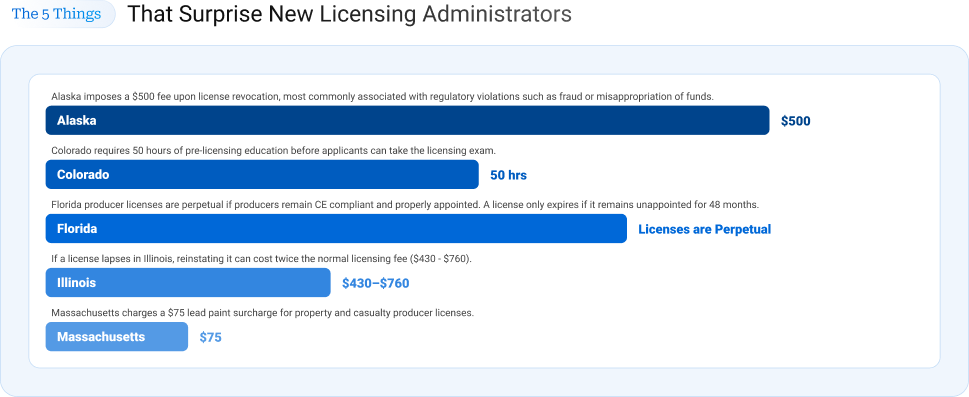
Which State Licensing Details Catch Teams Off Guard?
Some state licensing rules are easy to miss until they create an issue. For example, Alaska imposes a $500 fee upon license revocation. If a license lapses in Illinois, reinstatement can cost significantly more than the normal licensing fee.
In Florida, producer licenses are perpetual if producers remain CE compliant and properly appointed. Meanwhile, Massachusetts charges a $75 lead paint surcharge for property and casualty producer licenses, a fee entirely unique to this state.
Download the Free 50-State Insurance Licensing Infographic
Managing producer licensing across multiple states requires constant attention to varying renewal cycles, CE requirements, fingerprinting rules, fees, appointments, and state-specific exceptions.
Agenzee’s free 50-state insurance licensing infographic provides a clear visual reference for comparing producer licensing requirements across the U.S.
Use it to guide new licensing administrators, compare renewal cycles, identify CE outliers, review fingerprinting requirements, support onboarding conversations, explain licensing complexity to leadership, and spot where manual tracking may create risk.
When State Requirements Become a Workflow Problem
State licensing requirements, fees, continuing education requirements, and regulatory processes can change over time. An effective compliance management solution provides visibility into active producer licenses, resident/non-resident state records, lines of authority, renewal dates, CE completion dates, appointment status, fingerprint and background check steps, regulatory actions, audit history, and internal follow-up activity.
Agenzee helps insurance organizations manage licensing, appointments, renewals, CE tracking, alerts, and compliance workflows in one place, so teams are not relying on disconnected spreadsheets, inboxes, and manual reminders.
Turn State Licensing Requirements into a Manageable Workflow
Agenzee gives teams a centralized system for managing producer licensing, appointments, renewals, CE tracking, alerts, and compliance workflows in one place.
Spreadsheets depend on someone manually updating information. If one field is outdated, or a reminder is missed, the entire team may be working from incomplete information.
Move beyond static reference materials to active licensing, appointment, renewal, CE, alert, and compliance management with Agenzee.
Book a demo to see how Agenzee helps teams manage 50-state licensing requirements.
Alexandra is a copywriter and researcher who specializes in evergreen content production. She has authored hundreds of SEO-driven blogs, helping clients translate complex insurance coverage topics into clear, authoritative content.
Alexandra graduated from the University of Oregon with a BA in German: Language, Literature, and History, and a BA in Digital Art. She spent 20 years living abroad in Germany and Spain before returning to the US in 2025.
Disclaimer: This post is for informational purposes only and does not constitute legal or compliance advice. Agenzee does not warrant the accuracy of and assumes no liability for reliance. Please consult regulators or professional advisors as needed. See our full disclaimer for details.
Subscribe
Stay Ahead with Agenzee Insights
Join our community to stay up-to-date on the latest news and strategies for license and appointment management
INDUSTRY INSIGHTS FOR INSURANCE AGENCIES, CARRIERS, AND MGAS
Similar Blogs
Read our blog to discover the latest industry insights and trends in license and appointment management.

let's catch up!
Schedule a Live 1-On-1
Demo of Agenzee!
Our insurtech experts would be thrilled to give you a personalized demo of how Agenzee can transform your compliance management processes.
Customers Opinions on Our Services and Products
What Our Customers Say
Find out why our customers are happy they chose Agenzee.