

Published On: August 24, 2026
Updated On: August 24, 2026
Why Adjuster Licensing Management Matters for Claims Compliance in 2026

Adjuster licensing management matters in claims compliance because organizations need to confirm that adjusters have the required authority before assigning claim work. When license records are scattered, teams lose visibility into adjuster licensing status.
This guide explains how adjuster licensing affects claim assignment, catastrophe response, audit readiness, and multi-state workforce control. You’ll also learn the key licensing requirements teams need to monitor to ensure licensing data is reliable enough to support claims decisions.
Key Takeaways
- A licensed adjuster is not automatically ready for assignment.
- Adjuster licensing directly impacts compliance and claims readiness.
- Multi-state adjuster operations create risk when license status, renewals, CE, Designated Home State records, and documents are tracked manually.
- Weak licensing visibility can delay claim assignment, slow catastrophe response, and weaken audit evidence.
- Centralized workflows help claims, licensing, compliance, and operations teams identify exceptions before they become operational problems.
What Is Adjuster Licensing Management?
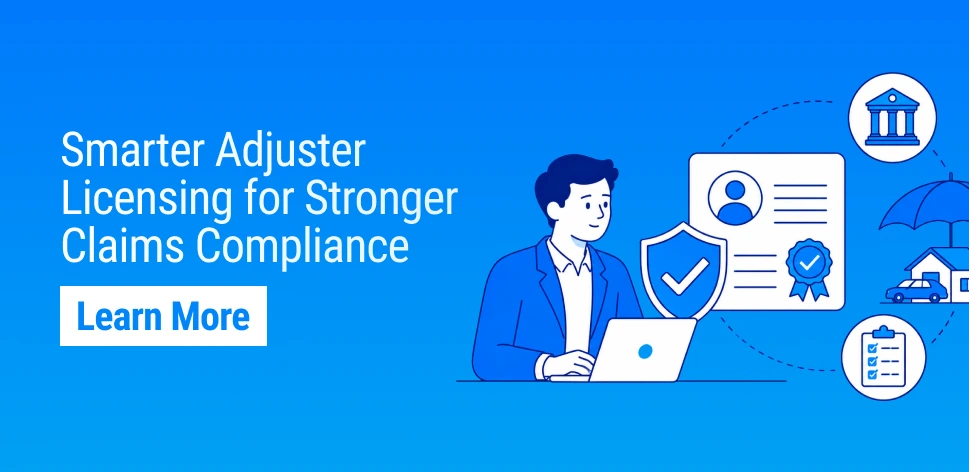
Adjuster Licensing Management Adjuster licensing management is the process of tracking license status, state authority, resident or non-resident status, Designated Home State records, renewal dates, continuing education, and compliance activity to determine which adjusters are ready to handle claims.
Traditionally, adjuster licensing is tracked through a mix of spreadsheets, shared calendars, email reminders, state DOI lookups, NIPR searches, shared drives, and individual adjuster self-reporting.
The first step is to gather basic information for each adjuster. Next, the team checks which states the adjuster is licensed in because an adjuster may be allowed to work in one state but not another. For example, an adjuster may have authority to handle claims in one state but require additional licensing or authorization before handling claims in another.
A good license management team does not wait until licenses expire. They look for problems ahead of time. For example, suppose a license expires in 60 days. The license management team can send out a renewal reminder to the adjuster.
Why Does Adjuster Licensing Management Matter for Claims Compliance?
Adjuster licensing management helps identify which adjusters are ready to work before claims are assigned. If the licensing record is incomplete, outdated, or difficult to verify, the organization may not know if an adjuster is authorized to begin a claim assignment.
Key reasons adjuster licensing management matters for claims compliance:
- Confirm the adjuster’s state authority
- Prevent unauthorized claim work
- Protect claim assignment decisions
- Reduce license renewal and expiration risk
- Improve audit readiness
Accurate and organized adjuster licensing data is essential to ensure claims compliance. Simplifying the licensing compliance processes benefits both adjusters and firms, especially in states with varying reciprocity rules.
Claims Compliance
For adjusting firms, claims compliance includes confirming that each adjuster is properly licensed, authorized, and documented according to applicable state insurance laws, carrier requirements, client standards, and internal procedures.
Confirm the Adjuster’s State Authority
Adjuster licensing is state-specific. An adjuster may be authorized to handle claims in one state but not another. Adjuster licensing management helps confirm the correct resident, non-resident, or Designated Home State authority.
Prevent Unauthorized Claim Work
Unauthorized claim work can create compliance risks for the adjuster, the adjusting firm, and the insurer or client relying on the firm. A licensing workflow helps prevent claims from being assigned to adjusters with expired, inactive, missing, or mismatched authority. The goal is to catch licensing issues before an adjuster begins to work on a claim.
Protect Claim Assignment Decisions
A strong adjuster licensing workflow helps the team determine which adjusters are ready for a specific claim, state, and claim type. Without reliable licensing data, claim assignment decisions may depend on manual lookups, old spreadsheets, email threads, or individual knowledge. This process can be slow and increase the chance of errors.
Reduce License Renewal and Expiration Risk
Adjuster licenses expire, and renewal requirements can vary by state. Some adjusters may also need continuing education before renewal. Adjuster licensing management helps firms connect license status, CE, renewal dates, state authority, and other requirements so claims teams can identify potential assignment issues before an adjuster is needed. This step reduces the risk of assigning work to an adjuster whose authority is about to expire or has already expired.
Improve Audit Readiness
Adjusting firms may need to prove that an adjuster was properly licensed when claim work was assigned or completed. Accurate adjuster licensing data helps claims, licensing, compliance, and operations teams work from a shared centralized record.
A centralized licensing workflow helps preserve records such as license approvals, renewal confirmations, CE records, state correspondence, emergency adjuster registrations, and internal review notes. Strong documentation gives the firm a clearer audit trail if a carrier, regulator, client, or internal reviewer asks for proof.
What Compliance Requirements Do Adjusting Firms Need to Monitor?
Adjusting firms need to track license status, state authority, lines of authority, renewals, CE, entity requirements, documents, and reportable changes so claim teams know which adjusters are ready to work before claims are assigned.
An adjusting firm should not assign claim work to an adjuster unless the adjuster has the required state license, line of authority, and active status for that assignment.
Adjuster Licensing Requirements
Confirm each adjuster is properly licensed before claim work is assigned. Track license status by active, pending, expired, suspended, inactive, or missing.
Some states require an adjusting firm or business entity to hold a separate license or registration. Where required, the entity may need to designate a licensed individual or responsible party and satisfy state-specific application and documentation requirements.
State and Line of Authority Requirements
Track where each adjuster has a resident, Designated Home State, or non-resident license, as well as what type of claims each adjuster is authorized to handle. For example, an adjuster may have authority for certain types of claims require additional authority, licensing, or qualifications for other claim types depending on the state and assignment.
Pre-licensing Education, Exam, and Application Requirements
State licensing rules may require pre-licensing education, an exam, fees, fingerprints, background checks, and supporting documents. Track adjuster licensing requirements by state to ensure the application steps were completed in the correct order.
Renewal and Continuing Education Requirements
Adjuster licenses may require renewal, completion of CE, payment of fees, and other requirements to be met by the due date. Continuing education requirements vary by state and adjuster license type. Where CE is required, teams should track the applicable credit hours, mandatory subjects, compliance period, and reporting status. Adjusters should complete CE well before the applicable renewal deadline to allow time for provider reporting and state record updates.
Emergency Adjuster Rules
Emergency adjuster rules create a tracking obligation around deployment date, event name, notice status, and expiration of temporary authority for adjusting firms.
Some states provide temporary or emergency authorization mechanisms that allow qualified adjusters to assist with claims following a declared catastrophe. Requirements may include insurer notification, registration, application information, fees, documentation, or other state specific conditions.
Adjusting firms should track the event, affected state, adjuster, authorization status, effective date, expiration date, and any required follow-up.
Record Retention and Documentation
Documentation may include licenses, renewal confirmations, CE records, applications, appointment records, emergency registrations, contracts, state notices, and internal review notes.
Reporting Changes and Regulatory Actions
Adjusters may be required to report changes such as name, address, or other licensing information within a state specific timeframe. Violations can result in license denial, non-renewal, revocation, probation, suspension, or civil penalties.
A regulatory action may include a license suspension, revocation, probation, civil penalty, administrative order, or disciplinary action from another state. Adjusting firms should monitor applicable regulatory actions because disciplinary activity may affect an adjuster’s license status, eligibility, or authority to handle claims.
How Adjuster Licensing Affects Claim Compliance
| Licensing Control | Operational Question | Claim Compliance Impact |
| Active license status | Is the adjuster authorized today? | Prevent assignments to an inactive or expired adjuster |
| State authority | Can the adjuster handle claims in this state? | Reduce delays when claims cross state lines |
| License type | Does the license match the work being performed? | Route claims to the right adjuster role |
| Resident or non-resident status | Is the adjuster licensed appropriately for the jurisdiction? | Support multi-state assignment decisions |
| Designated Home State | Does the adjuster’s DHS status affect applicable licensing authority? | Avoid confusion for adjusters from non-licensing states |
| Renewal date | Is the license close to expiring? | Protect claim assignment determinations |
| CE status | Could CE block renewal? | Reduce last-minute compliance issues |
| Documentation | Can the team prove the license status? | Strengthen audit and review evidence |
Why Is Adjuster Licensing Critical During Catastrophe Response?
Catastrophe response can place significant pressure on licensing and claims operations. Claims volume may increase quickly, and firms may need to deploy adjusters across state lines on short notice.
Some states require insurers or adjusting firms to submit information within a specified period after an adjuster is deployed under emergency authority. If licensing status is unclear, deployment decisions slow down. A spreadsheet may work under most circumstances but fail during an emergency when time pressure becomes a factor.
Catastrophe Response
In insurance adjusting, catastrophe response usually involves deploying adjusters quickly while confirming state licensing and any applicable emergency adjuster authority to help insurers move claims forward during a high-volume event.
A Hypothetical Hurricane Claims Scenario
Consider an independent adjusting firm that received an urgent request to support hurricane claims in two neighboring coastal states. The claims team needed adjusters for roof damage, wind damage, commercial property losses, and flood-related assignments.
The firm’s manual tracking process created a bottleneck. License details were stored in spreadsheets. Supporting documents were saved in shared folders. Some renewal information was in emails. Emergency authority details had to be checked separately.
The claims team wanted to respond quickly, but the licensing team had to verify each adjuster one by one. Eventually, the team identified qualified adjusters, but the process took longer than expected. A carrier reassigned part of the claim volume to another adjusting firm that could confirm adjuster readiness faster.
How Does Licensing Management Software Support Audit Readiness?
Licensing management software can support audit readiness by maintaining a centralized record of licensing status, supporting documentation, renewal activity, and compliance history.
Without sufficient evidence, the team may have to recreate a record from screenshots, inbox searches, state portals, and local files, which is slower and less defensible. For example, suppose a Third Party Administrator (TPA) handled claims for multiple carriers and needs to prove that assigned adjusters held proper authority.
If the TPA relies on disconnected files, the review may require manual reconstruction. On the other hand, if the TPA maintains centralized licensing records, the response can include active license status, renewal history, state authority, documentation, internal review notes, and more in one place.
What Does a Centralized Adjuster Licensing Workflow Look Like?
A centralized adjuster licensing workflow treats licensing data as claims operations infrastructure. The process should help teams identify who is authorized, where they can work, what is expiring, what is missing, and what follow-up needs ownership.
A strong workflow does not need to be complicated. It needs to be consistent.
- Central Adjuster Roster – The adjuster roster should show license status, state authority, renewal dates, CE status, emergency authority, documentation, and open tasks.
- State Readiness Views – Claims and operations teams should be able to see readiness by state, active adjusters, pending adjusters, expiring licenses, missing documents, and known exceptions.
- CE Connects to Renewal – If CE is incomplete, the team should see the risk before the renewal deadline becomes urgent.
- Exception Ownership – Every exception should have an owner for adjusters with a “pending,” “missing,” and “needs review” status.
- Audit-Ready History – The workflow should preserve evidence as the work happens, including status changes, documents, task notes, renewal actions, and approval records.
- Reporting Used to Surface Risk – Useful reports could show licenses expiring in 30, 60, or 90 days; missing CE; pending applications; missing documentation; and state-by-state readiness.
For teams that need a more connected insurance compliance solution, the practical goal is to gain better visibility, cleaner handoffs, fewer manual lookups, and stronger operational control.
Manual Tracking vs. Audit-Ready Licensing Management
| Workflow Area | Manual Tracking | Audit-Ready Licensing Management |
| License status | Checked through state portals or spreadsheets | Centralized record with current status |
| Claim assignment review | Case-by-case email or manual lookup | State readiness view before assignment |
| Renewal tracking | Calendar reminders or individual follow-up | Alerts, tasks, and escalation visibility |
| CE tracking | Separate transcript checks | CE status connected to renewal workflow |
| CAT deployment | Reactive review during the event | Emergency authority tracked by event and deadline |
| Documentation | Stored in inboxes, drives, or local folders | Linked to the adjuster record |
| Exception handling | Informal notes or scattered emails | Assigned tasks and activity history |
| Audit response | Manual reconstruction | Reportable history and supporting records |
Conclusion: Adjuster Licensing Management Is a Claims Readiness Control
Adjuster licensing management matters because claims operations depend on authorized, current, and properly documented adjusters. When licensing records are fragmented, teams lose time confirming who can work, where they can work, and what risks need attention.
A better workflow helps organizations move from reactive license checking to proactive adjuster readiness management, giving claims, licensing, compliance, and operations teams a clearer view of adjuster licensing.
Schedule a demo of Agenzee to learn how centralized licensing workflows can support adjuster readiness, compliance visibility, and operational control across states.
Adjuster Licensing Management FAQ
Q.1 What is adjuster licensing management?
Adjuster licensing management is the process of tracking adjuster licenses, state authority, license type, renewals, CE, Designated Home State status, emergency adjuster authority, documents, and compliance activity so organizations can confirm if adjusters are ready to handle claims.
Q.2 Why does adjuster licensing management matter for claims compliance?
Adjuster licensing management matters because claims organizations need to confirm that adjusters are authorized before assigning work. Without current licensing data, teams may delay assignments, miss exceptions, or struggle to prove compliance later.
Q.3 How does adjuster licensing affect claim assignment?
Adjuster licensing affects claim assignment by determining whether an adjuster can handle a claim in a specific state. A claims team may need to verify active license status, license type, non-resident authority, CE, renewal status, and documentation before assigning work.
Q.4 Why is adjuster licensing important during catastrophe response?
Adjuster licensing is important during catastrophe response because organizations may need to deploy adjusters quickly across state lines. Emergency adjuster authority, temporary registration, event tracking, and expiration dates need to be visible before deployment becomes chaotic.
Q.5 What is Designated Home State for adjusters?
Designated Home State status may apply when an adjuster’s resident state does not license adjusters for the authority sought. In that case, the adjuster may designate another state to be licensed.
Q.6 What are the risks of poor adjuster licensing management?
Poor adjuster licensing management can create expired license risk, missing non-resident authority, slow claim assignment, delayed catastrophe deployment, incomplete documentation, weak audit evidence, and inconsistent state-by-state workforce visibility.
Q.7 What should adjuster licensing software track?
Adjuster licensing software should track license status, license type, state authority, resident and non-resident records, Designated Home State status, renewal dates, CE, emergency adjuster authority, documents, task ownership, reporting, and audit history.
Alexandra is a copywriter and researcher who specializes in evergreen content production. She has authored hundreds of SEO-driven blogs, helping clients translate complex insurance coverage topics into clear, authoritative content.
Alexandra graduated from the University of Oregon with a BA in German: Language, Literature, and History, and a BA in Digital Art. She spent 20 years living abroad in Germany and Spain before returning to the US in 2025.
Disclaimer: This post is for informational purposes only and does not constitute legal or compliance advice. Agenzee does not warrant the accuracy of and assumes no liability for reliance. Please consult regulators or professional advisors as needed. See our full disclaimer for details.
Subscribe
Stay Ahead with Agenzee Insights
Join our community to stay up-to-date on the latest news and strategies for license and appointment management
INDUSTRY INSIGHTS FOR INSURANCE AGENCIES, CARRIERS, AND MGAS
Similar Blogs
Read our blog to discover the latest industry insights and trends in license and appointment management.

let's catch up!
Schedule a Live 1-On-1
Demo of Agenzee!
Our insurtech experts would be thrilled to give you a personalized demo of how Agenzee can transform your compliance management processes.
Customers Opinions on Our Services and Products
What Our Customers Say
Find out why our customers are happy they chose Agenzee.