

Published On: July 3, 2026
Updated On: July 10, 2026
How MGAs Manage Producers Faster with License and Appointment Management Software

Many organizations underestimate the complexity of producer compliance management. The individual tasks seem simple. Check a license. Confirm an appointment.
However, at scale, producer management becomes a complex system that impacts onboarding, sales readiness, regulatory exposure, and revenue continuity. When producer networks grow, even small tracking gaps can become difficult to control.
License management software helps by centralizing producer records, syncing licensing data, tracking appointments and terminations, surfacing renewal and CE issues, and creating dashboard visibility into readiness gaps.
This post dives into the challenges of managing appointed producers, and how to manage the process faster with license management software.
Definition: Appointed Producer
An appointed producer is a licensed insurance professional who has active authorization with an insurance carrier to conduct business on its behalf.
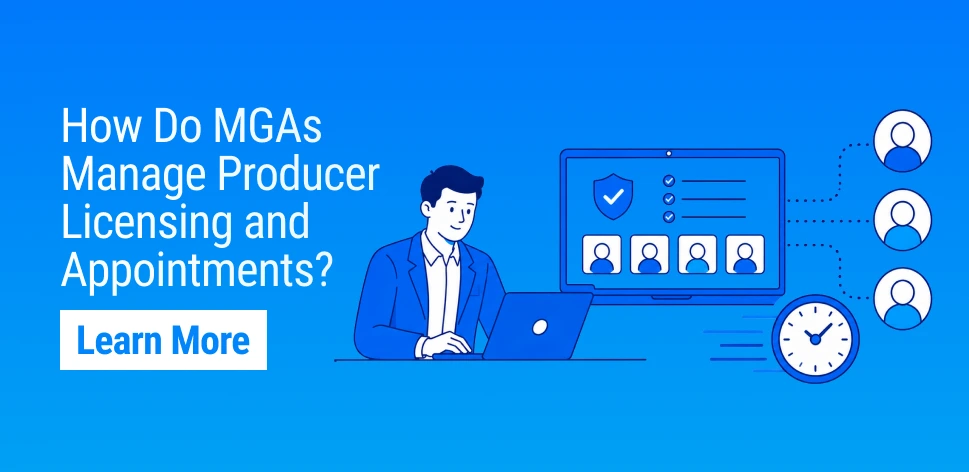
The Challenges of Managing Appointed Producers in MGAs
Managing General Agencies (MGAs) oversee producer compliance according to state laws. As authorized intermediaries between insurance carriers and agents, MGAs are typically responsible for maintaining visibility into producer data.
Definition: Managing General Agent (MGA) A managing general agent, or MGA, is an insurance intermediary with authority granted by an insurance carrier to perform functions on the carrier’s behalf. Duties may include underwriting policies, binding coverage, overseeing producer relationships, collecting premiums, and/or supporting claims.
Consider an insurance producer licensed in one state, appointed with multiple carriers, and selling several lines of business. Without clear visibility into that individual’s licensing and appointment status, the producer may appear “active” in a spreadsheet while missing a critical appointment.
On the surface, spreadsheets seem simple and affordable. The problem is that spreadsheets cannot automatically reconcile producer activity against state licensing and appointment requirements. In addition, producer activity tends to change faster than manual tracking can keep up. This limitation becomes visible when MGAs expand.
Tasks like validating appointment status or alerting the right individual when a producer’s status changes must be done manually in a spreadsheet-based system. Another issue is that manual systems make it difficult to maintain a complete audit trail unless every action is consistently documented.
Definition: Audit Trail An audit trail is documentation of actions, updates, and approvals tied to a compliance process. In MGA producer management, an audit trail helps show when a license was checked, when an appointment was submitted, who reviewed the producer record, what changed, and other details.
How to Confirm Producer Sales Readiness
MGAs need to confirm the producer has the correct line of authority, carrier appointment (where required), and has met any other internal onboarding requirements.
Information collected via emails, spreadsheets and shared folders gets pieced together manually before it can move forward. When data is missing or incorrect, producer onboarding slows down and sales readiness becomes harder to confirm.
State and Carrier Rules Are Not Uniform
A process that works for one carrier or state may not apply to another. Without a structured workflow, licensing teams spend too much time researching requirements, chasing missing documents, and confirming if producers are ready to sell.
Each state handles appointments, renewals, fees, and reporting requirements differently. In addition, each carrier may have a unique appointment process, documentation requirements, approval steps, and turnaround times.
Manual Tracking Creates Stale Data
A producer that appears appointed in a spreadsheet could still have a terminated appointment or other details may have changed in a carrier or state system. For MGAs, stale data can create serious problems.
The team may not discover the discrepancy until a producer tries to submit business and the carrier flags the issue. By then, the delay is already affecting sales readiness.
Audit Documentation Is Hard to Reconstruct
If the MGA needs to find out when a license was verified, when an appointment was submitted, who reviewed a producer record, or why a producer was approved, the team may need to search across disparate data sources, slowing down audit preparation and weakening operational control.
Producer Management Challenges and Solutions for MGAs
| Challenge | Impact for MGAs | Software-Supported Solution |
| Outdated spreadsheet data | Producer status may change between manual reviews. | Sync licensing data and flag changes earlier. |
| Licensed vs. appointed confusion | A producer may be licensed but not ready to sell for a carrier. | Track license and appointment status separately. |
| Carrier-specific requirements | Appointment requests slow down when each carrier needs different documentation. | Standardize appointment workflows and document tracking. |
| Renewal and CE gaps | Producers may lose authority if deadlines are missed. | Use alerts, CE tracking, and renewal dashboards. |
| No readiness visibility | Teams are unsure if a producer can write business. | Centralize readiness data by producer, state, carrier, and LOA. |
| Weak audit trail | Compliance evidence is hard to reconstruct after the fact. | Store activity history, reports, and documentation in one system. |
When Spreadsheet Oversight Stops Producer Business Activity
Consider a growing MGA managing 180 producers across multiple states and carrier partners. In the beginning, a producer spreadsheet works well enough. The licensing team uses different tabs for producer data, state licenses, carrier appointments, and renewal dates. However, the MGA quickly outgrows the spreadsheet.
The MGA and its carrier partner expand into Florida. The licensing team is focused on onboarding new producers, processing appointment requests, collecting required documentation, and coordinating approvals across multiple carriers and states.
At the same time, the MGA is responsible for managing appointment renewals for existing producers. Appointment renewals are often handled in batches and may involve large groups of producers within a state rather than a single individual. The renewal invoice arrives and is routed to the appropriate licensing inbox, but with competing priorities and no automated workflow in place, the renewal deadline is overlooked.
Because the renewal process is being tracked through spreadsheets and email rather than a centralized platform, no alerts are generated and no dashboard visibility exists to highlight the approaching deadline. The licensing team remains focused on new appointment activity while the renewal obligation remains buried among other administrative tasks.
Definition: Data Reconciliation Data reconciliation is the process of comparing information across systems to find and correct mismatches. For MGAs, data reconciliation means checking that license, appointment, CE, renewal, and producer status data match across spreadsheets, NIPR records, state databases, carrier portals, agency management systems, and internal reports.
The renewal deadline passes before payment is submitted. As a result, a group of producer appointments within the state is terminated. However, the spreadsheet still reflects the last manually updated status and continues to show the affected producers as active.
The issue is not discovered until producers begin submitting business and carrier records no longer match the MGA’s internal tracking. The MGA must pause business activity, identify affected producers, reconcile appointment records, process reinstatements where available, and work through carrier-specific requirements before normal operations can resume.
Without synchronized data, automated renewal reminders, workflow tracking, and centralized visibility, appointment-related issues may remain hidden until business is delayed, producers are impacted, or an internal review uncovers the discrepancy.
How License Management Software Helps MGAs Manage Producer Challenges
Manual tracking scales by creating more administrative work. License management software scales by reducing avoidable manual labor License management software helps organize producer license status, line-of-authority, appointment, renewal, and carrier information in actionable, up-to-date dashboards.
Instead of relying on multiple spreadsheets, the MGA uses dashboards, alerts, license and appointment tracking, NIPR-connected data, CE visibility, reports, and audit trails to see exactly where a producer stands.
Definition: License Management Software License management software is a system that helps insurance organizations track producer licenses, appointments, renewals, CE requirements, regulatory actions, documents, and compliance tasks in a centralized way that allows for producer management across states, carriers, and lines of authority.
License management software helps MGAs:
- Centralize producer records – licensing, appointment, CE, renewal, E&O, and documentation details are in one central location.
- Keep producer data current – reduce reliance on static spreadsheet entries that reflect the last manual update instead of the producer’s status.
- Improve appointed producer tracking – organize appointment status by producer, carrier, state, and line of authority through centralized dashboards.
- Reduce onboarding delays – show which requirements are missing before a producer can write business.
- Automate reminders – licensing teams can identify upcoming expirations before they become urgent problems.
- Track CE progress – see which producers are at risk of missing renewal requirements.
- Create actionable dashboards – identify pending appointments, upcoming renewals, and state-specific issues.
- Reduce manual follow-up – replace manual tracking through emails, calendar reminders, and spreadsheet notes with structured alerts and task visibility.
- Improve audit readiness – keep status history, documents, verification records, and activity details in one system.
- Support better offboarding – track which appointments need to be terminated when a producer leaves, changes roles, or stops writing with a carrier.
- Scale producer management – give teams a repeatable workflow instead of relying on individual memory, manual reconciliation checks, and disconnected files.
The result is faster administration, fewer preventable delays, cleaner producer onboarding, better carrier coordination, and above all, improve audit readiness.
Manual vs. Software-Supported Producer Licensing Workflows
| Workflow | Manual Process | Software-Supported Process |
| License tracking | Static records updated after manual review | Producer license information updated through NIPR-connected data services |
| Appointment tracking | Status stored in spreadsheets, emails, or online portals | Central dashboard shows appointment status visible by producer, carrier, and state |
| Renewal management | Calendar reminders and manual follow-up | Automated alerts set up at pre-defined intervals |
| CE tracking | Producer self-reporting or manual checks | CE visibility (where available) and automated renewal reminders |
| Reporting | Manual exports and spreadsheet cleanup | Export organized filtered reports |
| Audit preparation | Search emails, folders, and old files | Centralized records and activity history |
Turn Producer Management into a Marker of Operational Excellence
Producer growth should not create more uncertainty for an MGA. As the network expands, licensing, appointments, renewals, CE, carrier requirements, and audit documentation need to become more structured, not more difficult to control.
Agenzee helps MGAs move beyond manual tracking. Manage producer licensing and appointments with the visibility and control expected of a scalable, professional operation.
Ready to strengthen your producer management process? Book a demo with Agenzee to see how the platform helps MGAs streamline producer management from onboarding to ongoing compliance.
FAQs About MGA Producer License Management Software
Q.1 What is insurance license management software?
Insurance license management software helps insurance organizations track producer licenses, renewals, appointments, CE, regulatory actions, and compliance documentation. MGAs use it to centralize producer records, reduce spreadsheet dependency, monitor readiness, and improve operational visibility across states, carriers, and lines of authority.
Q.2 Why do MGAs need producer appointment tracking?
MGAs need producer appointment tracking because a producer may be licensed but not properly appointed with the correct carrier in the correct state. Tracking helps MGAs confirm producer authorization, identify missing appointments, manage terminations, and reduce compliance gaps.
Q.3 How does license management software improve producer onboarding?
License management software centralizes producer data, supports license verification, tracks appointment expiration and termination dates, stores documentation, sends alerts, and gives teams visibility into producer license and appointment status. Less time is spent reconciling data.
Q.4 Is NIPR integration enough for MGA compliance?
No. NIPR integration is important, but it is not the entire compliance workflow. MGAs still need internal processes for documentation, carrier-specific requirements, appointment decisions, CE tracking, readiness review, reporting, audit trails, and escalation. NIPR-connected data is most valuable when combined with structured workflows.
Q.5 What is the difference between license tracking and appointment management?
License tracking confirms whether a producer has an active license and the correct authority in a state. Appointment management tracks whether the producer is authorized to act on behalf of a specific carrier where appointments are required.
Q.6 How can MGAs reduce appointment delays?
MGAs can reduce appointment delays by standardizing intake requirements, verifying producer license status early, tracking appointment needs by carrier and state, centralizing documentation, using alerts, monitoring appointment renewals, and keeping appointment status visible to licensing, compliance, and operations teams.
Q.7 When should an MGA move away from spreadsheets?
An MGA should move away from spreadsheets before producer data becomes difficult to trust, appointment status is unclear, renewal follow-up is reactive, CE tracking is inconsistent, leadership lacks readiness visibility, or the team
Alexandra is a copywriter and researcher who specializes in evergreen content production. She has authored hundreds of SEO-driven blogs, helping clients translate complex insurance coverage topics into clear, authoritative content.
Alexandra graduated from the University of Oregon with a BA in German: Language, Literature, and History, and a BA in Digital Art. She spent 20 years living abroad in Germany and Spain before returning to the US in 2025.
Disclaimer: This post is for informational purposes only and does not constitute legal or compliance advice. Agenzee does not warrant the accuracy of and assumes no liability for reliance. Please consult regulators or professional advisors as needed. See our full disclaimer for details.
Subscribe
Stay Ahead with Agenzee Insights
Join our community to stay up-to-date on the latest news and strategies for license and appointment management
INDUSTRY INSIGHTS FOR INSURANCE AGENCIES, CARRIERS, AND MGAS
Similar Blogs
Read our blog to discover the latest industry insights and trends in license and appointment management.


let's catch up!
Schedule a Live 1-On-1
Demo of Agenzee!
Our insurtech experts would be thrilled to give you a personalized demo of how Agenzee can transform your compliance management processes.
Customers Opinions on Our Services and Products
What Our Customers Say
Find out why our customers are happy they chose Agenzee.