

Published On: September 16, 2026
Updated On: September 22, 2026
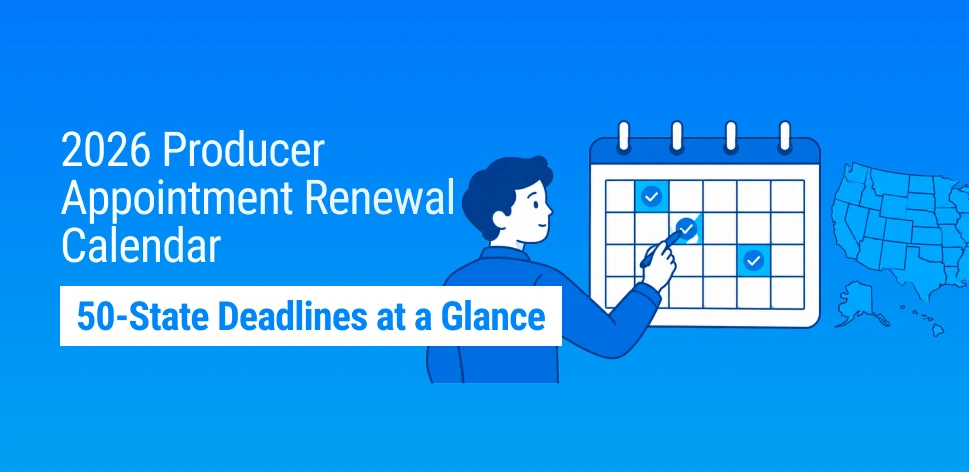
50 State Insurance Producer Appointment Renewal Calendar for 2026

Producer appointments do not follow one national renewal schedule. Some states require annual renewals. Others use biennial, rolling, or company-anniversary cycles. Several states do not require general producer appointments to be filed with the insurance regulator, while others keep appointments active until they are terminated.
This guide explains different appointment models of states with renewal obligations and provides a calendar for compliance teams to reference. All dates in the 2026 calendar were verified through state insurance department websites, regulator bulletins, state-operated portals, statutes, or administrative rules.
Key Takeaways
- Producer appointment renewals are not universal
- Renewal frequency may be annual, biennial by insurer category, every 24 months, or based on a company anniversary month
- The termination deadline may occur weeks or months before the payment deadline
- Some states do not require general producer appointments or have perpetual appointments
- Organizations track appointment renewals efficiently with licensing software
How to Use the Appointment Calendar
Start the review long before the termination deadline, not right before payment is due. Compare the state appointment roster with current employees, active producers, carrier relationships, and lines of business.
Before the invoice is created, terminate appointments that are no longer needed. Once the invoice opens, validate the number of appointments and the assessed fees. Complete payment before the hard deadline, save the confirmation, and verify that renewed appointments remain active.
States may revise instructions, deadlines, processing methods, or fees. Always recheck the applicable state insurance department notice before completing an appointment renewal.
States That Do Not Require General Producer Appointments (Registry States)
Some states do not require insurers to file general producer appointments with the state insurance department. These states are often referred to as registry or non-appointment states, although specific appointment, registration, or reporting requirements may still apply to certain lines or producer types. Specific products or producer types may still have separate requirements.
- Alaska
- Arizona
- Colorado – Colorado, Bail bond producer appointments are an exception and must be renewed annually before October 1st.
- Illinois – Appointments are only required for limited and temporary lines
- Indiana
- Maryland – An internal producer register is required for agents appointed on or after January 1, 2004.
- Missouri
- Oregon
Report terminations for cause to the relevant state Department of Insurance.
States With Perpetual Appointments
The next states have perpetual producer appointments. Appointments generally remain active until terminated, cancelled, or affected by the producer’s license status.
- California
- Delaware
- Hawaii
- Idaho
- Kansas
- Minnesota
- Montana
- New Hampshire
- New York
- Tennessee
- Texas
- Utah
In general, appointments in these states remain active until terminated or otherwise affected by changes in the producer’s license status or applicable state requirements.
2026 Producer Appointment Renewal Calendar
The calendar below places each state in the month when its appointment renewal window begins. Birth-month, licensure-month, and rolling renewal cycles appear first. Payment deadlines, renewal frequency, termination deadlines, and relevant penalties are included where available.
Birth Month and Licensure Month-Specific Cycles
Florida — Birth Month
- Renewal window: The licensee’s birth-month
- Payment due: Last day of the agent’s birth month. Payments not completed within the 45-day renewal window will result in the cancellation of all appointments.
- Frequency: Biennial
Maine — Licensure Month
- Individual Renewal window: During the month of first licensure. Producers first licensed between January and June renew in even-numbered years, while producers first licensed between July and December renew in odd-numbered years.
- Business Entity Renewal Window: Companies with January through June anniversary dates enter their Maine renewal cycle during 2026. Anniversary dates from July through December will renew in 2027.
- Payment due: Within 30 days of the invoice issuance.
- Frequency: Biennial
- Termination deadline: Complete terminations approximately two to three days before the first day of the anniversary month.
Washington – Rolling
- Renewal window: Ongoing transactional basis
- Payment due: Last day of the licensee’s birth month
- Frequency: Biennial
- Pennsylvania — Licensure Month
- Renewal window: Ongoing transactional basis
- Payment due: Within 30 days of the invoice issuance.
- Frequency: Annual
January
Alabama
- Renewal window: Appointments renew effective January 1st. Renewal invoices are available on or after January 12th.
- Payment due: March 1st
- Frequency: Annual
- Termination deadline: December 31st
Michigan
- Renewal window: Renewal invoice available January 1st. Michigan sends companies a roster of active appointments in early October.
- Payment due: Payment is due 30 days from the invoice date.
- Frequency: Annual
- Termination deadline: December 31st
Rhode Island
- Renewal window: Renewal invoices are available from January 1st
- Payment due: January 31st – Unpaid appointments terminate after the January deadline.
- Frequency: Annual
- Termination deadline: December 25th – Appointments active as of December 25th are included in the renewal cycle.
Iowa
- Renewal window: Renewal invoice available from January 2nd
- Payment due: March 15th
- Frequency: Annual
- Termination deadline: December 27th
New Mexico
- Renewal window: Appointment invoice is available from January 5th
- Payment due: April 30th. Failure to pay by the end of the renewal window results in termination of the company’s appointments.
- Frequency: Annual
- Termination deadline: December 26th
Wisconsin
- Renewal window: January 6th
- Payment due: March 15th – Failure to complete payment by the deadline results in termination of the appointments included on the invoice.
- Frequency: Annual
- Termination deadline: December 15th
Kentucky
- Renewal window: Renewal invoices are available from January 7th.
- Payment due: March 31st for the insurer categories assigned to even-numbered years
- Frequency: Biennial
- Termination deadline: December 31st
February
Wyoming
- Renewal window: Renewal invoices are available from February 1st
- Payment due: March 31st
- Frequency: Annual
- Termination deadline: January 31st
North Carolina
- Renewal window: Renewal invoices are available from February 3rd
- Payment due: March 31st
- Frequency: Annual
- Termination deadline: January 22nd
March
North Dakota
- Renewal window: Invoices available from March 1st
- Payment due: April 30th – North Dakota does not provide a grace period after the payment deadline. Unpaid appointments terminate.
- Frequency: Annual
- Termination deadline: February 15th
District of Columbia
- Renewal window: Invoices display by the second week of March
- Payment due: May 31st – Appointments added from January 1st – April 30th are generally exempt from that year’s renewal invoice.
- Frequency: Annual
- Termination deadline: March 1st
April
Mississippi
- Renewal window: Invoices are issued on or about April 1st
- Payment due: May 31st
- Frequency: Annual
- Termination deadline: March 15th
South Dakota
- Renewal window: Invoices available from April 6th
- Payment due: April 30th
- Frequency: Annual
- Termination deadline: March 31st
May
Connecticut
- Renewal window: Invoices available from May 1st
- Payment due: May 31st – Payments made after May 31st are subject to a 10% late fee, capped at $15,000.
- Frequency: Biennial in even-numbered years
- Termination deadline: April 15th
Nebraska
- Renewal window: Invoices available from May 1st
- Payment due: July 31st
- Frequency: Annual
- Termination deadline: April 24th
New Jersey
- Renewal window: Invoices available from May 1st
- Payment due: June 3rd
- Frequency: Annual
- Termination deadline: Complete terminations before March 27th
Arkansas
- Renewal window: Invoices available from May 29th (Appointments active through May 28th are included in the renewal cycle.)
- Payment due: June 30th. Renewals handled after July 1st may require direct state contact and may be subject to an increased fee.
- Frequency: Annual
- Termination deadline: May 22nd
June
Vermont
- Renewal window: Invoice displays June 3rd
- Payment due: June 30th
- Frequency: Annual
- Termination deadline: May 31st
West Virginia
- Renewal window: Invoice displays June 8th
- Payment due: before August 31st – If payment is not completed, the affected appointments terminate effective May 31st.
- Frequency: Annual
- Termination deadline: May 31st – Appointment changes made after May 31 may not appear on the renewal invoice.
July
Louisiana
- Business Entity renewal window: Invoices available from July 1st
- Business Entity payment due: August 3rd
- Frequency: Annual
- Termination deadline: Before invoice generation
Ohio
- Renewal window: Appointments automatically renew on July 1st
- Payment due: August
- Frequency: Annual
- Termination deadline: June 30th
Nevada
- Renewal window: Invoices are available from July 1st
- Payment due: September 1st
- Frequency: Annual
- Termination deadline: June 30th
Virginia
- Renewal window: Invoices are available from July 1st
- Payment due: May 10th, August 10th, November 10th, and February 10th
- Frequency: Annual
- Termination deadline: Virginia has a quarterly appointment billing schedule.
Massachusetts
- Renewal window: Invoices are available from July 19th
- Payment due: August 31st
- Frequency: Annual
- Termination deadline: June 30th
September
South Carolina
- Renewal window: Invoices are available from September 1st
- Payment due: September 30th – Renewals completed after September 30th are subject to a $250 penalty per appointment.
- Frequency: Biennial in even-numbered years
- Termination deadline: Before August 26th
November
Oklahoma
- Renewal window: Invoices are available from November 25th
- Payment due: December 31st
- Frequency: Annual
- Termination deadline: November 14th
December
Louisiana
- Individual producer renewal window: Invoices available from December 1st
- Individual Payment due: January 4th
- Frequency: Annual
- Termination deadline: Before invoice generation
Georgia
- Renewal window: Renewal listing available from December 31st
- Frequency: Annual
What are the Challenges of Managing Multi-State Appointment Renewals?
Managing producer appointment renewals across multiple states requires more than tracking one annual deadline. Each state may use a different renewal cycle, invoice process, payment window, termination cut-off, or appointment classification. Compliance teams must understand which rules apply to each carrier, producer, and state.
Different States Follow Different Renewal Cycles
Appointment renewals may be annual, biennial, birth-month based, licensure-month based, or processed on a rolling basis. Some states also divide biennial renewals by insurer type or appointment category.
For example, Florida renews appointments based on the licensee’s birth month, while Maine uses the company’s first-licensure month. Kentucky divides appointment categories between odd- and even-numbered renewal years. These differences make it difficult to manage renewals through a single standard calendar.
Termination Deadlines Come Before Renewal Invoices
Carriers often need to terminate appointments they no longer want to renew before the state creates the renewal invoice. Missing this cut-off can cause the carrier to be billed for appointments it intended to end.
The termination deadline may occur days, weeks, or even months before the payment deadline. For example, a state may generate renewal invoices in January but require appointment clean-up during December. Compliance teams must therefore track termination dates separately from invoice and payment dates.
Registry, Perpetual, and Renewable States Require Different Workflows
Not every state follows a traditional appointment-renewal model. Registry states generally require insurers to maintain internal producer authorization records rather than file general appointments with the state. Perpetual appointments typically remain active until the carrier terminates them or the producer’s license status changes.
Treating every state as an annual renewal state can lead to unnecessary filings, inaccurate internal records, and confusion about which appointments require action. Teams must first classify each state correctly before building a renewal workflow.
Appointment Data May Be Spread Across Multiple Systems
Appointment information may be stored in spreadsheets, carrier portals, customer management systems, state records, email inboxes, and internal databases. When the same information is maintained in several places, the records can quickly become inconsistent.
Missed Deadlines Can Trigger Terminations, Penalties, or Extra Work
The consequences of a missed deadline vary by state. Unpaid appointments may terminate automatically, enter a grace period, incur a late fee, or require direct contact with the state before they can be restored.
This variation makes it dangerous to assume that late payment can always be corrected through the normal renewal portal. A missed renewal can interrupt a producer’s authority, delay business, increase fees, and require additional reinstatement or reappointment work.
How Do Insurers Overcome the Challenges of Multi-State Appointment Renewals?
Insurers overcome multi-state appointment renewal challenges by creating repeatable workflows that account for state differences. The strongest process combines a centralized calendar, accurate appointment data, defined ownership, early termination reviews, and post-renewal reconciliation.
Classify States by Appointment Structure
The first step is to separate states into the correct appointment categories:
- Registry states
- Perpetual appointment states
- Annual renewal states
- Biennial renewal states
- Birth-month, licensure-month, or rolling renewal states
This step prevents teams from applying a general renewal workflow to all states and helps insurers identify exceptions, such as limited-line, bail bond, or business-entity appointment requirements.
Maintain a Central Renewal Calendar
A centralized calendar should track:
- Renewal-window opening date
- Invoice-availability date
- Termination cut-off
- Payment deadline
- Late-payment rules
- Renewal frequency
- Appointment types included in the cycle
Termination deadlines should receive special attention because they often occur before the invoice is generated.
Start Appointment Clean-Up Before Invoicing
Insurers should review active appointments before the state’s termination deadline rather than waiting for the renewal invoice.
The review should identify producers who:
- Have left the organization
- No longer write business in the state
- No longer need a particular line or carrier appointment
- Have an inactive or expired license
- Appear more than once because of duplicate records
- Should remain appointed because of current or expected business
Completing this review early can prevent unnecessary late renewal fees and reduce the number of corrections required after invoicing.
Reconcile Appointments with Licensing Data
Compare appointment records with resident and non-resident licenses, lines of authority, expiration dates, and business needs.
This reconciliation can reveal situations where:
- An appointment is active, but the supporting license is not
- A producer holds a license but lacks the required appointment
- A producer no longer wants to hold a state license and no longer needs an appointment
- The appointment and license reflect different lines of authority
- A renewal should be delayed while a licensing issue is resolved
Reviewing the two datasets together helps insurers avoid paying for appointments that cannot support active business.
Automate Routine Alerts and Reviews
Automated reminders can reduce the manual work involved in tracking renewal and termination dates.
Automation is especially helpful for recurring tasks, including:
- Renewal-window alerts
- Producer license-expiration reminders
- Appointment roster reviews
- Payment approvals
- Post-renewal verification
Renewal alerts can be sent before key milestones, such as 90, 60, and 30 days before a license renewal deadline.
Preserve Documentation and an Audit Trail
Each renewal cycle should produce a clear record of what the insurer reviewed and completed. Documentation may include the invoice, appointment roster, termination list, payment confirmation, exception notes, and final reconciliation report.
An audit trail helps the insurer explain:
- Which appointments were reviewed
- Who approved the payment
- Why certain appointments were renewed or terminated
- When the state submission was completed
- How discrepancies were resolved
This documentation also reduces the amount of research required when questions arise months after the renewal cycle closes.
Simplify Multi-State Appointment Renewals with Agenzee
Managing appointment renewals across states becomes easier when deadlines, appointment records, license data, and follow-up tasks are organized in one place.
Agenzee helps insurers reduce manual tracking, improve visibility, and stay ahead of renewal and termination dates across their producer network. Book an Agenzee demo to see how your team can manage multi-state appointment renewals with greater accuracy, control, and confidence.
Sources:
- Alabama Insurance License Appointments
- Florida Appointments for Insurance Agents
- Florida Appointment Renewal Procedure
- Maine Insurance Producer Appointment Renewals
- Iowa Insurance Producer Appointments
- Michigan Appointment Renewals
- New Mexico Annual Appointment Renewal
- Rhode Island Producer Appointment Guidance
- Wisconsin Agent Appointment Renewal
- District of Columbia Appointment Renewal
- Company Appointment Renewals in Kentucky
- North Dakota Insurance Producer Appointment Renewal
- South Dakota Insurance Producer Appointments and Terminations
- Mississippi License Appointments for Insurance Producers
- Arkansas Company Appointment Renewals for Insurance Producers
- Connecticut Appointment Requirements for Insurance Producers
- West Virginia Company Appointment Renewals
- Louisiana Company Appointment Renewals
- Ohio Insurance Producer Appointment Renewals
- Virginia Schedule of Appointment Billing and Payment Due Dates
- South Carolina Insurance Producer Appointment Renewals
- Montana Appointments of Insurance Producers by Insurers
- Nevada Company Appointments for Insurance Producers
- New York Insurance Licensing FAQ
- NIPR Company Appointment Renewals
Alexandra is a copywriter and researcher who specializes in evergreen content production. She has authored hundreds of SEO-driven blogs, helping clients translate complex insurance coverage topics into clear, authoritative content.
Alexandra graduated from the University of Oregon with a BA in German: Language, Literature, and History, and a BA in Digital Art. She spent 20 years living abroad in Germany and Spain before returning to the US in 2025.
Disclaimer: This post is for informational purposes only and does not constitute legal or compliance advice. Agenzee does not warrant the accuracy of and assumes no liability for reliance. Please consult regulators or professional advisors as needed. See our full disclaimer for details.
Subscribe
Stay Ahead with Agenzee Insights
Join our community to stay up-to-date on the latest news and strategies for license and appointment management
INDUSTRY INSIGHTS FOR INSURANCE AGENCIES, CARRIERS, AND MGAS
Similar Blogs
Read our blog to discover the latest industry insights and trends in license and appointment management.


let's catch up!
Schedule a Live 1-On-1
Demo of Agenzee!
Our insurtech experts would be thrilled to give you a personalized demo of how Agenzee can transform your compliance management processes.
Customers Opinions on Our Services and Products
What Our Customers Say
Find out why our customers are happy they chose Agenzee.