

Published On: July 14, 2026
Updated On: July 15, 2026
Individual vs. Business Entity Producer Licensing: Key Compliance Differences

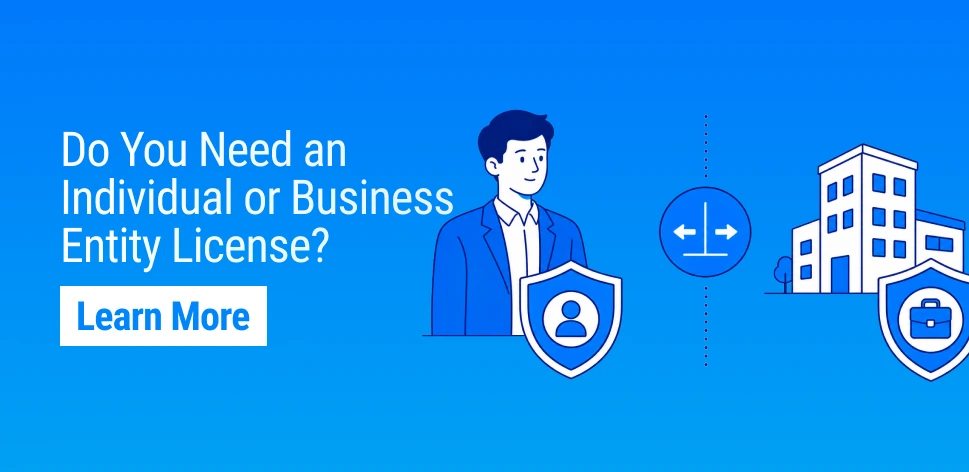
When an individual or business enters the insurance industry, one of the biggest questions they encounter is which license they need. Whether starting an agency or becoming a broker, obtaining valid producer licensing is necessary to sell, solicit, or negotiate insurance without violating state regulations.
However, it can be difficult to decipher the who, what, and where of needing a license, especially accounting for complex business structures, multi-state regulations, and role-based requirements. Knowing the compliance differences between individual and business entity producer licensing can help ensure that the appropriate responsibilities are met, operations are able to proceed smoothly, and violations are prevented before they happen.
Key Takeaways
- To transact insurance business, individuals and business entities must obtain different types of producer licenses. Understanding those differences is essential for compliance.
- Common misconceptions about individual and business entity licenses can prevent licensing validity and compliance.
- The top compliance differences between individual and business entity licenses include pre-licensing requirements, designation of compliance responsibility, and varied state-specific regulations.
- The compliance and operational challenges of multi-state expansion further emphasize the need to understand individual and business entity licensing requirements.
- Insurance license tracking software can help insurance organizations and individual producers manage compliance requirements for individual and business entity licenses.
Which License Do You Need?
The National Association of Insurance Commissioners (NAIC) stipulates that any individual or business entity seeking to transact insurance or conduct insurance business needs to obtain a producer license under their intended lines of authority (LOAs).
Generally, corporations, associations, partnerships, LLCs, and other non-individual entities must obtain a business entity license. Conversely, individual producers must obtain individual licenses. Which license is obtained depends on the applicant’s role, the intended scope of licensed activities, and the states in which they wish to conduct business.
| Individual License | Business Entity License | |
| Who holds the license? | Agent, Broker, Producer | Agency, Brokerage, TPAs, MGAs, Adjuster Firms |
| What will they do with the license? | Sell, solicit, or negotiate insurance | Conduct insurance business through licensed individuals |
| Where will they transact business? | Resident or Non-Resident State | Resident or Non-Resident State |
While both licenses enable the licensees to transact insurance business, their differences have notable implications for licensing compliance strategies. Misconceptions about which license is needed and when can increase compliance risk for individuals and business entities, and an effective compliance strategy will need to address them.
What is a business entity license?
Business entity producer licenses authorize corporations, associations, partnerships, limited liability companies, limited liability partnerships, or other legal entities to conduct insurance business through licensed individuals.
What is an individual producer license?
Individual producer licenses authorize individuals such as agents or brokers to sell, solicit, or negotiate insurance.
Common Misconceptions About Individual and Business Entity Licenses
Knowing the basic differences is important, but further misconceptions about individual and business entity producer licensing can prevent agencies, MGAs, or individual producers from achieving licensing compliance. Let’s examine some of the most common misconceptions:
- License Types are Interchangeable
For a business structure such as an agency, most states require that an individual producer holds a license, and the business entity maintains a separate license. One license type does not replace the other.
- Business Entity Licenses Authorize Employees
Business entity licenses cannot authorize unlicensed individuals to transact insurance. Even if an agency has a license, its agents still need individual licenses.
- Individual Licenses Authorize Business Entities
Similarly, even if licensed producers are operating through an agency, LLC, or other corporation, the entity itself may still need to obtain a separate business entity license.
- Only One License Type is Needed
While an individual or business entity may only need one license, this depends on their role. If a single licensed producer is operating through a legal business structure such as an LLC, for example, they may also be required to obtain a business entity license.
- Business Entity Licenses and Individual Licenses Follow the Same Compliance Rules
Finally, although both license types authorize the licensee to conduct insurance business in some form, they have fundamental differences that affect compliance.
The consequences of misunderstanding individual and business entity licensing are not isolated to the licensee. From onboarding to producer sales activities, each stage of operations depends on the valid licensing of both individuals and business entities, meaning compliance issues have the potential to disrupt the entire insurance workflow.
Top Compliance Differences for Individual and Business Entity Licenses
License application, renewal schedules, and Designated Responsible Licensed Producer (DRLP) requirements are among the key differences between individual and business entity licenses.
For the most accurate information, details for each specific license type should be confirmed directly with the relevant state Department of Insurance (DOI). However, we’ve outlined several high-level differences in the table below to support general understanding:
| Licensing Requirement | Individual License | Business Entity License |
| License Application | NAIC Uniform Application for Individual Producer License | Uniform Business Entity Application |
| Ownership | Associated with the individual producer | Associated with owners, officers, partners, or corporate structure |
| Compliance Responsibility | Associated with the individual producer | Associated with the DRLP |
| Line of Authority | Associated with the individual producer | Associated with the DRLP |
| Pre-Licensing & Continuing Education | Generally required | Not usually required |
| Appointments | Generally required | May or may not be required |
| Residency Status | Depends on the individual producer’s home state | Depends on the business entity’s resident state |
| State Filing Obligations | Depends on individual state requirements | Depends on the business entity type and individual state requirements |
For individual licensing, compliance typically centers on maintaining active licenses, continuing education, and appointments, while business entity licensing compliance involves DRLP management, ownership disclosures, and entity-level state requirements.
These differences become increasingly complex during multi-state expansion and organizational growth, as carriers, agencies, and MGAs must monitor separate renewal cycles, regulatory obligations, appointments, and licensing statuses across both individuals and entities. Without centralized management, these overlapping requirements can create onboarding delays, compliance gaps, and regulatory exposure.
State-Specific Considerations
Individual and business entity producer licensing management becomes especially important as carriers, agencies, and MGAs seek to maintain compliance across multiple states. Varying licensing requirements must be met to ensure that both individuals and business entities are licensed appropriately in the states where they conduct business.
Depending on the state, the following compliance requirements might differ for individual and business entity licenses:
License Type
States vary on whether and what kind of business entity licenses are required. Some require separate licenses for adjuster firms, MGAs, and TPAs, while others apply narrower requirements or do not require business entity licenses at all.
Lines of Authority (LOAs)
States vary in how LOAs are assigned and maintained. Individuals must obtain and renew specific LOAs tied to their license type, while business entities rely on LOAs held by DRLPs and may require separate entity-level approvals or appointments.
Residency Status & Reciprocity
Resident and non-resident licensing rules vary widely for individuals and business entities. State reciprocity can streamline non-resident license applications but may include additional requirements, fees, or verifications. Reciprocity standards may also differ between individuals and entities.
Renewals & Continuing Education (CE)
States maintain different renewal schedules and CE requirements depending on license type and jurisdiction. Typically, individual producers complete state-specific CE obligations to maintain active licenses, while business entities may face separate reporting obligations or DRLP-related requirements instead.
Designated Responsible Licensed Producer (DRLP)
Many states require business entities to appoint a DRLP, though rules vary by jurisdiction. Requirements may differ on whether the DRLP must hold resident licenses, maintain specific lines of authority, actively supervise operations, or remain continuously affiliated with the entity.
State Filing Obligations
Filing requirements differ by entity structure, licensing status, and jurisdiction. Business entities may be required to report ownership changes, officer updates, address changes, mergers, acquisitions, assumed names, or branch registrations within set time frames. Individual producers may face separate disclosure obligations for criminal history or licensing changes.
Background Checks
Fingerprinting and background screening requirements vary widely depending on license type and reciprocity standards. Some states require fingerprinting only for resident producers, while others extend additional screening requirements to non-resident applicants, DRLPs, or controlling persons associated with business entities.
These differences matter for scalable compliance during organizational growth, mergers, acquisitions, or multi-state expansion. Organizations managing individual and business entity producer licensing must navigate varying requirements, deadlines, and filing obligations to keep operations compliant. Without effective licensing software, maintaining that oversight can become unmanageable.
Operational Implications in the Real World
Tracking both individual and business entity licenses becomes difficult as organizations scale. Every additional state introduces new licensing rules, renewal timelines, filing obligations, reciprocity standards, and other compliance requirements that must be monitored separately for both the organization and each affiliated producer.
The inner workings of an agency attempting to scale across multiple states offer a real-world example. With twenty producers, the agency needs to obtain a business entity license and an individual producer license for each of its agents. The agency may be able to manage licensing requirements in a single state, but expanding to a new state introduces different requirements that complicate licensing management for each agent and the agency.
Imagine, for example, that the agency’s home state is in Florida, but it wants to expand to do business in Georgia. It will have to comply with Florida and Georgia requirements for both resident and non-resident agency and agent licenses, summarized in the following table:
| Licensing Requirement | Florida Agency | Florida Agent | Georgia Agency | Georgia Agent |
| License Type | Resident agency license | Resident producer license | Non-resident agency license | Non-resident producer license |
| Lines of Authority (LOAs) | Held at entity level | Aligns with individual license authority | Derived from resident license authority | Derived from resident license authority |
| Renewals & CE | Perpetual, no CE | Perpetual, based on CE status | Biennial renewal, no CE | Biennial renewal, reciprocal CE compliance |
| Responsible Licensed Person (DRLP Equivalent) | Agent In Charge (AIC) | N/A | Responsible Agent | N/A |
| Fingerprinting & Background Checks | Required | Required | Not required under reciprocity | Not required under reciprocity |
| State Filing Obligations | Agency filings and updates required | Individual filings and updates required | Maintain home-state compliance | Maintain home-state compliance |
What kind of impact does this have on operations? With twenty producers, the agency will now have to track LOAs, renewals, CE obligations, DRLP requirements, ongoing state filing requirements and more across:
- 1 Florida business entity license
- 1 Georgia non-resident business entity license
- 20 Florida individual licenses
- 20 Georgia non-resident licenses
All to expand into one additional state. That means the organization would now actively monitor over 40 separate licensing relationships and compliance obligations while accounting for appointments, renewals, and ongoing regulatory updates.
Administrative burden multiplies with each new state the agency attempts to expand to, and each additional layer of obligations becomes increasingly difficult to track manually.
How License Tracking Software Improves Individual and Business Entity Compliance
For individual licenses, insurance license tracking software centralizes producer status, renewal deadlines, continuing education requirements, and state filing obligations across every state where a producer is licensed, reducing the risk of lapsed licenses.
For business entity licenses, insurance license tracking software simplifies monitoring DRLP designation, ownership disclosure, entity-level renewals, and jurisdiction-specific reporting requirements, helping organizations stay compliant through growth, mergers, acquisitions, or state expansions.
Overall, for agencies, MGAs, TPAs, and other business entities managing both licenses, insurance license tracking software provides a unified platform that connects individual and entity-level compliance into one scalable system. Instead of fragmented tracking processes, compliance teams gain visibility across all licensing relationships, making it far easier to catch gaps before they become violations.
FAQs
Q.1 What is the difference between an individual and business entity license?
Individual licenses are obtained by individual producers such as agents or brokers. They authorize an individual to sell, solicit, or negotiate insurance. Business entity licenses, on the other hand, are often required for non-individual legal entities and authorize the licensee to conduct insurance business.
Q.2 If my agency is licensed, do my agents need to be licensed?
Business entity licenses do not authorize individual producers to sell insurance. Your agents will need to obtain individual producer licenses in every state where they wish to sell.
Q.3 What is a Designated Responsible Licensed Producer (DRLP), and who needs one?
A business entity is required to have a DRLP for each line of authority (LOA) on their business entity insurance license. The DRLP is responsible for ensuring the business is compliant with state laws and regulations.
Q.4 Are licensing requirements the same in every state for individuals and business entities?
No. Licensing requirements vary significantly by state for both individuals and business entities. Differences may include residency rules, renewal cycles, continuing education requirements, fingerprinting, DRLP obligations, and whether a business entity license is required at all.
Q.5 What are the common compliance risks for individual and business entity licenses?
Common risks include expired licenses, missing CE requirements, incorrect DRLP assignments, missed state filings, and misunderstanding whether a license applies to an individual or entity.
Q.6 How can license tracking software help manage individual and business entity licenses?
License tracking software helps centralize the management of individual and business entity licenses. It monitors renewals, CE requirements, DRLP assignments, and state-specific filing obligations, reducing manual tracking and helping prevent compliance gaps as organizations scale across multiple states.
Allison is a Content Writer at Agenzee, creating blogs, case studies, social media content, and other value-driven materials to support overall marketing strategies and spur brand growth. Her storytelling expertise infuses her work with a clear, captivating voice that successfully drives conversion and engagement.
Educated in anthropology at Princeton University, Allison’s unique background in software solutions, fiction writing, ethnographic research, and tutoring gives her a unique perspective on the insurance licensing world, enabling her to pursue her mission: Making Agenzee the leader of insurance modernization.
Disclaimer: This post is for informational purposes only and does not constitute legal or compliance advice. Agenzee does not warrant the accuracy of and assumes no liability for reliance. Please consult regulators or professional advisors as needed. See our full disclaimer for details.
Subscribe
Stay Ahead with Agenzee Insights
Join our community to stay up-to-date on the latest news and strategies for license and appointment management
INDUSTRY INSIGHTS FOR INSURANCE AGENCIES, CARRIERS, AND MGAS
Similar Blogs
Read our blog to discover the latest industry insights and trends in license and appointment management.

let's catch up!
Schedule a Live 1-On-1
Demo of Agenzee!
Our insurtech experts would be thrilled to give you a personalized demo of how Agenzee can transform your compliance management processes.
Customers Opinions on Our Services and Products
What Our Customers Say
Find out why our customers are happy they chose Agenzee.