

Published On: May 26, 2026
Updated On: May 28, 2026
Multi-State Producer Licensing Challenges and the Role of Insurance License Management Software

Managing insurance producer licensing across multiple states is a difficult operational task. Each state has unique renewal cycles, continuing education rules, appointment requirements, fees, lines of authority, documentation standards, and regulator expectations.
As agencies, MGAs, carriers, and other insurance organizations expand, licensing workflows become increasingly difficult to manage through spreadsheets and manual processes. Insurance license management software establishes a centralized way to track producer licenses, renewals, appointments, CE status, documents, and compliance activity across states.
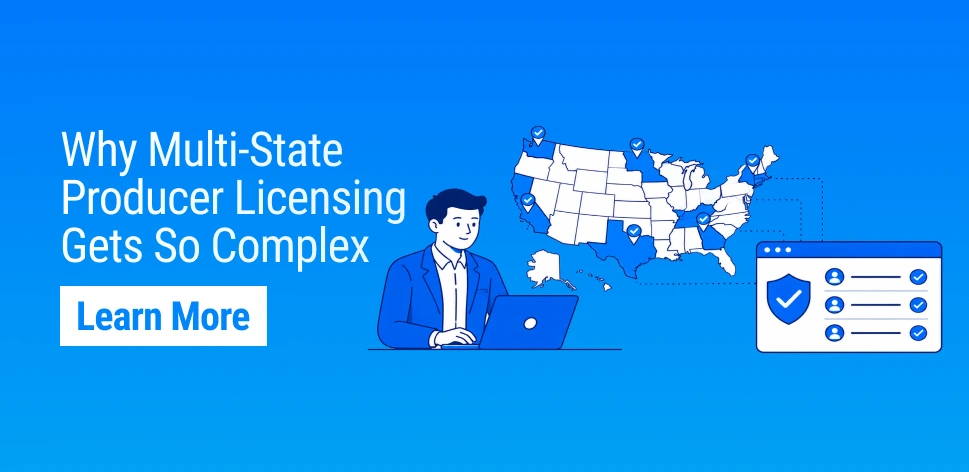
What Is Multi-State Producer Licensing?
Multi-state producer licensing is the process of managing insurance producer resident and non-resident licenses, lines of authority, renewals, continuing education, appointments, terminations, regulatory actions, and state-specific documentation requirements across U.S. states.
Every individual who sells, solicits, or negotiates insurance must hold a license in each state where they conduct business. As a result, each producer adds additional compliance and administrative complexity as non-resident licenses and lines of authority expand.
Definition: Multi-State Producer Licensing
Multi-state producer licensing refers to the process of tracking, maintaining, and validating producer authority across multiple state jurisdictions.
Why Multi-State Producer Licensing is Challenging
The core challenge is the number of variables that change from state to state. A producer may be licensed in several states, appointed with several carriers, selling multiple lines of authority, and subject to different renewal windows. Multiply that by dozens, hundreds, or thousands of producers, and the workflow becomes hard to control manually.
Spreadsheets become a weakness when compliance work becomes more complex. For example, spreadsheets cannot validate license status automatically, sync with regulatory data, create reliable escalation paths, or show if an appointment, renewal, or CE item was reviewed in time.
State Licensing Challenge Examples
| State | Licensing Challenge | Detail | Importance |
| Arizona | Different renewal cycle and higher CE total | Producer licenses renew every four years, and major-line producers need 48 hours of CE, including 6 hours of ethics. | States with longer cycles can be easier to overlook. Track renewal patterns for each state. |
| Colorado | Pre-licensing and late-renewal limitations | Colorado requires 50 hours of pre-licensing education per line of authority. Inactive licenses cannot be late-renewed and must be reinstated through NIPR’s resident license application. | Additional onboarding and reinstatement complexity, especially when producers hold multiple lines of authority. |
| Florida | Perpetual license, but CE required | Individual licenses are perpetual, but producers must complete CE every two years. Appointments can only be made if CE requirements are completed on time. | A “perpetual” license can create a false sense of security. Teams still need CE tracking because missed CE can affect producer readiness. |
| Georgia | Different portals and business entity rules | Georgia allows use of the Georgia DOI or NIPR, but new resident applications must be completed through the Georgia state licensing system beginning April 1, 2026. Business Business entities have no late renewal period. | Portal variation adds process complexity. Teams need to know when to file with NIPR and when to use a state-specific portal. |
| Illinois | No late renewal grace period | Illinois does not provide a grace period for late renewals. If a producer misses the deadline, they must begin the reinstatement process. | One missed renewal can quickly become a reinstatement issue. This creates urgency around renewal alerts and escalation workflows. |
| Michigan | CE noncompliance can trigger suspension | Resident producer licenses are perpetual if the producer remains CE compliant. Failing to meet CE requirements results in suspension for 90 days or until requirements are met. | CE visibility is necessary to understand if a producer is in good standing. |
| Texas | DRLP and renewal penalty rules | Nonresident agencies must provide data for a Texas designated responsible licensed producer with a Texas producer license in the same line(s) of authority as the agency. Late renewal rules change depending on whether the license is less than or more than 90 days late. | Texas creates both entity-level and producer-level tracking issues. Teams need to monitor DRLP details, renewal timing, CE, and penalties together. |
Challenge 1: Licensing Workflows Break Down at Scale
Manual producer license tracking can work for a small team with a limited number of states. It becomes unreliable when producer count, state count, appointment volume, and renewal complexity increase.
The workflow may appear organized until someone asks a basic operational question:
“Is this producer licensed and appointed to sell this product in this state today?”
If the answer requires checking three spreadsheets, a state portal, email history, and a producer file, then the organization has fragmented workflows.
Definition: Manual Producer License Tracking
Manual producer license tracking is the process of monitoring producer licenses, renewals, continuing education, appointments, and compliance deadlines without a centralized licensing system. Teams typically rely on spreadsheets, email reminders, calendar alerts, shared folders, and manual lookups in state or NIPR records.
Challenge 2: State Licensing Requirements Are Not Standardized
Although national systems help standardize portions of the licensing workflow, insurance licensing remains state-based, creating significant operational variation.
The most common multi-state license management challenges:
- States have different renewal dates
- CE requirements differ by state and license type
- Appointment and termination processes vary
- Resident and nonresident rules differ
- Ownership of producer compliance tasks is unclear
- Producer data is stored in multiple systems
- Manual reminders depend on one person remembering the deadline
- Appointment requests arrive before licensing status is confirmed
- Missing audit trail for who reviewed, approved, or completed a task
For insurance agencies, multi-state licensing challenges affect onboarding, producer readiness, commission validation, and business continuity.
Definition: Insurance Producer Compliance
Insurance producer compliance is the process of ensuring required licenses, lines of authority, appointments, continuing education, and documentation are in place to sell, solicit, or negotiate insurance. Producer compliance includes tracking renewals, monitoring state-specific requirement changes, and maintaining records that support regulatory reviews.
Challenge 3: Renewal and CE Deadlines Are Easy to Miss
License renewal tracking becomes more difficult when producers hold licenses in multiple states. One producer may hold licenses across multiple states, each with its own renewal timeline, continuing education requirements, and filing procedures.
The challenge is understanding which requirements must be completed before a renewal can be submitted.
For example, compliance teams may need to confirm CE completion, ethics requirements, resident and nonresident license status, state renewal windows, renewal fees, required disclosures, background questions, and the appointment impact if the license lapses.
When renewal tracking depends on spreadsheets, gaps are easier to miss. A producer may appear active in one system while CE remains incomplete in another. By the time the issue is found, the team may be working against a short deadline or managing a reinstatement instead of a routine renewal.
Challenge 4: Appointment Management Requires More Than License Status
A producer license does not always mean a producer is ready to write business for a specific carrier. In many states and distribution models, the producer may also need the correct carrier appointment.
That creates another layer of operational oversight.
Appointment management may require teams to confirm if an appointment is required in the state, which carrier the producer is writing for, which line of authority applies, and many other details.
When appointment records are spread across multiple systems, teams spend unnecessary time researching basic status information. It also becomes more difficult to verify who reviewed the appointment, when it was submitted, and whether the producer was properly authorized at the time of business activity
Challenge 5: Compliance Data Lives in Too Many Places
Many insurers struggle with data spread across too many systems. A producer’s compliance record can include information from:
- NIPR or PDB reports
- State insurance department portals
- Agency management systems
- Carrier appointment portals
- HR or onboarding files
- Shared drives
- Email threads
- Internal spreadsheets
- CE records
- Compliance notes
When data is fragmented, teams spend too much time reconciling information instead of managing the workflow. One system may show a producer as active. Another may show missing CE. A spreadsheet may show an old line of authority. A carrier portal may contain appointment information that has not been updated internally.
This type of fragmentation creates reporting risk. If leadership asks for a compliance snapshot, the team may need to gather data manually from several places or reconstruct the history after the fact.
The Solution: Insurance License Management Software
Insurance license management software helps centralize the producer compliance workflow. Although software cannot remove the complexity of state-based insurance regulation, it can help manage complexities in one location.
A well-structured insurance licensing system can support:
- Producer profile management
- NPN and license data tracking
- Multi-state license visibility
- Renewal monitoring
- CE tracking
- Carrier appointment tracking
- Appointment terminations
- Regulatory action visibility
- Document storage
- Workflow assignments
- Alerts and reminders
- Audit trails
- Reporting dashboards
The main value of insurance compliance automation is visibility. Licensing teams see what producers are active, , and who owns the next step. Operations leaders know when licensing issues are slowing down onboarding, renewals, appointments, or producer productivity.
Definition: Insurance License Management Software
Insurance license management software is a system used to track, organize, and manage producer licensing activity. Software supports license status monitoring, renewal tracking, CE tracking, appointment visibility, document storage, alerts, reporting, and audit support.
Manual Tracking vs. License Management Software
| Workflow Need | Spreadsheet-Based Process | License Management Software |
| License status tracking | Manual updates from reports or state lookups | Centralized status visibility |
| Renewal monitoring | Calendar reminders or spreadsheet filters | Automated renewal alerts and task views |
| CE tracking | Manual producer follow-up | CE status visibility where supported |
| Appointment tracking | Email threads, carrier portals, or separate files | Centralized appointment records and workflow visibility |
| Producer onboarding | HR, licensing, and compliance tasks often split | Structured workflow across teams |
| Audit trail | Hard to prove who did what and when | Documented activity history |
| Reporting | Manual exports and spreadsheet cleanup | More consistent compliance reporting |
| Scaling | Requires more admin time as producer count grows | Supports larger producer networks with less fragmentation |
What to Look for in License Management Software
Before choosing a platform, map the licensing lifecycle from onboarding through renewal, appointment management, reporting, and offboarding.
Look for software that supports:
- Multi-state license tracking
- NIPR or PDB data access where applicable
- License renewal tracking
- CE tracking
- Appointment management
- Appointment termination workflows
- Producer onboarding support
- Document management
- Audit trail visibility
- Role-based access
- Dashboard reporting
- Alerts and reminders
- Bulk actions
- Escalation workflows
- Integration potential with internal systems
The platform should reduce manual follow-up but also preserve control. Compliance teams need to review exceptions, handle complex cases, and document decisions.
Benefits of Insurance License Management Software for Agencies, MGAs, and Carriers
Insurance compliance software doesn’t remove people from the process. Software removes avoidable manual work so people can focus on judgment-based tasks.
Licensing teams need to interpret state nuances, resolve errors, coordinate with carriers, answer producer questions, and manage exceptions. Software creates a better operating environment.
Insurance Agencies
Producer license tracking, CE visibility, appointment management, and renewal monitoring keep producers ready to sell. For insurance agencies, the biggest benefits are usually time savings, fewer follow-up emails, better producer accountability, and cleaner operational visibility.
MGAs and FMOs
MGAs and FMOs manage large producer networks with downstream relationships. Visibility across producers, sub-producers, carrier relationships, appointments, and onboarding status adds structure to operations.
Insurance Carriers
Insurance carriers get accurate producer and appointment data to support distribution oversight, appointment filings, audit readiness, and regulatory reporting. This helps carriers understand whether producers writing business are properly licensed and appointed where required.
When Manual Tracking Is No Longer Enough
Many organizations already have access to licensing data. The problem is that the data is spread across too many places. More data does not help unless the team can act on it.
Centralized control gives licensing staff , so they can understand the next task, document the decision, and report the outcome.
Manual tracking may no longer be enough when your organization experiences:
- Producers asking the same licensing status questions repeatedly
- Renewal follow-up depending on one person
- CE gaps discovered too close to the deadline
- Appointment requests delayed by manual research
- Compliance reports taking too long to prepare
- Different teams keeping different versions of producer records
- Leadership lacking visibility into licensing risk
- Onboarding slowed by license and appointment uncertainty
- Offboarding missing appointment termination steps
These signs point to the fact that the workflow has outgrown the system supporting it.
From Compliance Burden to Operational Discipline
Multi-state producer licensing, state rules, producer movement, appointment requirements, CE obligations, and regulatory expectations will continue to create complexity.
Manual processes depend on memory, spreadsheets, inboxes, and individual experience. However, a centralized licensing platform gives teams a clear structure for tracking producer status, managing renewals, monitoring appointments, documenting activity, and preparing reports.
For organizations managing producers across multiple states, the goal is to create a licensing workflow that remains organized, consistent, and scalable as operations grow. Centralizing licensing and compliance activities into a single workflow helps improve visibility, reduce manual coordination, and support ongoing operational efficiency
Explore how Agenzee supports producer compliance operations. Book a demo today.
FAQ: Multi-State Producer Licensing and License Management Software
Q.1 What is insurance license management software?
Insurance license management software helps organizations track producer licenses, renewals, CE status, appointments, documents, and compliance activity. Agencies, MGAs, carriers, and compliance teams that need centralized visibility across producer licensing workflows use this kind of software.
Q.2 Why is multi-state producer licensing difficult?
Multi-state producer licensing is difficult because every state has different licensing rules, renewal cycles, CE requirements, appointment processes, fees, and documentation standards. The workflow becomes challenging when producers hold multiple licenses and write across several jurisdictions.
Q.3 What is producer license tracking?
Producer license tracking is the process of monitoring license status, expiration dates, lines of authority, resident and nonresident licenses, CE requirements, and other compliance details. Producer license tracking helps organizations confirm if a producer is authorized to sell insurance in a specific state.
Q.4 How does license renewal tracking help compliance teams?
License renewal tracking helps compliance teams identify upcoming expirations, CE gaps, missing documentation, and producers at risk of lapse. It gives teams time to follow up before a missed deadline affects business operations.
Q.5 What is the difference between licensing and appointments?
Licensing confirms that a producer is authorized by a state to sell, solicit, or negotiate insurance. An appointment confirms that a carrier has authorized the producer to write business for that carrier in states where appointments are required.
Q.6 Can insurance license management software replace NIPR?
No. Insurance license management software does not replace NIPR. The National Insurance Producer Registry (NIPR) serves as a centralized national hub for producer licensing transactions and regulatory data exchange, operating within the broader NAIC (National Association of Insurance Commissioners) framework and supporting state Departments of Insurance.
License management software works alongside NIPR by helping insurance organizations organize producer data, streamline internal workflows, track licensing activity, manage compliance deadlines, generate reporting, and maintain audit-ready records in a single system of record for agency operations.
Q.7 Why do spreadsheets fail for insurance licensing compliance?
Spreadsheets fail at scale because they require manual updates, depend on individual users, lack automated validation, and fail to provide reliable workflow control. As producer count and state complexity grows, spreadsheets make it harder to maintain accurate records, timely renewals, and clear audit trails.
Alexandra is a copywriter and researcher who specializes in evergreen content production. She has authored hundreds of SEO-driven blogs, helping clients translate complex insurance coverage topics into clear, authoritative content.
Alexandra graduated from the University of Oregon with a BA in German: Language, Literature, and History, and a BA in Digital Art. She spent 20 years living abroad in Germany and Spain before returning to the US in 2025.
Disclaimer: This post is for informational purposes only and does not constitute legal or compliance advice. Agenzee does not warrant the accuracy of and assumes no liability for reliance. Please consult regulators or professional advisors as needed. See our full disclaimer for details.
Subscribe
Stay Ahead with Agenzee Insights
Join our community to stay up-to-date on the latest news and strategies for license and appointment management
INDUSTRY INSIGHTS FOR INSURANCE AGENCIES, CARRIERS, AND MGAS
Similar Blogs
Read our blog to discover the latest industry insights and trends in license and appointment management.

let's catch up!
Schedule a Live 1-On-1
Demo of Agenzee!
Our insurtech experts would be thrilled to give you a personalized demo of how Agenzee can transform your compliance management processes.
Customers Opinions on Our Services and Products
What Our Customers Say
Find out why our customers are happy they chose Agenzee.