

Published On: July 13, 2026
Updated On: July 13, 2026
Why CE Expiration Is Still a Major Risk for Insurance Agencies in 2026

Continuing Education (CE) expiration is still a major risk for insurance agencies and compliance teams in 2026. Although CE completion seems simple in theory, the reality is that manual CE tracking, outdated producer files, and missed renewal reminders continue to create operational risks.
This post explains how missing CE requirements still pose a major risk to insurance agencies in 2026 and how to solve the issue with software that improves workflow visibility. By having the right systems in place, insurance agencies can prevent license renewal issues before they happen.
Definition: Continuing Education (CE)
Continuing Education (CE) is coursework required for a licensed insurance agent to maintain an active license and renewal readiness, including LOA relevant courses, ethics, flood, state-specific, and coverage specific courses as required per renewal period.
What are Insurance Producer CE Requirements?
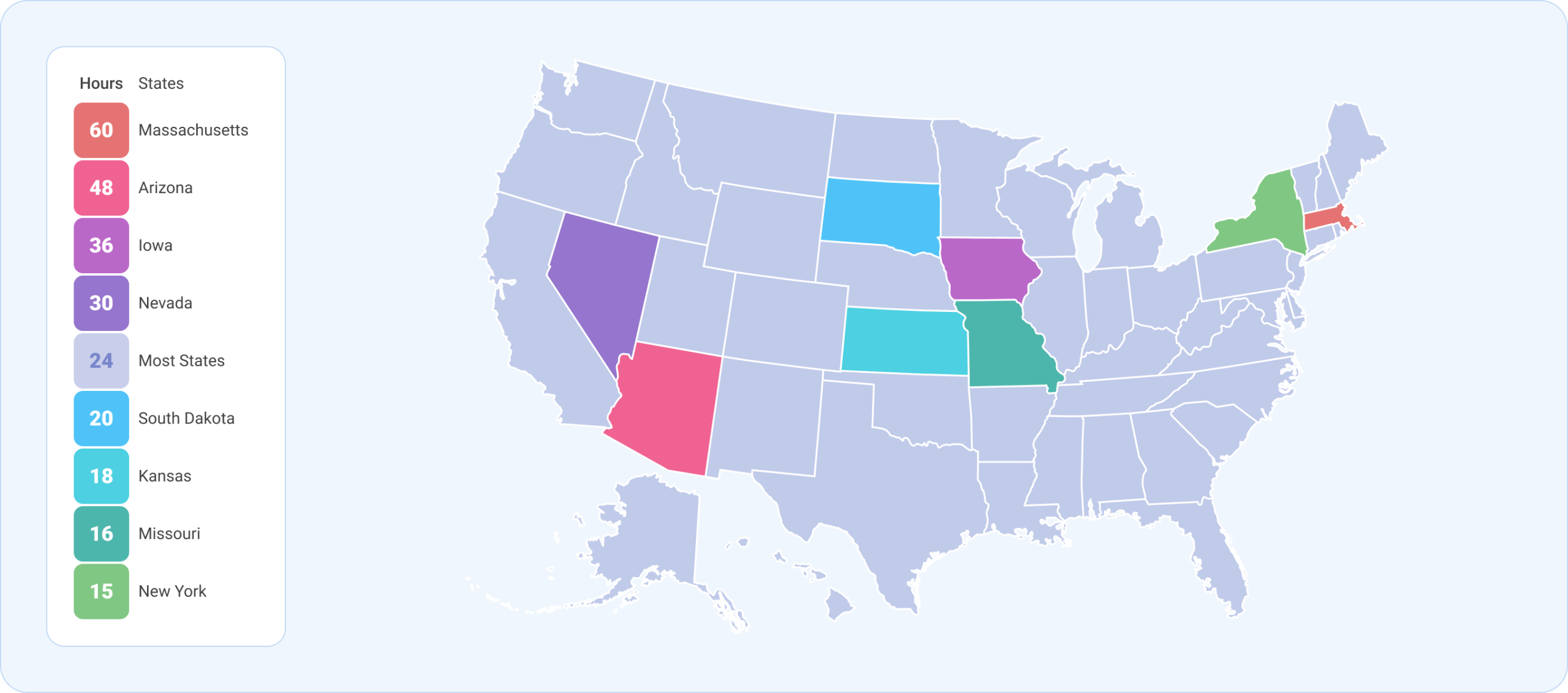
Producer CE requirements include a total number of mandated state-approved line-specific course hours, ranging from 15 to 60 hours depending on the state, in the agent’s major line(s) of authority (life, health, property, casualty, etc.). CE requirements also include an ethics component of 3 to 6 hours.
While 43 states have 2-year CE renewal cycles, other states may have 3-year or 4-year cycles. In some cases, the first renewal may occur before a full two years and require early CE completion.
Definition: State-Specific CE Requirements
State-specific CE requirements are the continuing education rules set by each state’s insurance department, and include the number of required CE hours, renewal cycle length, ethics requirements, course approval rules, reporting deadlines, exemptions, and product-specific training.
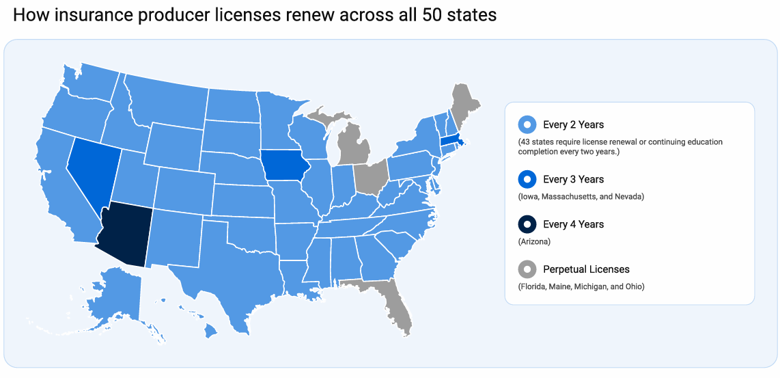
Despite some states having perpetual licenses, CE is still due on time for resident agents, producers, and adjusters (when required) to avoid appointment cancellations and license lapses, unless exemptions apply.
Definition: Ethics CE
Ethics CE is the portion of an insurance producer’s continuing education requirement focused on professional conduct, regulatory responsibilities, consumer protection, suitability, conflicts of interest, and ethical sales practices.
Reciprocity rules typically apply to non-resident license renewals. However, some states do not share CE reciprocity or have state-specific course requirements.
Definition: CE Reciprocity
CE reciprocity means a nonresident insurance producer can satisfy continuing education requirements in other states by staying CE-compliant in their resident/home state. Reciprocity may or may not apply, depending on the state.
Why Missing CE Deadlines is a Critical Operational Risk
Licensees may become non-compliant due to missed CE requirements. When the renewal date arrives and CE is incomplete, the license may expire, appointments may be cancelled, and agents may be left unable to conduct further business. The agency can face producer licensing compliance issues including penalties, fines, and regulatory action.
The Agent Has an “Inactive/Non-Compliant” Status
Agents with a CE non-compliant or inactive status faces suspension of authority. The agent or producer is then unable to write new business, serve existing policies, or provide related services. State-specific penalties and late CE fees may also apply.
Late CE Has Direct Financial Consequences
The immediate financial consequences include lost revenue from halted commissions and late license renewal or reinstatement fees. Last-minute CE courses may also be more expensive than standard CE course bookings. In addition, a lapsed license due to missed CE will require reappointment in appointment states, adding to the total cost.
Agency Can Face E&O Exposure
An insurance agency may face compliance exposure if an agent’s license expires due to missing CE. The E&O policy may not cover errors during the lapsed license period, leaving the agency directly exposed to compliance risks and making written policies void.
What Happens When an Agent Misses CE?
| CE Risk | What Can Happen | Agency Impact |
| CE is incomplete before renewal | The producer may be unable to renew the license on time. | Licensing team must manage late renewal, reinstatement, or reapplication steps. |
| License moves to inactive or non-compliant status | The producer may lose authority to sell, solicit, negotiate, or service policies. | New business and client service activities may be interrupted. |
| Appointment is cancelled or disrupted | In appointment states, the producer may need to be reappointed after the license issue is resolved. | Additional administrative work, carrier follow-up, and potential onboarding delays. |
| CE credits are completed but not reported yet | Internal records may show CE as complete while state or NIPR records still show pending status. | Compliance teams may not have reliable proof that the producer is renewal ready. |
| Deadline is missed across multiple states | Resident and nonresident license issues can create a broader compliance problem. | Multi-state producer teams become harder to monitor without real-time visibility. |
| Manual reminders fail | The producer may not receive timely notice before the deadline. | The agency may face preventable license lapses, penalties, or operational disruption. |
The Challenges of Tracking CE Across Large Producer Teams
How do agents and agencies miss CE requirements? Manual CE expiration tracking, poor visibility, and missed reminders are common causes for late CE.
In small agencies, manual processes may work short-term, but as business scales, the shortcomings of spreadsheets and manual monitoring become evident.
Before missed CE deadlines, agencies may see warning signs in their workflow. Common risk indicators include:
- CE credits are still pending close to the license renewal date.
- The producer is not responding to renewal or CE reminders.
- Internal records do not match state or NIPR data.
- The producer holds licenses in multiple states with different CE rules.
- The agency does not have a clear record of CE completion.
Definition: CE Tracking
CE tracking for insurance agencies is the process of monitoring each producer’s continuing education status to confirm whether producers are renewal-ready before their licenses expire. The process involves identifying missing CE, pending credits, inactive statuses, and renewal risks across multiple producers, states, and lines of authority.
Spreadsheets and Manual Monitoring Fail at Scale
Manual CE tracking creates compliance gaps and renewal issues because the data becomes stagnant. Without daily updates, CE data quickly becomes outdated.
Compliance relies on continuous monitoring for state-specific updates and changes to CE requirements. For example, Georgia now offers a 4-hour CE reduction for producers that have at least 20 years of experience.
If changes are overlooked, agencies may be operating with outdated spreadsheet data. As a result, agencies could overlook CE requirements, and a license may fail to renew, leaving the agent unlicensed. At scale, the challenges of monitoring resident and non-resident licenses increase.
Manual Tracking Creates Compliance Gaps
The complexities of multi-state insurance CE tracking create a high volume of compliance tasks. When completed manually, human error combined with a lack of real-time visibility into agent data can lead to compliance gaps.
For example, a spreadsheet may show CE as complete but other data suggests CE is still pending approval. A single source of truth is missing to give compliance teams the confidence they need in the data’s accuracy to complete their work.
How Software Helps Manage the Risks of Producer CE Compliance
Traditionally, agencies would manually check state-specific CE transcripts through state portals and the NIPR for each producer. The Insurance license renewal tracking process is labor intensive and requires frequent updates to spreadsheets. CE credits typically require several days to appear in the system, requiring agencies to complete multiple manual checks.
Definition: CE Transcript
A CE transcript is a record of an insurance producer’s completed course hours, course types, ethics credits, reporting dates, and whether the producer has met the state’s CE requirements for license renewal.
Insurance license management software centralizes producer licensing data, simplifying producer CE tracking by creating a single source of truth. Producers and agencies can monitor CE status from a central dashboard and identify missing requirements before license renewal dates. The data syncs with NIPR and state sources daily to keep a current database of producer licensing information.
Similarly, sending manual email reminders to each agent about upcoming renewal and CE deadlines is time-consuming and prone to human error. However, by setting up automated alerts in insurance licensing software, teams can trigger reminder notifications 90, 60, and 30 days before license renewal deadlines.
- Monitor renewal dates across resident and nonresident licenses.
- Verify CE completion through transcripts, state data, or NIPR records.
- Identify producers with missing, pending, or incomplete CE.
- Send reminders before the renewal window becomes urgent.
- Keep a record of follow-up activity for internal review or audit preparation.
Software improves CE tracking, visibility, and renewal readiness by creating an actionable dashboard where teams can view the most up-to-date versions of state, NIPR, and internal producer data.
Manual CE Tracking vs. Software-Based CE Tracking
| CE Tracking Task | Manual Process | Software-Based Process |
| Monitor renewal dates | Compliance teams track deadlines in spreadsheets or calendars. | Renewal dates are centralized in a dashboard. |
| Verify CE completion | Staff manually check NIPR, state portals, or CE transcripts. | CE status can be monitored from one system using updated licensing data. |
| Identify missing CE | Teams search through producer records one by one. | Dashboards flag producers with missing or incomplete CE before renewal. |
| Send reminders | Staff send individual emails and follow-ups manually. | Automated alerts can notify producers 90, 60, and 30 days before deadlines. |
| Track state-specific requirements | Teams must manually research CE hours, ethics rules, exemptions, and product training. | State-specific requirements can be tracked alongside producer license data. |
| Manage large producer teams | Spreadsheets become harder to trust as producer count, states, and license types increase. | Centralized data creates a clearer source of truth for compliance teams. |
| Prepare for audits or internal review | Records may be scattered across spreadsheets, inboxes, portals, and documents. | Licensing activity and status data are easier to review from a shared system. |
Track Insurance License CE More Reliably
Insurance CE tracking becomes harder as agencies add more producers, states, licenses, and renewal deadlines. A spreadsheet may work when a team is small, but it can quickly become unmanageable when CE credits are pending, renewal dates change, or state-specific requirements are overlooked.
Insurance license tracking software gives agencies a more reliable way to monitor CE status, renewal readiness, and license risk across producer teams. Instead of relying on manual portal checks and scattered email reminders, agencies can use centralized data, automated alerts, and dashboard visibility to identify missing CE before a license lapse, appointment issue, or compliance problem.
Ready to manage CE deadlines with more confidence?
Book a demo of Agenzee to see how insurance license tracking software can help your agency monitor producer CE and reduce renewal risk.
FAQ on Insurance Producer CE Risks
Q.1 What does CE compliant mean in insurance?
CE compliant means an insurance agent completed continuing education hours, including ethics requirements, and state-specific training. In addition, the status means the credit hours were reported on time before the license expiration date.
Q.2 Can insurance agents renew licenses without CE?
Usually not. The NIPR does not typically permit license renewals without proof of CE completion.
Q.3 How early should insurance agents complete CE?
NIPR recommends completing required CE at least 30 days before license expiration. CE providers may take three to five business days to report completion results to the state and NIPR. Ideally, producers should complete CE well before the renewal deadline, not at the last minute.
Q.4 What happens if an insurance producer misses a CE deadline?
If a producer misses a CE deadline, the license may fail to renew, move into a non-compliant or inactive status, require late renewal, reinstatement, or reapplication depending on the state.
Q.5 How can producers check if CE credits have been reported?
Producers can check their CE transcript through NIPR or the state insurance department portal. NIPR recommends reviewing CE transcripts before license renewal. For agencies, transcript checks are especially important when a producer says CE is complete, but the licensing record shows a pending or incomplete status.
Alexandra is a copywriter and researcher who specializes in evergreen content production. She has authored hundreds of SEO-driven blogs, helping clients translate complex insurance coverage topics into clear, authoritative content.
Alexandra graduated from the University of Oregon with a BA in German: Language, Literature, and History, and a BA in Digital Art. She spent 20 years living abroad in Germany and Spain before returning to the US in 2025.
Disclaimer: This post is for informational purposes only and does not constitute legal or compliance advice. Agenzee does not warrant the accuracy of and assumes no liability for reliance. Please consult regulators or professional advisors as needed. See our full disclaimer for details.
Subscribe
Stay Ahead with Agenzee Insights
Join our community to stay up-to-date on the latest news and strategies for license and appointment management
INDUSTRY INSIGHTS FOR INSURANCE AGENCIES, CARRIERS, AND MGAS
Similar Blogs
Read our blog to discover the latest industry insights and trends in license and appointment management.


let's catch up!
Schedule a Live 1-On-1
Demo of Agenzee!
Our insurtech experts would be thrilled to give you a personalized demo of how Agenzee can transform your compliance management processes.
Customers Opinions on Our Services and Products
What Our Customers Say
Find out why our customers are happy they chose Agenzee.