

Published On: May 25, 2026
Updated On: May 28, 2026
How Insurance License Tracking Software Scales Producer Growth Without Compliance Breakdown

When Manual Insurance License Tracking Can’t Keep Up
Compliance breakdown during growth is a recurring challenge for insurance carriers, agencies, and MGAs.
The story typically begins with manual systems in place to track producer data and manage onboarding. At a small scale, around twenty producers or fewer, these processes appear to function effectively, and the insurance license tracking methods in place seem sufficient. This level of stability often supports initial growth, as the organization begins to expand its producer base.
However, although seeing the number of producers double or triple might seem a cause for celebration, the impact on a manual system of maintaining compliance tells a different story. Each new producer brings licenses, appointments, and continuing education (CE) requirements that may need to be verified across multiple states for that producer to be able to sell, increasing opportunities for breakdown. While compliance tasks may grow linearly in a manual system, producer-related data and requirements often scale more rapidly across multiple states and jurisdictions.
The exact number is different for every business, but at some stage of growth, compliance inevitably reaches a breakpoint. How can carriers, agencies, and MGAs scale license management to achieve meaningful growth without intensifying compliance risk? Why does compliance break down at scale?
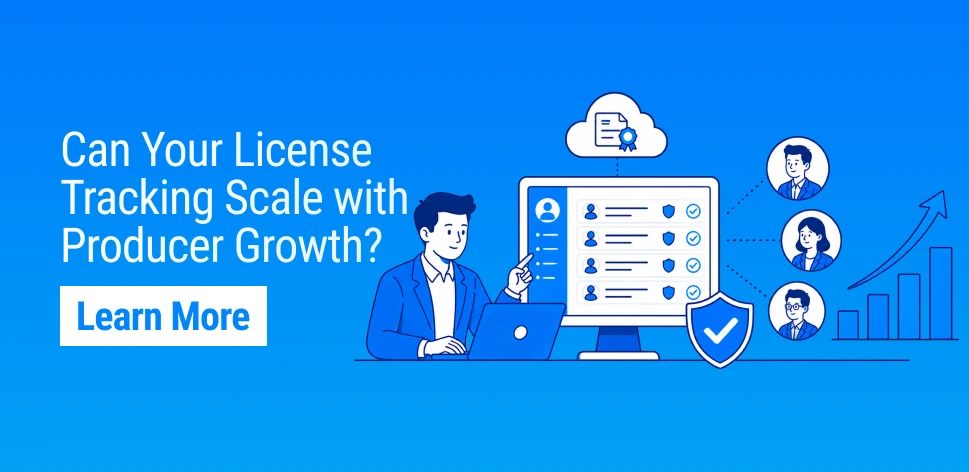
Three Key Insurance License Tracking Failure Points
Traditionally, producer onboarding teams will use a master spreadsheet to track producer details such as name, NPN, resident and non-resident licenses, and carrier appointments. Teams have to manually source information from state DOIs, NIPR, and direct communication with producers.
This strategy might work at first, but once carriers, agencies, and MGAs start to grow, licensing compliance breaks down at three key failure points in the operational infrastructure.
| Data Fragmentation | Spread across multiple spreadsheets, crucial producer data gets lost as headcount increases. |
| Validation Gaps | As numbers increase, manual licensing and appointment status checks can’t keep pace. |
| Renewal Gaps | Inefficient renewal tracking and appointment verification increase the risk of expired licenses and regulatory exposure. |
The more producer headcount grows, the more that licensing, appointment, and CE compliance fragments across multiple states and jurisdictions. When compliance isn’t properly maintained, operational disruption can impact the distribution network, limiting producer activity and delaying product availability.
Expert Insight:
“Insurers are stuck in a scaling trap. They know speed-to-market is key, but their infrastructure is holding them back. When 71% of insurers say time-to-market is their number one IT challenge, it’s a clear signal that the current approach just isn’t working” — Jim Campbell, CCO at Covernet
How Insurance License Tracking Compliance Collapses
Whether carrier, agency, and MGA growth is triggered by a hiring surge, multi-state expansion strategy, merger, or acquisition, a more in-depth understanding of how insurance license tracking compliance breaks down at each stage of growth can empower compliance teams to understand why software has such a powerful impact. Here’s deeper insight into how insurance license tracking compliance challenges limit scalability as producer headcount increases, from 5 to 500.
5 Producers: Hidden Instability
At 5-10 producers, manual licensing, appointment, and CE tracking strategies appear manageable, but only because teams are actively compensating for their limitations. At five producers, licensing teams can still double check their work, identify mistakes, and fill in missing information. Still, manual tracking only works at this stage if individuals are constantly fighting built-in weaknesses. As growth starts to accelerate, the cracks that were once contained begin to widen.
50 Producers: The Process Breaks Down
At 50-100 producers, the manual insurance license tracking process starts to break down. What was siloed data at 5 producers becomes misalignment across teams at 50 producers. What was one person’s ownership over license and appointment tracking becomes an operational bottleneck. Overall, coordination between teams begins to decline as each team deals with a different data reality. Then, if growth continues, challenges with synchronization, conflicting information, and workflow bottlenecks converge to create a continuous state of compliance risk.
500 Producers: System Failure
At 5 producers, system gaps can be manually addressed. At 50 producers, coordinating that reactive system becomes the main challenge. However, at 500 producers, manual issue resolution is no longer feasible. At this growth stage and beyond, a reliable, real-time picture of compliance is impossible, as carriers, agencies, and MGAs can’t compensate for system gaps. Instead, with little trust between systems, they’re forced to operate with limited real-time visibility into producer compliance.
What is Compliance Visibility?
In insurance, compliance visibility refers to a company’s ability to understand and maintain a complete view of producer compliance with state and federal regulations. Effective insurance compliance tracking monitors licensing, appointment, and CE status to support compliance visibility at every stage of company growth.
The Full Story of Compliance Breakdown
The full story of compliance breakdown is more than missed renewal reminders and expired licenses. It’s a carrier, agency, or MGA that can’t operate the way they want to. At every stage of growth, data fragmentation, validation, and renewal gaps undermine scalability, revealing an infrastructural strategy that just can’t keep up.
Here’s the complete picture of how each failure point fractures exponentially:
| 5 Producers ➡ | 50 Producers ➡ | 500 Producers | |
| Data Fragmentation | Multiple spreadsheets require manual reconciliation | Teams work from conflicting data sources | Dataset trust is limited |
| Licensing & Appointment Validation | Manual checks occur at one point-in-time | Workflow-based verification delays | No real-time compliance visibility |
| Licensing & Appointment Renewal Gaps | Calendar reminders and manual tracking | Pipeline backlog across producers | Continuous overlapping renewal states |
From this example, it’s clear that the number of producers a carrier, agency, or MGA is working with does not determine success on its own. Issues that feel manageable at an early stage of growth become increasingly difficult to manage as producer headcount increases, leaving companies with limited visibility into compliance and forcing teams to address operational gaps that are already embedded within existing processes.
Benefits of Insurance License Tracking for Carriers, Agencies, and MGAs
Manual tracking doesn’t fail all at once. It degrades in stages as organizations scale, ultimately preventing carriers, agencies, and MGAs from attaining effective scalability. This is where insurance license tracking software provides measurable value.
At the early-stage of growth, insurance license tracking software can take companies from manual visibility to real-time insight. As companies grow, software can help replace coordination challenges with streamlined workflow. Finally, at the enterprise level, insurance license tracking software takes companies from compliance risk to audit readiness, delivering specific benefits for carriers, agencies, and MGAs respectively.
| Business Entity | Impact of Insurance License Tracking Software |
| Carriers | Enhanced governance, appointment control, and downstream oversight |
| Agencies | Improved onboarding speed, producer mobility, and multi-state expansion |
| MGAs | Reduced authority complexity and improved carrier-specific compliance mapping |
Leveraging Insurance License Tracking for Lasting Growth
Automation, integration, and real-time intelligence in insurance license tracking can reduce reliance on spreadsheets and manual workflows, supporting scalable, long-term growth. At each stage of growth, insurance license tracking can make a positive impact on compliance, increasing efficiency, visibility, and allowing companies to add producers without increasing overhead.
With synchronized data, automated validation, and real-time renewal alerts, insurance license tracking software streamlines administration, reduces compliance risk, and improves collaboration. By preventing compliance breakdowns during expansion, producer licensing tracking solutions enable lasting carrier, agency, and MGA growth.
FAQs
Q.1 What are the common insurance license tracking compliance challenges?
Ineffective insurance license tracking strategies increase the risk of missed renewals, expired licenses, and lost or inaccurate producer data, contributing to compliance gaps, fines, and other consequences.
Q.2 Why do carriers, agencies, and MGAs need insurance license tracking software?
Insurance license tracking software can help carriers, agencies, and MGAs streamline their operations and producer management, empowering them to stay compliant at scale.
Q.3 Do manual methods work for insurance license tracking?
Manual insurance license tracking methods such as spreadsheets only work for a limited number of producers. They introduce cracks in data fragmentation and licensing and appointment validation that create compliance gaps later on.
Q.4 What are the most effective insurance license tracking software features?
The most effective insurance license tracking software features include license tracking automation, NIPR integration, real-time approval and regulatory action alerts, and continuous compliance monitoring.
Q.5 How does license tracking automation support scalability?
License tracking automation supports scalability by reducing producer activation time and compliance-related administrative work as onboarding volume increases.
Allison is a Content Writer at Agenzee, creating blogs, case studies, social media content, and other value-driven materials to support overall marketing strategies and spur brand growth. Her storytelling expertise infuses her work with a clear, captivating voice that successfully drives conversion and engagement.
Educated in anthropology at Princeton University, Allison’s unique background in software solutions, fiction writing, ethnographic research, and tutoring gives her a unique perspective on the insurance licensing world, enabling her to pursue her mission: Making Agenzee the leader of insurance modernization.
Disclaimer: This post is for informational purposes only and does not constitute legal or compliance advice. Agenzee does not warrant the accuracy of and assumes no liability for reliance. Please consult regulators or professional advisors as needed. See our full disclaimer for details.
Subscribe
Stay Ahead with Agenzee Insights
Join our community to stay up-to-date on the latest news and strategies for license and appointment management
INDUSTRY INSIGHTS FOR INSURANCE AGENCIES, CARRIERS, AND MGAS
Similar Blogs
Read our blog to discover the latest industry insights and trends in license and appointment management.

let's catch up!
Schedule a Live 1-On-1
Demo of Agenzee!
Our insurtech experts would be thrilled to give you a personalized demo of how Agenzee can transform your compliance management processes.
Customers Opinions on Our Services and Products
What Our Customers Say
Find out why our customers are happy they chose Agenzee.