

Published On: July 13, 2026
Updated On: July 15, 2026
From Classroom to Compliance: Connecting Insurance Education, Licensing, and InsurTech

Insurance education, licensing, and regulatory compliance are often treated as separate functions. Education teams develop courses. Licensing professionals process applications and renewals. Compliance teams monitor regulatory obligations. Technology supports the systems and workflows behind each area.
Inside an organization, that separation may seem practical.
Regulators, carriers, producers, and consumers, however, do not experience these responsibilities as separate functions. They experience them as one continuous lifecycle.
A producer moves from education and examination to licensing, appointments, onboarding, production, continuing education, renewal, and ongoing regulatory monitoring. Failure at any point can affect every stage that follows.
That is why insurance education should not be viewed as something that ends when a course is completed or an examination is passed. Education is the beginning of a much larger compliance process.
The real test begins when a producer must apply what was learned consistently, accurately, and under the pressures of the working environment.
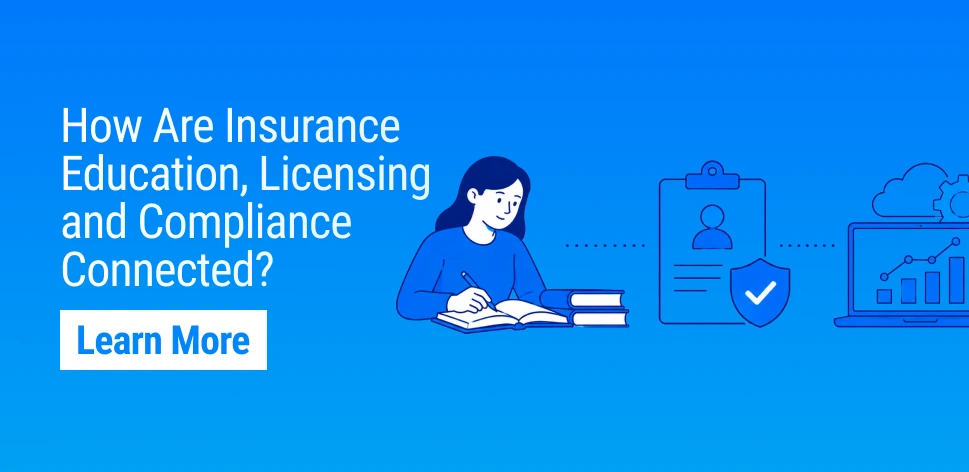
One Continuous Producer Lifecycle
The producer’s lifecycle often includes:
Education. Examination. Licensing. Appointment. Onboarding. Production. Continuing Education. Renewal. Regulatory Monitoring.
Different departments may own different stages of this process, but each stage depends on the one before it.
A producer may complete training but not understand the next licensing step. A license application may be submitted, but a manager may mistake submission for approval. A carrier certification may be completed, but the required appointment may still be pending. Continuing education may be finished, but the organization may not have a reliable way to verify completion.
These are not always training failures. Many times, they are handoff failures.
Every handoff creates an opportunity for information to be delayed, misunderstood, entered incorrectly, or lost.
From a regulatory perspective, internal handoffs do not eliminate responsibility. Saying “another department handled it,” “we thought the producer knew,” or “the information was in a spreadsheet” may explain what happened, but it does not demonstrate that an effective compliance control existed.
How Examiners View Compliance Failures
A regulatory examination is not simply about finding individual mistakes. Examiners are generally looking to determine whether an organization has appropriate systems, controls, procedures, and documentation to support compliant operations.
The questions are often straightforward:
- What was the organization required to do?
- Did the organization understand the requirement?
- Was there a process in place?
- Was the process followed consistently?
- Can the organization produce evidence?
- What happened when the process failed?
That last question is critical.
Regulators understand that errors can occur. No organization, employee, producer, or system is perfect. The larger concern is whether the organization can identify the issue, explain why it happened, correct it, and reduce the chance of it happening again.
A strong compliance environment does not claim mistakes are impossible. It demonstrates that mistakes can be identified, escalated, corrected, documented, and used to improve the process.
Policies matter, but policies alone are not enough. The real question is whether the policy is reflected in daily behavior.
What Compliance Controls Should Demonstrate
| Six Key Qualities of an Effective Licensing and Compliance Control Environment | |
| Consistency | The organization follows a defined process across departments, offices, producers, and product lines. |
| Timeliness | Applications, renewals, appointments, disclosures, updates, and terminations are handled within required timeframes. |
| Accountability | It is clear who owns each step and who is responsible for review, approval, escalation, and resolution. |
| Documentation | The organization can produce evidence showing what occurred, when it occurred, and who completed or reviewed the action. |
| Monitoring | The organization has a reliable way to identify approaching expirations, incomplete requirements, missing information, or potential compliance concerns. |
| Corrective Action |
When an issue is found, the organization corrects the individual problem and considers whether the same issue may exist elsewhere. Correcting one record solves an immediate problem. Understanding why the issue occurred helps strengthen the control. |
Why Well-Trained Producers Still Struggle
It is easy to assume compliance problems happen because someone was not properly trained. Sometimes that is true. But in many cases, producers received training and understood the general requirement. The breakdown occurred after the education ended.
Common reasons include:
- Competing pressure to begin selling quickly
- Fragmented information from education, licensing, carriers, and management
- Unclear ownership of the next step
- Different processes by state, carrier, product, or business unit
- Limited visibility into current license or appointment status
- Weak reinforcement after the initial training is completed
A producer may know that licensing and appointment requirements must be complete before conducting business. But if the producer cannot see current status, the manager assumes approval, and the licensing team tracks the information separately, the organization still has risk.
That is not simply a knowledge problem. It is a visibility, workflow, and communication problem.
The Educator as a Compliance Control
Insurance educators are often among the first people to shape how a producer thinks about compliance.
Before a producer interacts with a licensing specialist, compliance officer, auditor, or examiner, the producer may already have formed opinions about what compliance means.
- Is compliance a professional responsibility or is it paperwork that delays sales?
- Is licensing an ongoing obligation or is it something that ends after passing the examination?
- Is continuing education part of professional competence or is it something to complete at the last possible moment?
Educators influence these attitudes. That makes education one of the organization’s first compliance controls.
The educator may not submit the license application or verify the appointment, but education establishes the context in which those actions will later occur.
The classroom is where organizations can begin building habits of accuracy, verification, documentation, escalation, and professional accountability.
Exam Success Is Not the Same as Audit-Resilient Behavior
Passing an examination and operating successfully in a regulated environment require different skills.
| An exam may ask … | The Workplace asks … |
|
What is the licensing requirement?
|
How do I verify that the requirement has been completed before I act? |
|
When must an address change be reported?
|
Who must I notify, what system must be updated, and how do I document the change? |
|
What is an appointment?
|
Has my appointment been approved for this state, carrier, product, and line of authority? |
Has my appointment been approved for this state, carrier, product, and line of authority?
Training should move beyond memorizing the rules. It should help producers understand:
- What action must be taken
- What cannot happen until approval is complete
- Who owns the next step
- What evidence must exist
- When to escalate questions or concerns
This is how education supports audit-resilient behavior.
A Common Breakdown
Consider a producer who completes training, passes an examination, and submits a license application.
The licensing team knows the application is pending. The sales manager sees the application has been submitted and assumes the producer is ready. The producer completes carrier training and begins preparing to sell. However, the state license has not yet been approved, and the appointment cannot be completed until approval is received.
No one intended to create a compliance problem. The producer was trained. The licensing team followed its process. The manager believed the producer was cleared. The carrier had begun onboarding.
The failure occurred between the functions. The solution is not simply to train the producer again, but to ask:
How can the organization prevent an incomplete application from being mistaken for completed authorization?
Training for Sustained Compliance
Insurance educators can help reduce compliance risk by designing training that connects knowledge to action.
Effective training should:
- Explain why the requirement exists, not just what the rule says
- Define the behavior expected of the learner
- Explain what happens after training is completed
- Identify who owns the next step
- Teach when and how to escalate uncertainty
- Reinforce the importance of documentation
- Connect the training message to the workflow where the action occurs
Instead of saying, “Make sure you are properly licensed,” training should be more specific:
Verify your current license and appointment status before conducting regulated activity.
That instruction is clearer, more actionable, and easier to reinforce.
Where InsurTech Fits
Technology should not replace education. A dashboard cannot teach professional ethics. An alert cannot create judgment. A workflow cannot interpret every regulatory circumstance. A platform cannot replace the experience of a knowledgeable educator, licensing professional, or compliance leader.
Technology can, however, help make compliant behavior easier to repeat, monitor, and document. Modern licensing and compliance technology can help organizations centralize producer information, track licenses and appointments, identify upcoming expirations, monitor continuing education, document requests, alert users to potential issues, and reduce reliance on disconnected spreadsheets.
Technology helps operationalize what educators teach. The educator explains the requirement. The workflow puts the requirement into practice. The system helps verify and monitor whether the requirement has been completed. The compliance team reviews exceptions and determines the appropriate response. The strongest outcomes occur when these roles are connected.
Reinforcing Education Through Workflow
A platform can reinforce education in practical ways:
- If educators teach that license and appointment status must be verified before conducting business, technology can provide visibility into that status.
- If educators teach the importance of renewing licenses on time, dashboards and alerts can identify upcoming expirations.
- If educators teach continuing education responsibilities, CE tracking can help producers and organizations monitor completion.
- If educators teach that submitting an application is not the same as approval, request tracking can show whether an application is awaiting state action or has been approved.
The goal is not to replace training with software. The goal is to connect what was taught to the producer’s daily working environment.
Strong technology extends the life of the educational message.
A Connected Compliance Framework
Organizations can strengthen outcomes by applying a simple five-part framework:
Clarify. Convert. Connect. Confirm. Correct.
Clarify the Expectation: Explain the rule and the purpose behind it.
Convert Knowledge into Behavior: Define what the learner must actually do.
Connect the Behavior to the Workflow: Identify where the action occurs, who owns it, and what system supports it.
Confirm Completion with Evidence: Verify that the required action occurred and can be documented.
Correct and Reinforce: When a problem occurs, correct the issue, identify the cause, and reinforce the expected behavior.
This framework positions education as more than content delivery. It makes education part of the compliance control environment.
The Classroom Is the Beginning
Education, licensing, compliance, and technology may be managed by different teams, but the producer experiences one lifecycle. The consumer interacts with one insurance professional. The regulator evaluates one organization.
The challenge is to make these separate functions operate as a connected system.
Education establishes the standard. Licensing establishes authority. Compliance monitors responsibility. Technology supports consistency, documentation, and visibility.
When these functions work together, organizations do more than reduce the likelihood of a regulatory finding. They strengthen professionalism, improve the producer experience, create clearer accountability, and reinforce consumer protection.
Insurance education does not end with a certificate, it continues through the workflow.
Kevin Milner, CIC, CRM, CFE, is an accomplished insurance professional with more than 20 years of experience in insurance operations, education leadership, regulatory compliance, and risk management. A respected speaker, writer, and compliance‑focused subject‑matter expert, he has authored numerous insurance pre‑licensing and continuing education publications used throughout the industry.
Kevin’s background includes leading national instructor‑led and web‑based education programs, guiding curriculum development, and advancing compliance initiatives aligned with evolving regulatory standards. As a Certified Fraud Examiner (CFE), he brings a deep understanding of regulatory oversight, ethical business practices, and risk mitigation to his work.
In his role as Insurance Licensing Coordinator, Kevin helps agencies, FMOs, and carriers leverage Agenzee’s unified, automated platform to simplify licensing, streamline appointments, and maintain seamless compliance across all 50 states.
Disclaimer: This post is for informational purposes only and does not constitute legal or compliance advice. Agenzee does not warrant the accuracy of and assumes no liability for reliance. Please consult regulators or professional advisors as needed. See our full disclaimer for details.
Subscribe
Stay Ahead with Agenzee Insights
Join our community to stay up-to-date on the latest news and strategies for license and appointment management
INDUSTRY INSIGHTS FOR INSURANCE AGENCIES, CARRIERS, AND MGAS
Similar Blogs
Read our blog to discover the latest industry insights and trends in license and appointment management.

let's catch up!
Schedule a Live 1-On-1
Demo of Agenzee!
Our insurtech experts would be thrilled to give you a personalized demo of how Agenzee can transform your compliance management processes.
Customers Opinions on Our Services and Products
What Our Customers Say
Find out why our customers are happy they chose Agenzee.