

Published On: May 8, 2026
Updated On: May 14, 2026
How Agencies Get Appointed with Insurance Carriers (2026 Guide): Steps, Compliance, Common Pitfalls & Approval Strategies

Successful insurance agencies know that securing carrier appointments for their producers is essential for maintaining regulatory compliance, supporting smooth operations, and driving revenue. Partnering with the right carrier for your agency needs is crucial for financial stability, positive reputation, effective selling, and a productive carrier-agency relationship.
For beginner agencies, however, knowing exactly how to get appointed with insurance carriers can be difficult, especially with rapidly changing regulatory requirements. Additionally, complications managing appointment compliance across agents, brokers, and producers, each with role-based differences and multi-state requirements, can lead to delays, rejected appointments, filing confusion, and visibility gaps.
When agencies follow proven steps to getting appointed, they experience faster onboarding, fewer compliance issues, and greater producer success. The insurance carrier appointment process may be complex, but it doesn’t have to be. With expert guidance and an automated appointment compliance management platform, your agency can easily navigate appointment approvals, terminations, and compliance.
What Is an Insurance Carrier Appointment?
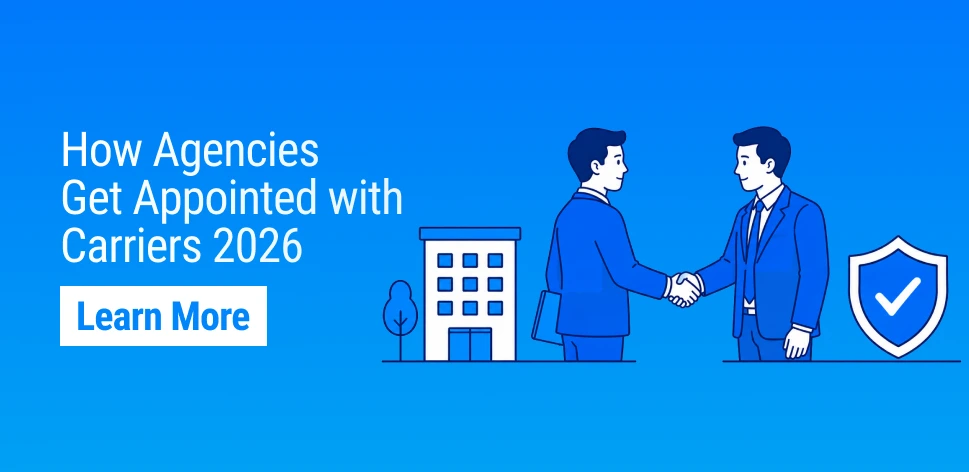
An insurance carrier appointment is a formal agreement between a carrier and producer that legally authorizes an agent, broker, or agency to sell the carrier’s insurance products. The appointment process can be initiated by an individual producer, or by an agency on the producer’s behalf.
How Appointments Work
First, the agency or agent reaches out to the carrier, requesting an appointment. Once the insurance carrier approves the request, the carrier submits the appointment to their state Department of Insurance (DOI) to notify them of the relationship. Producers need to meet licensing, background, and state regulation requirements to ensure appointment eligibility, and in some cases, carriers and insurance products have specific training requirements. Finally, there are additional regulations for appointment renewals and terminations, which must also be submitted to the state.
Regulatory Context
While specific carrier appointment requirements for agencies vary by producer role and state, a producer acting as an agent of an insurer is generally required to be appointed, based on state regulations aligned with NAIC guidance. However, agencies themselves may not always be required to be appointed.
“Appointments may not be required for insurance agencies. (Each state will determine whether appointments will be required)” – “Uniform Appointment Process” (National Association of Insurance Commissioners, State Licensing Handbook, Appendix X)
Nevertheless, agencies with producers acting on behalf of insurers should familiarize themselves with appointment regulations. The National Association of Insurance Commissioners (NAIC) sets certain appointment regulations in Chapter 11 of the State Licensing Handbook. A strong foundational understanding of these regulations can make an agency’s journey to carrier appointment a smooth one. NAIC guidance outlines the following expectations for states and insurance carriers:
| States Must | Insurers Must |
|
*(Check with your DOI to confirm the exact timeline for your state). |
“It is the insurer’s responsibility to verify that the producer is licensed and qualified to sell all products the producer sells for that insurer” – “Uniform Appointment Process” (National Association of Insurance Commissioners, State Licensing Handbook, Appendix X)
How Appointments Differ from Licensing
Because licensing and appointment compliance are both key concerns for agencies, carriers, and regulatory bodies, and fundamental requirements for producers, it’s understandable that the differences between appointments and licenses can become confused.
Knowing the difference is important for producer appointment compliance. An insurance license allows a producer to sell, solicit, or negotiate insurance products in a particular state. It reflects the state approval to conduct business, not insurer approval. A carrier appointment, on the other hand, is the insurer’s permission for a producer to work with their specific product. A producer needs a valid license to be appointed.
Appointment Requirements Agencies Must Know
The Massachusetts Insurance Journal reports that the NAIC will deepen its focus on data aggregation, analytics provision, and early warning monitoring in 2026, increasing proactive regulatory oversight, risk identification, peer review, and policy insight. Agencies need to prepare to meet updated appointment requirements to ensure their producers are allowed to sell.
Required Documentation
To gain a carrier appointment, agencies must prove legal eligibility to sell for each producer requesting an appointment. Selling requirements include an active resident or non-resident license, a verified Line of Authority (LOA), and an established National Producer Number (NPN). Agencies should provide required documents for each producer seeking appointment. Standardizing this process across carriers can help facilitate quicker appointment approvals.
Appointment Fees & Schedules
Appointment Fees
When requesting an initial appointment, agencies may be required to pay fees to the carrier per producer and per appointment. These charges can add up, especially when managing appointments for multiple producers across multiple states.
- Carrier Fees: Carriers may assess appointment-related fees per producer per state, sometimes including administrative charges. In certain cases, carriers may absorb these costs for agencies with higher production volumes or established relationships.
- State Fees: States typically require a per-appointment filing fee, which varies by jurisdiction. While these fees are often paid by the carrier at the time of filing, they are frequently passed back to the agency.
- Other Costs: Additional expenses may include onboarding fees, Errors & Omissions (E&O) insurance, background checks, and other compliance-related requirements depending on the carrier and state.
Appointment Scheduling
There are specific time frames for insurance carrier appointments, particularly for filing requirements. The NAIC generally requires insurers to file appointments within 15 days from the date the agency contract is executed or the first insurance application is submitted, with some variations depending on state law. Deadlines to request a first appointment depend on the state and situation, and can take place before transacting business or within a certain number of days after the first sale.
Additional time frames determine appointment approvals and renewals.
- Just-in-Time (JIT) Appointments: Some states allow the appointment process to begin once business is written.
- Carrier Approval: Internal carrier approval can take anywhere between 2-10 business days, depending on whether processing is automated.
- State Approval: Because appointments are usually filed electronically to the state via the National Insurance Producer Registry (NIPR), processing can range from instant to a few days.
- Appointment Renewals: Renewal timelines range by state, with states specifying exact time frames each year.
Stricter Renewal Timelines
In the past year, many states have been tightening their appointment renewal timelines, implementing stricter deadlines, mandatory electronic processing, and additional requirements for carriers and appointing entities. Updated appointment renewal guides for each state can be found on NIPR.
The following table highlights states with appointment renewal timelines published through NIPR. These states participate in NIPR-supported appointment renewal processing and/or have defined renewal timelines for carrier appointments.
State Renewal Timelines (per NIPR)
| State | Renewal Timeline |
| Alabama | Jan 6 – Feb 28, 2026 |
| Arkansas | May 29 – Jul 1, 2026 |
| Connecticut | May 1 – May 31, 2026 |
| District of Columbia | Mar 4 – May 31, 2026 |
| Guam | Apr 1 – Jun 30, 2026 |
| Illinois | Nov 5, 2026 – Jan 2, 2027 |
| Iowa | Jan 5 – Mar 15, 2026 |
| Kentucky | Jan 7 – Mar 31, 2026 |
| Louisiana (Business) | Jul 1 – Aug 3, 2026 |
| Louisiana (Individual) | Dec 1, 2026 – Jan 5, 2027 |
| Maryland | Jun 3 – Aug 31, 2026 |
| Massachusetts | Jul 19 – Aug 31, 2026 |
| Nebraska | May 1 – Jul 31, 2026 |
| New Jersey | Apr 1 – Jun 3, 2026 |
| New Mexico | Jan 5 – Apr 30, 2026 |
| North Carolina | Feb 3 – Mar 31, 2026 |
| North Dakota | Mar 2 – Apr 30, 2026 |
| Oklahoma | Nov 25 – Dec 31, 2026 |
| Rhode Island | Jan 1 – Jan 31, 2026 |
| South Carolina | Sep 1 – Oct 1, 2026 |
| South Dakota | Apr 6 – Apr 30, 2026 |
| Vermont | Jun 3 – Jun 30, 2026 |
| West Virginia | Jun 6 – Aug 31, 2026 |
| Wisconsin | Jan 6 – Mar 15, 2027 |
Note: This classification is based on publicly available NIPR appointment renewal data and state regulatory frameworks. The categories used (Fixed Renewal Window, State-Managed Renewal Window, and Continuous / License-Based / No Formal Renewal Window) are intended to illustrate common structural differences in renewal approaches and should not be interpreted as official regulatory classifications. Renewal timelines are subject to change and may vary based on carrier, appointment type, or regulatory updates.
However, while some states follow fixed renewals, often supported through NIPR processing, others rely on license-based cycles, state-administered processing, or continuous appointment models with no renewal requirement. States may also move between categories depending on appointment type. Further information for each state can be found on state DOIs.
Fixed Renewal Window
|
Defined, state-wide renewal periods Examples (Commonly classified): ● Alabama ● New Jersey ● Wisconsin |
State-Managed Renewal Window
|
Renewal timelines are defined at the state level but may not follow a uniform NIPR-standardized renewal cycle. Examples: ● Connecticut ● New Mexico ● North Dakota |
Continuous / License-Based / No Formal Renewal Window
|
Appointments do not follow a formal renewal filing cycle and/or are tied to licensing status. Examples: ● Delaware ● California ● Texas ● Florida |
Agencies must provide complete documentation and ensure any applicable fees are addressed in a timely manner to support the appointment process. However, only insurance carriers are authorized to submit, renew, or terminate appointments with the state in accordance with regulatory requirements. Renewal timelines vary by state, and some states do not require renewals at all, adding complexity to multi-state appointment management.
Under Review: Uniform Appointment Process
Created by the Producer Licensing (EX) Working Group in 2002, the Uniform Appointment Process establishes general guidelines for appointment requests, renewals, and terminations. This year, the NAIC’s Producer Licensing Uniformity Working Group is expected to revise this portion of the State Licensing Handbook, potentially leading to more standardized appointment regulations across states. Agencies should look for upcoming revisions that could affect multi-state appointment management.
How to Get Appointed with Insurance Carriers
Once you have a full understanding of how carrier appointments work and what regulations shape them, you’re ready to begin the appointment process for your agency. Although applying for a carrier appointment involves a complex assortment of documentation, using the right organizational strategies can help streamline the journey. The best practices include but are not limited to the following.
Preparing Your Application
1. Choose the Right Carrier
Before beginning the appointment process, agencies should carefully select the carriers they want to work with. It’s important to consider trustworthy carriers that have proven reputations and financial stability, offer products your agency wants to sell, align with agency goals, and provide incentivizing resources for agents. Fully researching carrier performance and expectations before requesting an appointment can help prepare your agency for success.
2. Meet Carrier Prerequisites
Most carriers have thorough prerequisites that agencies must meet to secure an appointment. These requirements vary by carrier and determine whether the agency qualifies for appointments. Basic expectations include:
- Valid licensing
- E&O insurance
- Proven experience
- Established client base
Carriers closely evaluate agency selling history, alignment with carrier values, and some set minimum production requirements for approval.
3. Prepare Agency Credentials
Agencies will need to provide the requested documentation for each agent seeking appointments. Additionally, agencies will need to submit documents on their own behalf, verifying passed background checks, business financials, and a business plan highlighting the agency’s accomplishments. Preparing documents prior to the appointment process can help reduce setbacks.
Required Documents Checklist
Producer Identification & Licensing Documents
These are required to validate eligibility for appointment.
- Resident/Non-Resident License
- National Producer Number (NPN)
Agency/Producer Contract
These are used to establish the legal relationship between carrier and producer or agency.
- Producer/agency agreement
- Commission and tax documents
Errors & Omissions (E&O) Insurance:
These demonstrate professional liability coverage required for appointment eligibility.
- Certificate of E&O insurance
- Minimum coverage amount
Background/Disclosure Forms
These are compliance documents verifying suitability and regulatory transparency.
- Background check authorization
- Disclosure questionnaire
Appointment Filing Data
These are administrative data required to process and submit the appointment.
- Producer and agency details
- State and LOA
Applying for an Appointment
Thorough carrier research and document preparation helps streamline the appointment application process, which typically follows these steps:
1. Initiate the Appointment Process
Agencies request contracts directly with their selected carrier, typically through carrier-specific onboarding or contracting portals. These submissions provide the information carriers need to evaluate producer eligibility and determine whether to approve the appointment request.
What is a Carrier Portal?
Carrier portals are internal systems used by each carrier to collect and manage appointment requests. Agencies submit producer and agency information through these portals or via email, allowing carriers to review qualifications, validate licensing, and assess alignment with their requirements. Approval within the carrier portal is a prerequisite to moving forward with state filing.
What is NIPR?
The National Insurance Producer Registry (NIPR) is the centralized platform used to submit appointment and termination transactions to state Departments of Insurance. Once an appointment is approved, the insurance carrier is solely responsible for submitting the appointment to the state through NIPR, using the producer’s National Producer Number (NPN).
2. Verify Data Accuracy
To file an appointment, carriers require data about producer details such as name and NPN, agency affiliation, and which states require appointments. The carrier may also perform a background check on each producer using identifying information such as social security number or date of birth.
3. Submit Appointment
After validating the required information, the carrier will review and, if approved, submit the appointment to the state. Agencies should monitor for confirmation of the filing and may also verify the appointment status through the state Department of Insurance (DOI) to ensure it has been processed and approved.
By selecting the best submission method, ensuring data accuracy, and confirming submission, agencies can streamline approval and avoid delays. Once approved, the process concludes with appointment submission to the state, which enables the producer to legally transact business with the carrier.
Tracking Appointment Approvals
After submitting your appointment request, approval status can be monitored on two separate levels. First, carrier approval status can be tracked through carrier portals, contracting platforms, or internal onboarding teams. Second, state approval status can be tracked through NIPR, state DOI websites, or appointment and compliance monitoring platforms.
While waiting for approval, agencies can prepare to handle any rejections or corrections that might be requested.
Managing Appointments at Scale: Manual vs. Automated Approaches
At this point, it’s clear that in-depth regulatory understanding, flourishing carrier-agency relationships, accurate documentation, and an organized submission workflow are all fundamental to getting appointed with insurance carriers. However, successful carrier appointments also require seamless coordination across carriers, states, and regulatory timelines, which can be difficult to manage.
From tracking approval statuses in multiple systems to meeting strict filing deadlines and renewal requirements, agencies have to determine how to manage a high volume of moving parts simultaneously. Choosing between manual and automated methods can mean all the difference between appointment confusion or delayed approvals and a streamlined, compliant onboarding process.
The differences become clear when comparing how each approach handles core appointment workflows:
| Appointment Factor | Manual Approach | Automated Approach |
| Tracking Visibility | Limited | Real-Time |
| Renewal Alerts | Reactive | Proactive |
| Multi-State Complexity | High | Low |
| Compliance Risk | High | Reduced |
| Audit Readiness | Weak | Strong |
Because appointment regulations can differ depending on state, producer role, and resident filing status, as agencies expand across states and carriers, the gap between manual and automated management can become more pronounced.
Manual methods to appointment management can break down under increased volume, keeping agencies in the dark about missing requirements. Data errors and inaccurate documentation can lead to incomplete applications, missed filing deadlines, and limited visibility into approval status.
Automated systems, on the other hand, centralize appointment data and tracking, facilitating easier appointment management across states no matter the number of producers. This allows agencies to maintain compliance while scaling producer onboarding efficiently.
5 Best Practices for Appointment Compliance & Audit Readiness
To manage carrier appointments at scale across states and producer roles, agencies should seek to standardize workflow, track appointment requirement details, and maintain compliance. Proven strategies can help protect agencies from regulatory exposure caused by missed multi-state requirements and filing deadlines.
Here are our top five tips to achieve appointment compliance and audit readiness:
- Build a Carrier Appointment Playbook: Define onboarding requirements, submission workflows, state-specific filing rules, and procedures for handling potential delays or rejections.
- Create a Standardized Checklist: Ensure consistent collection of licensing, E&O, disclosure, and contracting data across carrier appointment submissions.
- Automate Notifications and Status Tracking: Gain visibility into appointment delays, potential compliance gaps, and upcoming deadlines.
- Implement Continuous Compliance Monitoring: Monthly appointment audits can help agencies verify that all producers are appropriately licensed and appointed in each necessary state.
- Integrate with Licensing Databases: Synchronize license status, lines of authority, and eligibility to prevent compliance violations.
Leveraging centralized visibility into appointment status and automated alerts tied to business activity is one of the most effective ways to reduce regulatory exposure, maintain audit readiness, and keep your appointments compliant.
FAQs
Q.1 How long does carrier appointment approval take?
Carrier appointment approval timelines vary depending on the state, carrier, and submission format. Internal carrier approval can take up to 10 business days or more, depending on whether the process is manual or automated. Once the carrier submits the appointment to the state via NIPR, however, approval could be as quick as the same day.
Q.2 Do appointments have to be filed in every state?
Appointment filing requirements depend on state laws and whether the producer is acting as an agent or broker. Agents or representatives of insurers are generally required to be appointed, but appointments are not always required for brokers.
Q.3 Can agencies submit carrier appointments before licensing issues are approved?
Agencies may submit appointment requests before licensing is finalized, but approvals will not be completed until licensing requirements are met. Licensing issues must be resolved for appointments to be approved by carriers, and producers must hold an active license within the appropriate Line of Authority (LOA) for a carrier to approve an appointment and submit it to the state.
Q.4 Do carriers reject appointments for minor data errors? Why do carriers delay appointment approval?
Absolutely. Mismatched producer details, incomplete documentation, or missing E&O coverage could all cause delays or rejections. Appointment tracking automation can help support accurate, standardized data submission to avoid delays.
Q.5 What happens if an appointment is late?
Late appointment filings can violate regulations, leading to audit risk exposure, fines, and enforcement actions. Many states require appointments to be filed within 15 days of contract execution or first application.
Q.6 Are there appointment renewal requirements?
Yes. Appointment renewals are required, and timelines vary by state. It’s important for agencies to actively track renewal cycles, as they are becoming stricter.
Q.7 Do states require separate appointment filings?
Yes. Appointments are state-specific and must be submitted for each state where a producer is acting on the insurance carrier’s behalf. While the carrier is responsible for submitting and renewing these appointments with the state, agencies should actively monitor appointment status to ensure they remain in force. If an appointment lapses, the producer may be unable to write business until it is reinstated.
Q.8 How does automation reduce appointment delays?
Automation leverages NIPR-sourced data to provide centralized visibility, track status updates, and proactively alert teams to gaps or deadlines that could delay appointments.
Q.9 Are appointment fees refundable?
No, appointment fees are not refundable for the carrier or the agency.
Q.10 Should appointment submission be centralized?
Definitely. Decentralized or manual submission processes increase the risk of duplicated records and filing mistakes.
Q.11 How far in advance should appointments be filed?
It varies from state to state. Some states require appointments before transacting business, while others allow filing within a set time frame after the first sale.
How Agencies Simplify Carrier Appointments at Scale
Automated insurance licensing and appointment compliance management platforms do more than streamline workflows. They are a crucial component of leveraging appointment compliance to generate revenue. By combining centralized data, coordinated workflows, and proactive compliance monitoring, agencies can manage high volumes of appointments across carriers and states without increasing regulatory risk.
Centralizing appointment data, standardizing workflow across carriers and states, and actively monitoring compliance creates a proactive, system-driven approach that helps agencies reduce delays, increase approval rates, and stay audit-ready. Furthermore, maintaining a central location for licensing, LOA, NPN, and appointment status data can eliminate inconsistencies, empowering agencies to scale producer onboarding without increasing administrative burden.
About Agenzee:
Agenzee is an insurance license and carrier appointment management platform that helps agencies, carriers, and MGAs automate carrier appointment workflows, achieve compliance readiness, and onboard producers faster. By providing a centralized compliance and workflow system that syncs directly with NIPR, Agenzee automates appointment visibility, status updates, and related tasks across carriers and states to improve carrier appointment management.
Summary
Ultimately, while appointments are essential for compliance and revenue, they can be complex to manage as agencies scale across states and producers. Successful appointment management requires agencies to understand multi-state requirements, maintain accurate licensing and documentation, and actively monitor appointment status. While carriers are responsible for submitting appointments and renewals to the state, agencies must ensure those filings are completed and remain active to avoid disruptions. Since not all producers require appointments, agencies must also navigate evolving regulatory distinctions.
An automated approach can empower agencies to organize documents, prevent delays, and maintain compliance, transforming appointment management from an operational challenge to a structured, scalable process that primes your business for success.
Allison is a Content Writer at Agenzee, creating blogs, case studies, social media content, and other value-driven materials to support overall marketing strategies and spur brand growth. Her storytelling expertise infuses her work with a clear, captivating voice that successfully drives conversion and engagement.
Educated in anthropology at Princeton University, Allison’s unique background in software solutions, fiction writing, ethnographic research, and tutoring gives her a unique perspective on the insurance licensing world, enabling her to pursue her mission: Making Agenzee the leader of insurance modernization.
Disclaimer: This post is for informational purposes only and does not constitute legal or compliance advice. Agenzee does not warrant the accuracy of and assumes no liability for reliance. Please consult regulators or professional advisors as needed. See our full disclaimer for details.
Subscribe
Stay Ahead with Agenzee Insights
Join our community to stay up-to-date on the latest news and strategies for license and appointment management
INDUSTRY INSIGHTS FOR INSURANCE AGENCIES, CARRIERS, AND MGAS
Similar Blogs
Read our blog to discover the latest industry insights and trends in license and appointment management.


let's catch up!
Schedule a Live 1-On-1
Demo of Agenzee!
Our insurtech experts would be thrilled to give you a personalized demo of how Agenzee can transform your compliance management processes.
Customers Opinions on Our Services and Products
What Our Customers Say
Find out why our customers are happy they chose Agenzee.