

Published On: May 13, 2026
Updated On: May 28, 2026
Vermont Appointment Renewals Are Coming: What Organizations Need to Do Now

The Vermont Department of Financial Regulation has outlined key requirements and deadlines for the 2026 company appointment renewal cycle. With mandatory electronic processing through NIPR and a firm cutoff for terminations, organizations must ensure their appointment data is accurate before invoicing begins. Renewal fees, line-of-authority groupings, and payment limitations add additional complexity. This update highlights what you need to know, and why early preparation, reconciliation, and visibility into your appointment data are critical to avoiding unnecessary costs and maintaining compliance.
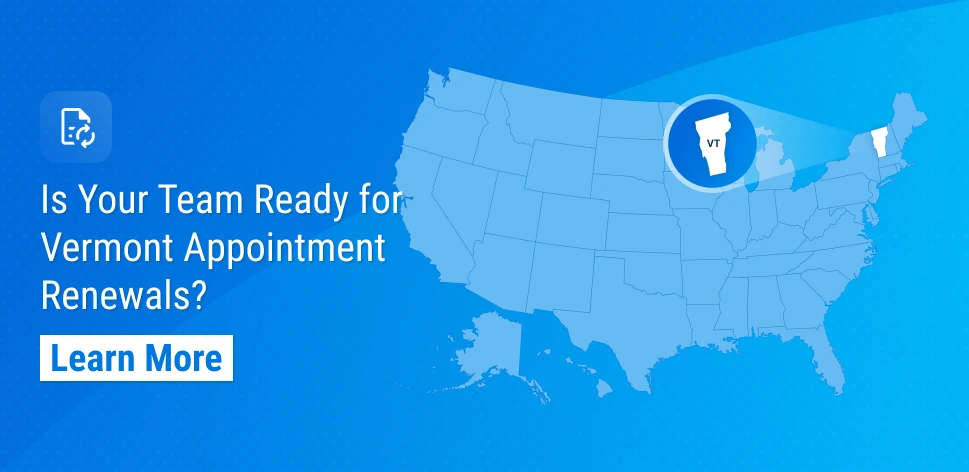
Why Vermont’s Renewal Cycle Demands Early Action
Appointment renewals are not just a billing process; they are a reflection of your data accuracy.
In Vermont, all active appointments tied to valid licenses as of June 1, 2026, will be invoiced. Any appointment that remains active, even if no longer needed, will be included in the renewal cycle.
What makes Vermont different is the rigidity of the process:
- Terminations must be completed by May 31, 2026
- After June 1, no terminations are allowed for the current cycle
- All renewals must be processed electronically through NIPR
This means once the window closes, your opportunity to correct data is gone.
Organizations that rely on last-minute reviews risk carrying forward unnecessary appointments and absorbing avoidable costs.
Key Dates That Define Your Window of Control
The Vermont renewal cycle is tightly structured:
- May 31, 2026: Final day to submit terminations
- June 1, 2026: Appointment data is effectively locked
- June 3 – June 30, 2026: Invoice window available through NIPR
Appointments submitted after May 31 will not be included in the 2026 renewal cycle and will instead roll into 2027.
This creates a clear dividing line between what you can control, and what becomes a fixed cost.
The organizations that prepare early retain control. Those that delay shift into reactive mode.
Understanding Fees and Line of Authority Complexity
Unlike flat-fee states, Vermont introduces additional complexity through line-of-authority (LOA) groupings.
Examples include:
- Property and Casualty combined into a single fee
- Life and Accident & Health grouped together
- Certain lines charged individually per LOA
- Specialty lines (e.g., travel, credit, portable electronics) priced separately
Most fees are $80 per grouping or per LOA, with some specialty lines reaching $90 per LOA.
Additional nuances include:
- Fees apply to non-Vermont domiciled carriers
- Multiple fees may apply if both major and limited lines are held
- Fees are non-refundable, regardless of errors
Without a clear understanding of how these groupings apply, organizations may underestimate total renewal costs or overlook duplicate charges.
Payment Processing Can Impact Execution
Payment is not just a final step, it can become a bottleneck if not planned correctly.
Key considerations include:
- Mandatory processing through National Insurance Producer Registry
- 1% processing fee (minimum $5, maximum $1,000)
- Credit card limit of $60,000 per transaction
- Electronic check requirements and authorization thresholds
For organizations with large appointment volumes, these limits may require multiple transactions or alternative payment methods.
Delays or errors in payment processing can impact renewal completion and create additional administrative burden.
Reconciliation Is the Most Critical Step
The most important, and most overlooked, step happens before invoices are generated.
Carriers have the ability to:
- Review appointment data
- Validate active vs. inactive relationships
- Process terminations before the cutoff
- Resolve discrepancies directly with the state
Without reconciliation, organizations are relying on assumptions instead of verified data.
And once invoices are generated, those assumptions become financial commitments.
Summary
Vermont’s 2026 appointment renewal cycle is a clear example of how timing and accuracy drive compliance outcomes.
With a firm termination deadline, mandatory electronic processing, and non-refundable fees, there is little room for error.
Organizations that take a proactive approach, reviewing data early, reconciling records, and understanding fee structures, can reduce costs and maintain clean, accurate appointment records.
Those that delay risk paying for outdated data and carrying unnecessary compliance exposure into the next cycle.
Because in a structured renewal environment like Vermont, control is determined before the invoice is ever created.
Laura Crowell is a seasoned insurance professional with over 25 years of experience specializing in agency contracting, licensing, and appointment management. As Insurance Licensing Administrator at Agenzee, Laura brings her hands-on industry experience to the development of technology that helps insurance organizations and professionals manage licensing, contracting, appointments, compliance, and related operational processes more efficiently.
With a background in education, a P&C license, and a CPSR designation, Laura understands the importance of clear communication, effective training, and organized, reliable information. She works closely with customers and internal teams to identify opportunities to improve processes, strengthen the user experience, and make insurance technology more practical for the people who use it every day.
Laura is passionate about helping simplify the administrative complexity of insurance operations and supporting technology that brings information, processes, and people together. Her goal is to help insurance professionals spend less time managing administrative processes and more time focused on the work that matters.
Disclaimer: This post is for informational purposes only and does not constitute legal or compliance advice. Agenzee does not warrant the accuracy of and assumes no liability for reliance. Please consult regulators or professional advisors as needed. See our full disclaimer for details.
Subscribe
Stay Ahead with Agenzee Insights
Join our community to stay up-to-date on the latest news and strategies for license and appointment management
INDUSTRY INSIGHTS FOR INSURANCE AGENCIES, CARRIERS, AND MGAS
Similar Blogs
Read our blog to discover the latest industry insights and trends in license and appointment management.



let's catch up!
Schedule a Live 1-On-1
Demo of Agenzee!
Our insurtech experts would be thrilled to give you a personalized demo of how Agenzee can transform your compliance management processes.
Customers Opinions on Our Services and Products
What Our Customers Say
Find out why our customers are happy they chose Agenzee.