

Published On: July 9, 2026
Updated On: July 15, 2026
Affiliations vs. DLRPs: Understanding Two Critical Licensing Requirements

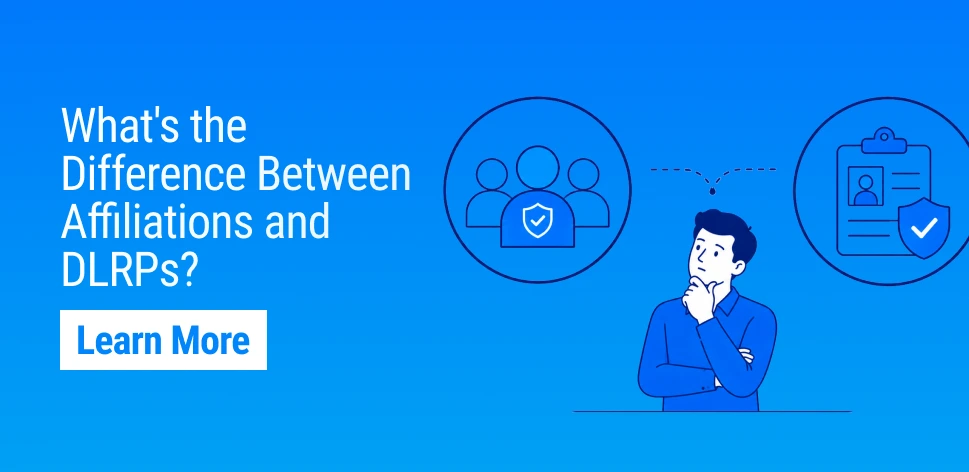
Business entity licensing involves much more than obtaining a license and appointing producers. Many states require organizations to maintain affiliations between producers and agencies, while others require a Designated Responsible Licensed Producer (DLRP) to support the business entity license. Although the terms are often used interchangeably, they serve very different purposes. Understanding the distinction can help agencies maintain accurate records, support licensing transactions, and avoid unnecessary delays when applying for new licenses, renewals, and regulatory updates.
Why This Topic Creates So Much Confusion
If you’ve spent any amount of time managing insurance licenses, you’ve probably encountered the terms “affiliation” and “DLRP.”
You’ve also probably heard them used interchangeably.
In reality, they are two completely different concepts that happen to involve a relationship between an individual producer and a business entity.
The confusion often occurs because both requirements may be requested during the licensing process. A state may require a business entity to identify a DLRP while also requiring certain producers to maintain affiliations with the agency. Because both pieces of information are frequently collected together, many organizations assume they serve the same purpose.
They do not.
Understanding the distinction becomes increasingly important as agencies expand into additional states, onboard new producers, acquire other agencies, or begin managing larger licensing populations.
The more states you operate in, the more important it becomes to understand what each state is actually requesting and why.
What Is an Insurance Affiliation?
In insurance licensing, an affiliation refers to the formal relationship between an insurance producer and a business entity that the producer is authorized to represent.
Affiliations help establish the connection between the individual and the organization.
Depending on the state and license type, affiliation information may be required when applying for a new license, renewing an existing license, or updating licensing records.
For example, business entity affiliations are required in states such as Washington and Massachusetts. Other states require affiliations for specific individual license types and transactions.
Examples include:
New Applications
- Arizona (Navigator)
- Nebraska (Producer – Pre-Need)
- Iowa (Sales Agent)
- Puerto Rico (Authorized Person)
Non-Resident New Applications
- Nebraska (Producer – Pre-Need)
- Iowa (Sales Agent)
- Puerto Rico (Authorized Person)
Renewals
- Arizona (Navigator)
- Puerto Rico (Authorized Person)
Certain states also impose unique restrictions. For example, Puerto Rico Authorized Person licenses and Nebraska Producer–Pre-Need licenses permit only one affiliation per license.
These requirements are established by state regulators and vary significantly across jurisdictions.
This is why agencies cannot assume that affiliation requirements are the same from state to state.
What Is a DLRP?
DLRP stands for Designated Responsible Licensed Producer.
A DLRP is the licensed individual designated as legally responsible for an insurance agency’s compliance with state insurance laws and regulations.
Many states require business entities to identify at least one DLRP as part of the licensing process.
The DLRP serves as the agency’s responsible licensed individual and is often required to hold the appropriate license type and line of authority for the business entity.
While the exact requirements vary by state, the purpose remains largely consistent:
The DLRP provides regulatory accountability for the agency.
Think of it this way:
An affiliation establishes a relationship.
A DLRP establishes responsibility.
While the same individual may serve as both an affiliated producer and the DLRP, the two designations serve entirely different regulatory functions.
Why Agencies Often Run Into Problems
One of the most common licensing mistakes occurs when organizations assume that identifying a DLRP satisfies affiliation requirements.
Another common mistake is assuming that because a producer is affiliated with an agency, they automatically qualify as the DLRP.
Neither assumption is correct.
A business entity may have:
- One DLRP and hundreds of affiliated producers
- Multiple affiliated producers with no DLRP requirement in a particular state
- Different DLRPs for different business entities
- State-specific affiliation requirements that must be maintained separately
When records are incomplete or inaccurate, agencies may experience:
- Delayed license approvals
- Additional state correspondence
- Application deficiencies
- Renewal delays
- Regulatory questions
These situations create unnecessary administrative work and can slow down business operations.
Why Accurate Recordkeeping Matters
As organizations grow, affiliation and DLRP management becomes increasingly important.
Changes such as:
- Agency acquisitions
- Ownership changes
- Producer onboarding
- Producer terminations
- Officer changes
- DLRP resignations
- Expansion into new states
may all require updates to one or more licensing records.
Without a centralized process for managing affiliations and DLRPs, organizations can quickly lose visibility into who is connected to which entity and what regulatory requirements apply.
The result is often reactive licensing management instead of proactive licensing management.
The agencies that experience the fewest licensing issues are typically those that maintain accurate records and regularly review their affiliations and DLRP assignments.
Affiliations vs. DLRPs at a Glance
| Affiliation | DLRP |
|
Establishes the relationship between a producer and a business entity |
Identifies the individual responsible for agency licensing oversight |
| May be required for specific license types or states | Commonly required for business entity licensing |
|
Supports licensing transactions and regulatory reporting |
Supports regulatory accountability |
| Multiple affiliated producers may exist within one agency | Typically, one or more designated individuals |
| Requirements vary by state and transaction type | Requirements vary by state business entity laws |
Frequently Asked Questions
Q.1 If someone is listed as the DLRP, does that automatically satisfy affiliation requirements?
Not necessarily. While the DLRP is often affiliated with the business entity, states may require separate affiliation information depending on the license type and transaction being processed.
Q.2 Can an agency have multiple affiliated producers but only one DLRP?
Yes. Most agencies have multiple affiliated producers. Depending on state requirements, only one DLRP may be required to support the business entity license.
Q.3 Summary
Affiliations and DLRPs are both important components of insurance licensing, but they serve very different purposes.
Affiliations establish the relationship between a producer and a business entity. DLRPs establish regulatory responsibility for the agency itself.
Understanding the distinction helps agencies maintain accurate records, support licensing transactions, and avoid unnecessary delays when applying for licenses, renewing licenses, or expanding into new states.
As licensing requirements continue to evolve, organizations that understand these relationships and manage them proactively will be better positioned to support growth, maintain visibility, and navigate the complexities of multi-state licensing with confidence.
Laura Crowell is a seasoned insurance professional with over 25 years of experience specializing in agency contracting, licensing, and appointment management. As Insurance Licensing Administrator at Agenzee, Laura brings her hands-on industry experience to the development of technology that helps insurance organizations and professionals manage licensing, contracting, appointments, compliance, and related operational processes more efficiently.
With a background in education, a P&C license, and a CPSR designation, Laura understands the importance of clear communication, effective training, and organized, reliable information. She works closely with customers and internal teams to identify opportunities to improve processes, strengthen the user experience, and make insurance technology more practical for the people who use it every day.
Laura is passionate about helping simplify the administrative complexity of insurance operations and supporting technology that brings information, processes, and people together. Her goal is to help insurance professionals spend less time managing administrative processes and more time focused on the work that matters.
Disclaimer: This post is for informational purposes only and does not constitute legal or compliance advice. Agenzee does not warrant the accuracy of and assumes no liability for reliance. Please consult regulators or professional advisors as needed. See our full disclaimer for details.
Subscribe
Stay Ahead with Agenzee Insights
Join our community to stay up-to-date on the latest news and strategies for license and appointment management
INDUSTRY INSIGHTS FOR INSURANCE AGENCIES, CARRIERS, AND MGAS
Similar Blogs
Read our blog to discover the latest industry insights and trends in license and appointment management.

let's catch up!
Schedule a Live 1-On-1
Demo of Agenzee!
Our insurtech experts would be thrilled to give you a personalized demo of how Agenzee can transform your compliance management processes.
Customers Opinions on Our Services and Products
What Our Customers Say
Find out why our customers are happy they chose Agenzee.