

Published On: May 29, 2026
Updated On: June 19, 2026
How Insurance Carriers in the U.S. Operate, Stay Compliant, and Scale in 2026

For U.S. insurance carriers, maintaining alignment between compliance, distribution, and internal operations is a top priority.
In the United States, carriers operate within state-based regulatory frameworks, requiring underwriting, producer oversight, market conduct, solvency management, and technology systems to work together.
This post explains what insurance carriers are, how they operate, what compliance requirements and challenges they face, what technology they use, and what the future holds.
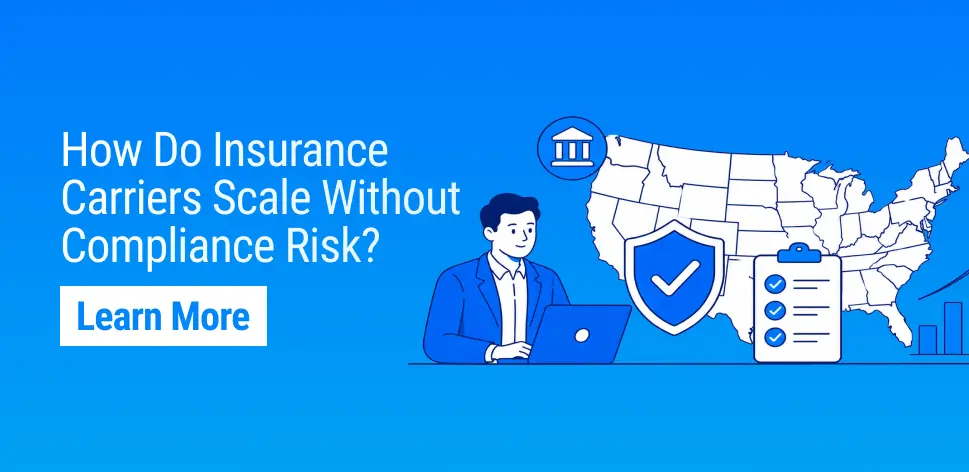
What Are Insurance Carriers?
Insurance carriers differ from agencies, brokers, and MGAs. Agencies and brokers distribute products. MGAs may have delegated authority in certain areas.
Carriers are the entities that assume risk, issue policies, collect premiums, hold capital, and pay covered claims.
Definition: Insurance Carrier An insurance carrier is the legal entity that accepts insured risk and is responsible for issuing policies, collecting premiums, maintaining capital reserves, and paying valid claims. A carrier may distribute insurance products through employees, agencies, brokers, MGAs, digital channels, or a combination of channels, while remaining the risk-bearing institution.
How Insurance Carriers Operate
A carrier’s operating model usually includes underwriting, distribution, policy administration, billing, claims, compliance, analytics, and reinsurance. The specific technology stack varies, but the underlying goal is to price risk correctly, issue business lawfully, service policies consistently, and maintain enough financial resilience to meet obligations.
The table below shows the core operating areas.
Core Functions of an Insurance Carrier
| Function | What the Carrier Does |
| Underwriting | Evaluates risk, classifies submissions, and decides terms |
| Policy administration | Issues policies, endorsements, renewals, and records |
| Billing and finance | Collects premium and manages financial flows |
| Claims | Handles notice, investigation, payment, and reserving |
| Distribution management | Oversees agencies, producers, appointments, and access |
| Compliance | Tracks regulatory obligations, appointments, filings, and audits |
| Reinsurance | Transfers selected risk to reinsurers |
| Risk and solvency | Assesses enterprise risk and capital adequacy |
Table Sources: NAIC producer licensing guidance, NAIC market conduct regulation, NAIC model law, and NAIC ORSA guidance.
Definition: Own Risk and Solvency Assessment (ORSA) Own Risk and Solvency Assessment, or ORSA, is a carrier’s internal process for evaluating risk and capital adequacy under various stress scenarios. ORSA is an ongoing part of enterprise risk management.
Underwriting and Pricing
Underwriting is a central carrier operation. Carriers determine which risks to accept and set terms and prices. In 2026, that work is increasingly shaped by better data, more automation, and regulatory scrutiny surrounding AI-assisted underwriting decisions.
Policy, Billing, and Claims Operations
Policy issuance and claims handling are regulated operating functions. Market conduct oversight evaluates compliance in areas including underwriting, claims handling, sales practices, and marketing. Carrier operations need clean workflows, clear controls, and traceable records.
Distribution, Producers, and Appointments
Insurance carriers operate within a large licensing environment that includes millions of individual producers and hundreds of thousands of business entities across the United States.
Carriers operate through a distribution model that may include internal sales teams, appointed producers, agency partners, and delegated MGA relationships. As carriers expand across state lines, producer licensing oversight and appointment management grow increasingly important.
Definition: Line of Authority (LOA) A line of authority, or LOA, is the general subject area of insurance a producer is licensed to sell. A producer may hold an active license but still lack the correct LOA for a specific line of business.
Capital, Risk, and Reinsurance
Reinsurance is essential for managing risk and capital reserve requirements. Carriers use reinsurance to expand underwriting capacity, stabilize results, distribute risk, and obtain catastrophe protection.
Definition: Reinsurance Reinsurance is a financial arrangement in which an insurance carrier transfers part of its risk to another insurer, called a reinsurer.
Licensing, Appointments, and Compliance Requirements
U.S. insurance carriers must manage producer licensing visibility, lines of authority, appointment status where required, termination reporting, market conduct controls, and enterprise risk governance.
In addition, producers must be appointed in states that require appointments. Carriers must also file a notice of appointment within each state’s required timelines. In many jurisdictions, terminations must be reported within a defined deadline, often 30 days, but carrier teams should confirm each state’s rule.
Definition: Carrier Appointment A carrier appointment is the state registration showing that a producer is acting on behalf of an insurer. Appointment rules vary by jurisdiction, but where appointments apply, carriers need a repeatable process for new appointments, renewals, and terminations.
Key Compliance Controls for Insurance Carriers
| Control | What the Carrier Verifies | What Can Go Wrong |
| Producer license status | Active resident or non-resident | Business placed through an inactive producer |
| Line of authority | Correct LOA for the product sold | Producer lacks authority for the product written |
| Appointment status | Appointment on file where required | Producer is not authorized to represent the carrier |
| Termination reporting | Timely filing and record cleanup | Stale appointments remain active |
| PDB and NPN accuracy | Consistent identifiers and source data | Duplicate or conflicting records |
| Audit trail | history | Weak audit defense or incomplete documentation |
| Risk governance | Ongoing ERM and solvency assessment | Operational growth exceeds risk controls |
Technology Used by Modern Insurance Carrier
According to the NIPR, there were 185.9 million transactions in 2025, 9.2 million producer records in its database, and $1.38 billion processed on behalf of states and U.S. territories. Managing these records requires highly organized and connected technology systems to support carrier compliance. Modern carriers run on a connected software stack. Insurance carrier technology usually includes core policy, billing, and claims systems, plus CRM, document management, analytics, workflow tools, and a dedicated carrier operations system or compliance layer for licensing and appointments. Insurers are increasingly evaluating scalable AI use cases across operations and compliance workflows.
A practical carrier stack often includes:
- Core administration systems for policy, billing, and claims
- Rating and underwriting tools
- CRM and agency management integrations
- Document and workflow management
- BI dashboards and operational reporting
- Producer licensing and appointment tools
- Data integrations with sources like the NIPR
- APIs to connect the stack across teams and systems
Definition: Insurance Carrier Platform An insurance carrier platform is the operational layer that helps carrier teams manage data, workflow, oversight, and reporting across licensing, appointments, compliance, and adjacent processes. The platform creates greater operational control, workflow consistency, and reporting visibility across the systems a carrier already uses.
Insurance Carrier Challenges
One of the major challenges for insurance carriers is fragmentation. A carrier may have one information source for producer data, another for appointments, another for internal workflows, and separate reporting tools for leadership.
Other recurring challenges include:
- State-by-state appointment variation
- Mismatched producer, LOA, and appointment records
- Slow onboarding and offboarding workflows
- Weak audit evidence
- Duplicate work across compliance and operations teams
- Legacy systems that limit AI and analytics adoption
- Rising expectations around privacy, cybersecurity, and AI governance
One significant operational challenge is connecting licensing, appointments, reporting, audit readiness, and day-to-day workflow management across systems.
A modern insurance carrier platform improves operational control. When carrier teams can rely on workflow data, they have better control over audit readiness.
Future Trends Shaping Insurance Carriers in 2026
Insurance carriers are modernizing operations while maintaining strong compliance discipline. The biggest shifts in 2026 are happening in workflow automation, governance, data quality, and distribution oversight. For carriers, the future involves building a more controlled operating model that can scale.
Many carriers still manage core functions across disconnected systems, spreadsheets, inboxes, and manual reviews. Future trends point toward a connected operational infrastructure.
Carriers want cleaner links between producer data, compliance workflows, dashboards, and leadership reporting. The goal is faster decision-making with less manual reconciliation.
As carriers grow agency networks, MGA relationships, and expand across states, producer oversight becomes more complex. Licensing, appointments, renewals, terminations, and authority checks all need to stay aligned with where and how business is written.
Stronger insurance carrier compliance management helps carriers stay organized as producer onboarding, renewals, and appointment activity become more complex.
How Agenzee Supports Insurance Carriers
Carriers that can standardize workflows, centralize compliance data, and improve reporting are better positioned to scale distribution and respond to regulatory pressure.
Technology decisions must support long-term operational strategy. Carriers need software that organizes information and helps teams act on it.
A compliance platform for carriers can:
- Centralize producer licensing and appointment visibility
- Reduce spreadsheet dependence
- Connect NIPR data to daily workflows
- Support new appointments and terminations
- Automate alerts for deadlines and regulatory changes
- Maintain audit-ready records
- Create cleaner operational dashboards
That is also why the right insurance carrier solution should be evaluated as operational infrastructure. If licensing, appointments, and compliance data remain disconnected from onboarding, reporting, and oversight, the carrier still carries operational drag.
Learn how Agenzee fits into insurance carrier workflows. Schedule a demo of Agenzee today.
Insurance Carrier FAQs
Q.1 What is an insurance carrier?
An insurance carrier is the risk-bearing company that assumes insured risk, issues policies, collects premiums, and pays covered claims.
Q.2 What is the difference between an insurance carrier and an agency?
A carrier assumes risk and issues insurance contracts. An agency or broker distributes insurance products and may represent one or more insurers, but it typically does not assume policy risk or claims obligations.
Q.3 What is a carrier appointment?
A carrier appointment is the state registration showing that a producer is acting on behalf of an insurer. In appointment states, it is a core compliance control tied to distribution.
Q.4 What is the Producer Database, or PDB?
The PDB is NIPR’s centralized repository of producer credentialing information that includes licensing details from all 50 states, the District of Columbia, Guam, Puerto Rico, and the U.S. Virgin Islands.
Q.5 What is an NPN in insurance?
An NPN, or National Producer Number, is a unique identifier assigned during the licensing application process. NPNs are assigned to individuals and business entities.
Q.6 Why do insurance carriers need dedicated compliance systems?
Producer licensing, appointments, audit trails, and state-specific rules become difficult to manage through disconnected spreadsheets and email workflows. Dedicated systems improve visibility, control, and reporting across large producer populations.
Q.7 What technology trends matter most for insurance carriers in 2026?
The biggest themes are AI moving into workflows, consistent data foundations, modernization of legacy systems, tighter governance around AI and cybersecurity, and better integration across core operations and compliance.
Alexandra is a copywriter and researcher who specializes in evergreen content production. She has authored hundreds of SEO-driven blogs, helping clients translate complex insurance coverage topics into clear, authoritative content.
Alexandra graduated from the University of Oregon with a BA in German: Language, Literature, and History, and a BA in Digital Art. She spent 20 years living abroad in Germany and Spain before returning to the US in 2025.
Disclaimer: This post is for informational purposes only and does not constitute legal or compliance advice. Agenzee does not warrant the accuracy of and assumes no liability for reliance. Please consult regulators or professional advisors as needed. See our full disclaimer for details.
Subscribe
Stay Ahead with Agenzee Insights
Join our community to stay up-to-date on the latest news and strategies for license and appointment management
INDUSTRY INSIGHTS FOR INSURANCE AGENCIES, CARRIERS, AND MGAS
Similar Blogs
Read our blog to discover the latest industry insights and trends in license and appointment management.


let's catch up!
Schedule a Live 1-On-1
Demo of Agenzee!
Our insurtech experts would be thrilled to give you a personalized demo of how Agenzee can transform your compliance management processes.
Customers Opinions on Our Services and Products
What Our Customers Say
Find out why our customers are happy they chose Agenzee.