

Published On: May 27, 2026
Updated On: May 28, 2026
From Chaos to Control: How Insurance Carriers Modernize Licensing

For many insurance carriers, spreadsheets, inboxes, and disconnected internal records are still standard practice for producer license management. However, carriers modernizing licensing workflows are increasingly using software and automation to streamline operations.
Insurance licensing modernization uses technology to shift from fragmented manual tracking to a centralized workflow for licenses, lines of authority (LOA), appointments, renewals, documents, and compliance activity.
Definition: insurance producer license management
Insurance producer license management is the process of tracking producer and entity licenses, appointments, renewal dates, lines of authority, supporting documents, and compliance actions.
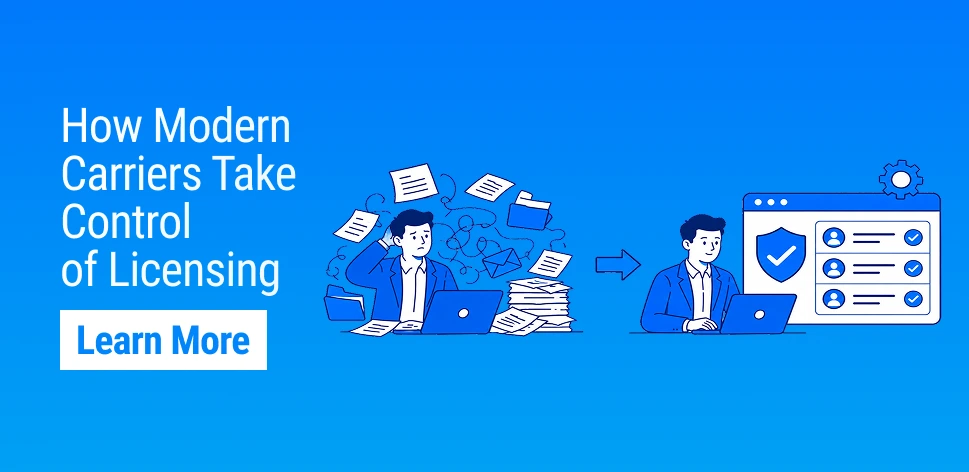
Why Manual Licensing Workflows Become Chaotic
Manual licensing processes become unstable over time. A single spreadsheet may be sufficient to manage a small producer group. Teams may track renewal dates manually, and shared calendars may hold appointment requests. State websites often fill in remaining gaps.
The problem is that the insurance workflow depends on too many disconnected control points. Common signs of weak producer management controls include:
- License records stored across multiple systems
- Duplicate data entry across teams
- Unclear ownership for renewals
- Slow answers to appointment questions
- Inconsistent document storage
- Reactive audit preparation
- Poor visibility across states
- Dependence on external resources for basic information
Teams tend to lose time researching basic status questions, reconciling conflicting records, and repeating follow-up work that should already be structured.
Why Multi-State Licensing Is Harder Than It Looks
Multi-state licensing is difficult because the work is not centralized. Carriers need to reference internal, state, and federal records to verify producer data.
A carrier may need to monitor:
- Resident and non-resident licenses
- State-specific renewal cycles
- Lines of authority by producer
- Appointment requirements
- Continuing Education (CE) status
- Business Entity Records
- Supporting documentation
- Onboarding deadlines
- Offboarding and termination activity
NIPR’s Producer Database (PDB) centralizes credential information. The PDB helps users verify license status across participating states. State DOI websites often provide supplemental verification details.
Definition: National Insurance Producer Registry (NIPR)
The National Insurance Producer Registry (NIPR) is a platform that helps insurance producers, agencies, carriers, and state insurance departments process licensing transactions electronically, such as license applications, renewals, appointments, and terminations.
However, carriers also need an internal workflow system. A carrier licensing system consolidates this disparate data into a centralized operational view. Definition: carrier appointment management
Carrier appointment management involves tracking producer authorization to represent a carrier. The processes include appointment filing, license verification, renewal handling, and termination reporting.
Why Appointment Tracking Can Create Operational Risk
A producer may hold an active license and still require appointment action, depending on the state, the carrier relationship, and the business being written.
The NAIC Producer Licensing Model Act requires that, in appointment states, insurers file a notice of appointment within required timeframes.The same model also states that terminations must be reported within 30 days of the effective termination date. vary by state, carriers need a workflow that supports both timing and documentation, not just a static record.
Definition: National Association of Insurance Commissioners (NAIC)
The National Association of Insurance Commissioners (NAIC) is a U.S. regulatory support organization with state insurance regulators from all 50 states, the District of Columbia, and U.S. territories. The NAIC helps state insurance departments coordinate on regulation, model laws, data reporting, market conduct, solvency oversight, and consumer protection.
Manual Licensing Workflows Weaknesses
| Workflow | Manual approach | What can go wrong |
| License tracking | Spreadsheet or local tracker | Conflicting records and missed updates |
| Renewals | Calendar reminders and email follow-up | deadlines |
| Appointment verification | Email research and portal checks | Slow answers and incomplete visibility |
| Document collection | Shared drives and inbox attachments | Missing support records |
| Onboarding | Requirements gathered across systems | Delayed producer readiness |
| Offboarding | manual review of historical records | Lingering appointments or unresolved status |
| Audit prep | Screenshots, exports, and manual cleanup | Weak audit evidence and increased administrative effort |
A modern insurance licensing workflow centralizes records, structures the work, and makes exceptions visible.
One Truth Replaces Multiple Records
A modern process uses automated alerts, assignments, escalation, and historical tracking. Insurance licensing automation becomes operationally useful by reducing repetitive follow-up work and improving scalability. Teams also retain evidence as the work happens.
Records show:
- What changed
- When it changed
- Who handled it
- Supporting documentation
- Unresolved issues
That improves audit readiness during internal reviews, audits, and compliance escalations.
Definition: insurance compliance automation
Insurance compliance automation is the use of rules, alerts, workflows, and centralized data to reduce manual licensing work. In carrier operations, automation is most effective when it supports renewals, appointment tracking, document handling, exception management, and reporting without removing human review where judgment is still required.
What a Centralized Licensing System Does
| Control Area | What is Centralized | Operational Impact |
| License status | Active, inactive, resident, non-resident, renewal dates | Reduces missed deadlines |
| Lines of authority | LOA by producer and jurisdiction | Prevents authority mismatches |
| Appointment status | Active, pending, terminated | Improves authorization tracking |
| Documents | Applications, background records, state support files | Strengthens compliance evidence |
| Alerts and tasks | Renewals, follow-ups, escalations | Reduces manual chasing |
| Reporting | Dashboards, activity history, exception views | Improves oversight and prioritization |
Benefits of Carrier Modernization
A modern licensing process creates value in operations. The practical benefits usually include:
- Better visibility across states and producers
- Fewer manual follow-ups
- Faster onboarding
- Cleaner appointment verification
- More disciplined offboarding
- Stronger audit readiness
- Less duplicate work
- Better reporting for compliance and operations leaders
- More confidence in the underlying data
A centralized insurance carrier platform reduces the manual steps required to keep licensing current. It gives teams a common operating layer for records, workflow, documents, and reporting, making it easier to scale.
How Agenzee Can Help
Agenzee moves carriers from fragmented licensing administration to a more centralized operating model.
That includes support for:
- License tracking
- Appointment visibility
- Renewal workflows
- Compliance task management
- Document organization
- Reporting and operational oversight
For teams evaluating an insurance licensing solution, the important question is if the system helps the team manage licensing work with more consistency, more visibility, and less manual effort.
Gain Control of Producer Licensing Workflows
Carriers move from chaos to control when they treat producer licensing management as an operational system. Centralized records, structured workflows, better visibility, and audit readiness are what make modernization work well.
Schedule a demo of Agenzee to learn more about modernizing producer licensing workflows.
FAQs on Producer License Management Modernization
Q.1 What is insurance licensing modernization?
Insurance licensing modernization is the move from manual, fragmented tracking to a centralized process for licenses, appointments, renewals, documents, and compliance workflows.
Q.2 What is an insurance license management system?
An insurance license management system is software used to track producer and entity licenses, lines of authority, deadlines, appointment status, documents, and related compliance activity.
Q.3 Why is multi-state insurance licensing so difficult?
Multi-state licensing is difficult because requirements vary by state, appointment rules are not fully uniform, deadlines are spread across the year, and teams often work across disconnected systems.
Q.4 What is carrier appointment management?
Carrier appointment management is the process of tracking whether a producer is properly authorized to represent a carrier in a jurisdiction, including appointment filing, verification, and termination activity where required.
Q.5 What should insurance licensing software automate first?
The first priorities are usually renewal alerts, task routing, appointment visibility, document collection, and exception reporting. Those areas create the most repetitive manual work.
Q.6 Does the NIPR replace internal licensing workflows?
No. The NIPR provides critical infrastructure for licensing transactions, data access, and reporting. Carriers still need an internal system to manage operational workflow, ownership, exceptions, and audit evidence.
Q.7 How do carriers improve audit readiness?
Carriers improve audit readiness by centralizing records, keeping supporting documents organized, tracking activity history, and using a repeatable workflow for renewals, appointments, and exceptions.
Alexandra is a copywriter and researcher who specializes in evergreen content production. She has authored hundreds of SEO-driven blogs, helping clients translate complex insurance coverage topics into clear, authoritative content.
Alexandra graduated from the University of Oregon with a BA in German: Language, Literature, and History, and a BA in Digital Art. She spent 20 years living abroad in Germany and Spain before returning to the US in 2025.
Disclaimer: This post is for informational purposes only and does not constitute legal or compliance advice. Agenzee does not warrant the accuracy of and assumes no liability for reliance. Please consult regulators or professional advisors as needed. See our full disclaimer for details.
Subscribe
Stay Ahead with Agenzee Insights
Join our community to stay up-to-date on the latest news and strategies for license and appointment management
INDUSTRY INSIGHTS FOR INSURANCE AGENCIES, CARRIERS, AND MGAS
Similar Blogs
Read our blog to discover the latest industry insights and trends in license and appointment management.

let's catch up!
Schedule a Live 1-On-1
Demo of Agenzee!
Our insurtech experts would be thrilled to give you a personalized demo of how Agenzee can transform your compliance management processes.
Customers Opinions on Our Services and Products
What Our Customers Say
Find out why our customers are happy they chose Agenzee.