

Published On: April 24, 2026
Updated On: May 14, 2026
What Every Insurance Carrier Should Know About the NIPR & PDB

Most insurance carriers are familiar with the National Insurance Producer Registry (NIPR) and the Producer Database (PDB) at a surface level. However, it’s easy to confuse the two. First, carrier operations tend to be siloed. Different teams working on filing, audits, or contracting, and each team views producer files from a unique perspective.
Second, many operations run on legacy systems with outdated recordkeeping methods that rely on spreadsheets, emails, and employee experience. As a result, carriers may not be fully aware of the critical differences between NIPR and PDB in relation to overall producer compliance management.
These gaps can create compliance exposure, unknown rule variations, missing evidence, and inaccurate records. Gaps between the two systems can create compliance risk, which is why understanding the distinctions is critical.
What Are NIPR and PDB in Insurance Compliance?
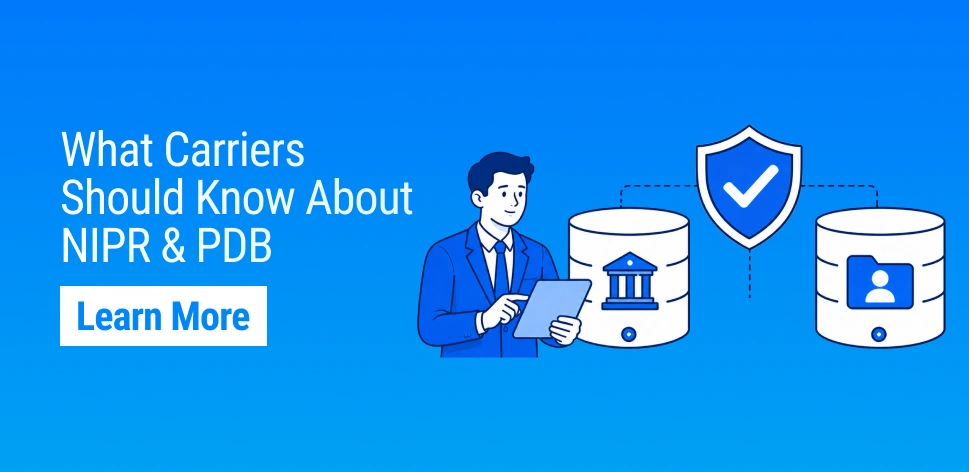
In simple terms, the NIPR supports transactions and the PDB is a service provided by the NIPR, but neither replaces carrier-side compliance controls.
What is National Insurance Producer Registry?
Definition: NIPR
The National Insurance Producer Registry, or NIPR, is a system used for insurance licensing-related transactions.
The NIPR supports license applications, renewals, appointments, terminations, contact changes, document uploads, and related licensing tasks for most states.
What is the Producer Database?
Definition: Producer Database (PDB)
The Producer Database is an electronic repository of insurance agent and broker (producer) information.
The PDB connects participating state regulatory licensing systems to compile a more complete producer profile. Carriers may find license numbers, authorized states, appointments, termination dates, and LOAs.
Definition: Line of authority (LOA) A line of authority is the type of insurance business a producer is authorized to sell, solicit, or negotiate under a a license class such as life, health, property, or casualty.
NIPR vs PDB: Key Differences
NIPR is used when a carrier needs to file, submit, or process an action. It is the operational side of producer licensing activity.
The PDB is used when a carrier needs to check, review, or confirm producer licensing information. It is the visibility side of producer compliance.
NIPR vs PDB: Quick Comparison Table
| System | Function | What It Does | What It Does Not Do | Risk |
| NIPR | Transaction processing | Support application, appointment, renewal filings | Validate carrier compliance | False sense of compliance |
| PDB | Licensing visibility | Show producer license status and state data | Guarantee real-time accuracy | Missed violations |
How NIPR and PDB Fit into Carrier Compliance Workflows
NIPR and the PDB support different aspects of producer licensing workflows. Carriers use the PDB to review data before onboarding producers and NIPR to process transactions after verification. However, the PDB is not a complete compliance solution. Because the PDB is a centralized repository built from state and NAIC data sources, some information may be delayed, incomplete, or dependent on jurisdiction-specific reporting.
Carriers still need to account for reporting timing, update delays, and record context when they use it for compliance decisions. Use the PDB as part of a larger compliance process, but not as the only control.
The PDB does not eliminate the need for multi-state rule analysis, internal documentation, exception handling, or audit evidence showing that the carrier verified producer details before allowing business activity.
How NIPR and PDB Fit into a Carrier Workflow
| Workflow | Primary System | What to Confirm | Evidence to Retain |
| Pre-appointment review | PDB | Active license, correct LOA, producer identity, jurisdiction match | Review record, timestamp, reviewer note |
| Appointment or licensing action | NIPR | Correct filing type, state, producer, and timing | Submission confirmation, receipt, transaction record |
| Post-filing review | NIPR plus internal controls | Completion status and any follow-up issue | Confirmation notes, resolution record |
| Ongoing monitoring | PDB plus internal controls | Renewal status, LOA or record changes | Monitoring log, alerts, remediation notes |
| Termination handling | NIPR plus internal controls | Correct reporting and completion | Termination confirmation, closure note |
| Audit preparation | Internal records, NIPR, and PDB | Full compliance history and supporting documentation | Audit trail, status history, exception records |
The Correct End-to-End Workflow
Effective workflows separate review from filing and filing from proof. The NIPR and the PDB support different parts of that process, but neither one is enough on its own. Align workflows to move step by step from verification to action to documentation.
Step 1: Review PDB producer records
Start with the PDB producer report. The PDB helps carriers review license status, state activity, lines of authority, and record details that may affect if the producer can move forward.
Step 2: Check for missing, delayed, or inconsistent information
The PDB is an important source, but it may not always reflect immediate updates. It’s up to the carrier to determine what appointment timing, filing deadlines, and jurisdiction-specific rules could affect compliance.
The carrier should manage multi-state license tracking, internal appointment records, and recent transaction confirmations.
Step 3: Submit required transactions through NIPR
After verification is complete, the carrier can move to the transaction stage. NIPR supports filing, appointments, renewals, terminations, and other licensing-related actions. Monitor the transaction, confirm the outcome, and address any exception, rejection, or follow-up item that appears after filing through NIPR.
Step 4: Store audit evidence
Every compliance action should have a clear audit trail. The carrier should retain proof of reviewed records, filed transactions, actions, and issue resolutions in the insurance carrier platform. Later, these records help defend carrier workflows if there is an audit.
Definition: Audit trail An audit trail is the documented history of compliance activity tied to a producer record, including status checks, filings, timestamps, exception handling, and supporting records.
Where Manual Workflows Break Down
When a carrier exports PDB data into a spreadsheet, it may appear complete, but it can miss late state updates, unresolved appointment issues, or record mismatches that require follow-up.
Producer data can change after the spreadsheet is downloaded. making it an unreliable compliance control. If state verification, internal record comparison, or recent transaction confirmation gets skipped, then timing gaps, incomplete appointment oversight, or licensing details can appear.
Without clear audit trails, a carrier may struggle to prove review steps later if the evidence is split across email, spreadsheets, folders, and disconnected systems. If the carrier had to go beyond the PDB to verify an insurance agent license, and those checks are not documented, the workflow becomes even harder to defend.
Where NIPR and PDB Create Compliance Risk
Risks appear when carriers assume a transaction was handled correctly because it was submitted through NIPR or assume a producer record is complete because it appears in the PDB. In practice, most problems happen in the gap between what the systems support and what the carrier still needs to verify, track, and prove.
Appointment Timing Violations
States do not all handle appointments the same way. Some states allow just-in-time (JIT) appointments, where the filing can occur after a triggering event such as the first piece of business. Other states have different timing standards.
If a carrier uses a generic process across all jurisdictions, it can treat a timing rule as flexible when it is not. That is how late filings happen even when the team believes it is following a standard process.
Definition: Just-in-time appointment A just-in-time appointment allows the carrier to file the appointment after a triggering event, such as the first piece of business, rather than at the start of the producer relationship.
Writing Business Without Valid License or LOA
Inconsistencies arise when one system shows a change that another system does not yet reflect. This is driven by system timing gaps, not human error.
The NIPR, PDB, state systems, and internal carrier records do not update simultaneously. Each system reflects a different point in the life cycle:
- NIPR shows what was submitted
- State systems determine approval
- PDB reflects what has been reported and aggregated
- Internal systems reflect what the carrier believes is true
Those four views can be temporarily out of sync.
For example:
- A renewal is submitted through NIPR but not yet processed by the state
- The state approves the license, but the update has not yet reached the PDB
- The PDB still shows the old status
- Internal records show “in progress” or “active” based on assumptions
If a carrier fails to confirm the final license status, it is relying on incomplete information.
The same issue applies to lines of authority. A producer:
- Has an active license but lacks the required LOA
- Recently added an LOA that is not reflected across systems yet
- Has a restricted or state-specific authority not clearly visible in one system
This is why system gaps are responsible. Each system is correct in its own context, but none of them guarantees that the producer is fully authorized at that exact moment.
To manage this, carriers need to control the decision point in the carrier licensing system, not just the data source.
Incomplete Termination Reporting
Termination reporting is only complete when the carrier has closed every reportable producer relationship. Ending the relationship internally is not sufficient. The carrier needs to complete required termination filings in the applicable states and confirm that no appointment remains open where the producer is no longer authorized.
NAIC guidance treats termination reporting as a state-level regulatory obligation tied to the producer-carrier relationship, and examiners review how those notifications were handled.
In many states, the standard timeline for reporting a producer termination is 30 days from the date of termination, based on the NAIC Producer Licensing Model Act, but carriers should always confirm state-specific rules.
After terminating an agent or agency relationship, the carrier needs to report the termination in every state where termination reporting is required, consistent with that state’s appointment and termination rules.
Carriers also need to ensure their records reflect the producer’s affected authorities and appointments so active relationships are not left open.
The NIPR offers company appointment renewals for select states, and other states renew appointments on a per-appointment basis. Therefore, if a termination is missed, an appointment can remain open longer than intended and create unnecessary cleanup later.
Audit Failures Due to Missing Evidence
Some of the most expensive compliance issues happen due to insufficient documentation. The correct verification steps were taken, but the carrier is missing reporting documents to prove it.
Regulators evaluate audit evidence to confirm compliance. Neither the NIPR nor PDB create defensible compliance records for carriers. It’s up to the carrier to develop workflows that document producer compliance activities for each step of the process such as status checks, filing confirmations, timestamps, exception notes, and related records.
Definition: Audit evidence Audit evidence is the documentation that shows a compliance action was properly reviewed, completed, and tracked.
FAQ About the NIPR and PDB for Insurance Carriers
Q.1 What is NIPR used for in insurance?
NIPR processes insurance licensing transactions, including applications, renewals, appointments, terminations, and related actions, depending on the user and state.
Q.2 What is the Producer Database (PDB)?
The PDB is the centralized producer licensing database used to aggregate licensing information from participating jurisdictions into a common producer record.
Q.3 Are NIPR and PDB the same thing?
No. NIPR is the transaction platform. The PDB is the centralized data repository used for producer licensing visibility and reports.
Q.4 Does the NIPR verify license compliance?
Not by itself. The NIPR supports the filing and processing of transactions, but carriers still need internal validation of eligibility, timing, and state-specific compliance requirements.
Q.5 Is PDB always accurate and up to date?
Not always, but it is highly valuable. Carriers should not use the PDB as their only control. The data depends on participating jurisdictions and update timing, so carriers should pair it with internal review and reconciliation.
Q.6 Do carriers need both NIPR and PDB?
Yes. NIPR helps carriers process actions. The PDB helps carriers review licensing information.
Q.7 How do carriers use NIPR and PDB together?
Carriers typically use the PDB to review producer licensing status and NIPR to submit needed actions, then retain internal evidence showing what was checked, filed, confirmed, and resolved.
NIPR and PDB Are Only as Effective as Your Workflow
NIPR and the PDB are important parts of carrier compliance operations, but neither one solves the workflow problem on its own.
A dedicated insurance carrier solution helps centralize licensing status, appointments, terminations, alerts, and supporting documentation. This allows carriers to better monitor producer data, document actions, and close compliance gaps.
If you want to see how that works in practice, request a demo of Agenzee to see how carriers are streamlining licensing workflows, improving audit readiness, and reducing compliance risk.
Alexandra is a copywriter and researcher who specializes in evergreen content production. She has authored hundreds of SEO-driven blogs, helping clients translate complex insurance coverage topics into clear, authoritative content.
Alexandra graduated from the University of Oregon with a BA in German: Language, Literature, and History, and a BA in Digital Art. She spent 20 years living abroad in Germany and Spain before returning to the US in 2025.
Disclaimer: This post is for informational purposes only and does not constitute legal or compliance advice. Agenzee does not warrant the accuracy of and assumes no liability for reliance. Please consult regulators or professional advisors as needed. See our full disclaimer for details.
Subscribe
Stay Ahead with Agenzee Insights
Join our community to stay up-to-date on the latest news and strategies for license and appointment management
INDUSTRY INSIGHTS FOR INSURANCE AGENCIES, CARRIERS, AND MGAS
Similar Blogs
Read our blog to discover the latest industry insights and trends in license and appointment management.

let's catch up!
Schedule a Live 1-On-1
Demo of Agenzee!
Our insurtech experts would be thrilled to give you a personalized demo of how Agenzee can transform your compliance management processes.
Customers Opinions on Our Services and Products
What Our Customers Say
Find out why our customers are happy they chose Agenzee.