
Published On: May 1, 2026
Updated On: May 14, 2026
Inside the Workflow of a Modern Insurance Carrier Compliance Team

Insurance carrier compliance teams follow internal workflows to manage producer license checks, appointments, CE requirements, and regulatory expectations. Workflows differ by carrier and depend on each state’s laws, but they all share the goal of maintaining producer compliance.
This article explains common workflows modern insurance carrier compliance teams follow regarding producer oversight. Although there is no universal sequence of steps to follow, the workflow in this post reflects the steps involved in most carrier operations.
Carrier workflows may include additional steps depending on the product lines, state licensing rules, distribution models, and system configurations. This content is for educational purposes and should not be treated as legal or regulatory advice.
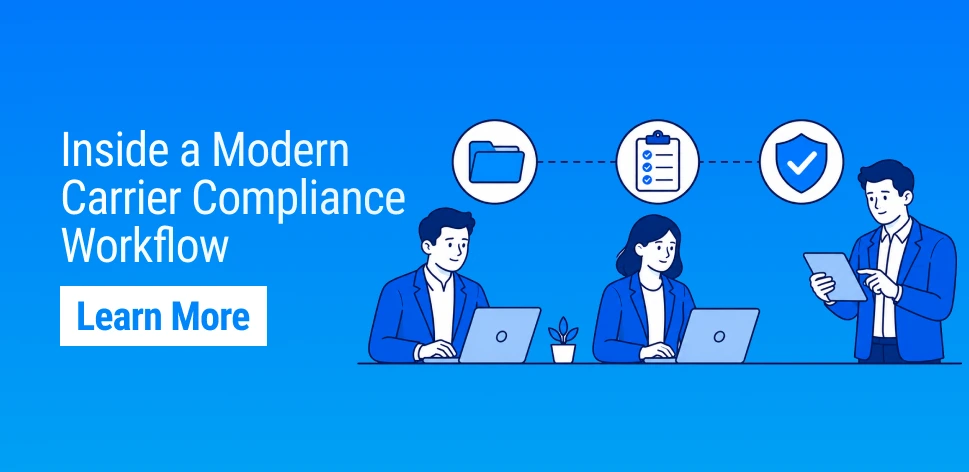
What a Carrier Compliance Workflow Includes
Carrier compliance teams monitor producer activity for operational risks. However, managing producer workflows across multiple states, teams, and systems is a major challenge for insurance carriers.
Who Usually Owns the Work
The system that carriers choose for producer compliance workflows needs to make ownership clear, even when the work is split across teams. Ownership varies by carrier. In some, licensing takes most responsibility for producer oversight. In others, different teams are responsible for different parts of the workflow.
Here’s what the typical carrier workflow looks like for producer compliance:
Producer Compliance Workflow Stages and What Can Go Wrong
| Workflow Stage | Step | What Can Go Wrong |
| Onboarding | Complete validation before access is granted | Producer is entered but not fully clear to write business |
| Licensing review | State status, LOAs, and renewal timing | Team sees active license but misses other critical details |
| Appointment handling | State rule, JIT timing, and filing ownership | Appointment status is assumed instead of tracked |
| Continuous monitoring | Alerts, CE, address changes, regulatory actions | Teams rely on periodic cleanup instead of ongoing review |
| Termination handling | Reporting deadlines and system cleanup | Producer leaves but records remain partially open |
| Reconciliation and audit trail | Internal and external data alignment | Records cannot be explained later and documentation is missing |
Typical Insurance Carrier Compliance Workflow
The day-to-day producer compliance workflow includes:
- Producer onboarding and validation
- Licensing oversight
- Appointment tracking
- Regulatory monitoring
- License, appointment, and renewal compliance reporting
- Audit preparation
Ideally, carrier workflows can handle variations in producer volume, state requirements, and documentation needs without increasing audit exposure. However, manual workflows often create reporting gaps, missed follow-ups, or unnecessary delays that could be reduced by improving the workflow.
Producer Onboarding and Validation
Carrier compliance begins with producer onboarding. The average workflow includes:
- Verifying active license status
- Confirming resident and nonresident state coverage
- Reviewing lines of authority
- Checking business-entity details where applicable
- Reviewing background or 1033-related requirements where relevant
- Collecting required onboarding documents
- Creating and updating internal producer records
- Flagging missing items before the producer moves forward
Strong workflows prevent problems with appointments, renewals, and reporting later.
Validate Licensing and Ready-to-Sell Controls
Before a producer can begin binding business, compliance teams need to:
- Review the producer’s licensing footprint by state
- Confirm the correct line of authority for the business being written
- Check expiration dates and upcoming renewals
- Review continuing education status where applicable
- Confirm there are no open licensing issues that block activity
- Compare internal records against trusted external data
- Determine whether the producer meets the carrier’s ready-to-sell standard
- Move unresolved records into an exception queue
An active license alone does not always mean the producer is ready to write a specific product in a specific state.
Definition: Ready-to-sell status Ready-to-sell status is the carrier’s determination that a producer is ready to begin writing business. The decision involves line-of-authority review, appointment status where required, onboarding completion, and carrier-specific validation tied to product access.
Appointment Strategy, Including JIT Appointments
The next part of the producer compliance process is to determine if appointment action is needed.
- Check which states require appointments
- Confirm producer appointments
- Determine if JIT appointment is allowed
- Identify when the filing clock starts
- Route the request for internal approval where needed
- Submit the appointment or queue it for filing
- Track pending, active, and renewal appointment status
- Document the outcome in the producer record
The appointment process is one of the most operationally sensitive parts of the workflow because state rules, carrier procedures, and timing windows do not always align.
For carriers using a centralized insurance carrier platform, organizing appointment workflows is a high-value capability to have. Appointment oversight often breaks down when records are fragmented, or carrier-specific requirements are buried in email threads.
Definition: Just-In-Time appointment A Just In Time, or JIT, appointment lets a carrier wait to file an appointment until the producer submits business, where state rules permit that approach.
Continuous Monitoring and CE Tracking
Carrier compliance does not stop once a producer is onboarded or appointed. Ongoing insurance license management tracks:
- License status changes
- Address and demographic updates
- CE completion progress
- Upcoming renewal deadlines
- Appointment changes and renewals
- Regulatory-action alerts
- Exceptions triggered by system alerts
NIPR can support the transaction side of producer licensing and appointments, but carriers still need internal workflows to review records, resolve exceptions, and organize compliance documents.
Definition: Exception management Exception management is the controlled handling of records that fall outside normal workflow rules such as missing lines of authority, incomplete CE, delayed state updates, appointment gaps, address changes, or regulatory-action alerts.
Regulatory Reporting, Offboarding, and Termination Handling
The workflows for regulatory, reporting, offboarding, and terminations are some of the most critical for compliance management. At this point, weaknesses may appear in manual workflows if steps are overlooked.
Teams often take actions to:
- Determine if appointment termination reporting is required
- Confirm the effective date of the change
- Identify all affected states and appointments
- Submit required contract and appointment termination notices
- Update internal systems and status fields
- Document the reason for the change where appropriate
- Retain proof of reporting and related notes
- Confirm that no open appointment or renewal items remain
- Close the workflow only after all required actions are complete
Some states publish state-specific appointment renewal periods, deadlines, and invoice timing. As a result, there may be additional steps beyond the ones listed above.
Producer Record Reconciliation and Audit Evidence
Regulators may want to see if the carrier’s licensed and appointed producer records match department records, if the producer was properly authorized where business was written, and if appointment termination handling was documented.
Typical processes for record reconciliation and audit preparation include:
- Comparing internal producer data to external record sources
- Identifying mismatches in license, appointment, or status information
- Investigating unresolved discrepancies
- Documenting review times and the individual responsible for each action
- Keeping proof of filings, follow-ups, and escalations
- Closing exceptions with notes that another reviewer can follow
- Preparing reports for leadership, internal review, or audit response
A carrier compliance system can help the team organize work, surface changes, and retain evidence more consistently. These steps help prevent compliance penalties and violations.
Definition: Producer record reconciliation Producer record reconciliation compares internal records to data from the NIPR, Producer Database, and state DOIs to catch mismatches before they become compliance problems.
Weaknesses of Manual Workflows
Manual workflows have weaknesses because they create blind spots.
Common weak points include:
- Duplicate records across systems
- Unclear ownership
- Appointment status tracked by memory
- Missing proof of follow-up
- Delayed appointment termination handling
- Inconsistent exception escalation
- Weak onboarding controls
- No clear ready-to-sell standard
- Inconsistent JIT tracking
- CE handled too late
- Missing reconciliation and audit evidence
Operational Results of Manual vs Automated Compliance
| Manual approach | Automated approach | Operational result |
| Onboarding by email and spreadsheet | Structured onboarding workflow with validation checkpoints | Fewer missing documents and fewer handoff errors |
| License checks done one record at a time | Batch visibility plus exception review | Faster review with better consistency |
| Appointment rules tracked from memory | State-specific appointment logic and ownership | Less JIT and renewal risk |
| CE monitored close to expiration | Early CE visibility and reminder workflows to trigger alerts | Fewer renewal surprises |
| Terminations handled as one-off tasks | Controlled offboarding and reporting workflow | Cleaner closure and stronger audit proof |
| Audit prep done after the fact | Evidence built during daily work | Faster internal review and exam response |
Building a More Defensible Insurance Carrier Compliance Workflow
A more defensible workflow is one the team can follow and document consistently.
The workflow should have:
- One intake path for compliance-impacting events
- One owner for each task
- Visibility into licensing and appointment status
- Documented exception handling
- Reporting controls
- Audit evidence captured during normal work
When carriers choose an insurance carrier solution, it’s a workflow decision as much as a software decision.
Schedule a Demo of Agenzee to discover how insurance carriers are establishing effective workflows for their compliance teams.
FAQ About Insurance Carrier Compliance Workflows
Q.1 What does a producer compliance team do in an insurance carrier?
An insurance compliance team manages producer licensing, appointments, regulatory reporting, exception handling, and audit evidence. The goal is to keep producer authority aligned with business activity.
Q.2 How do insurance producer compliance teams manage licensing?
Compliance teams usually manage licensing through a mix of status review, renewal tracking, line-of-authority checks, alerts, exception queues, and documentation. State regulators license producers under state law, so carriers need a process that accounts for jurisdiction-level variation.
Q.3 What is insurance carrier appointment compliance?
Carrier appointment compliance is the process of determining if appointment is required in a specific state. Since appointment rules vary by jurisdiction, carriers should not assume that the same filing rules apply everywhere. The carrier files or renews appointments where necessary, and documents status changes.
Q.4 How do insurance carriers track producer compliance tasks?
Carriers may use a mix of internal workflow tools, alerts, reports, dashboards, and documented ownership. NIPR and PDB provide reports and alerts for license updates, appointment and termination changes, and regulatory actions.
Q.5 Why do insurance carriers need producer compliance systems?
Carriers need compliance systems to perform ongoing, state-based monitoring work. Manual compliance work requires teams to consolidate producer data from multiple different sources. Software improves visibility, allowing compliance carriers to organize producer data from the NIPR, PDB, and internal systems in a centralized location.
Q.6 Is NIPR the same as a carrier compliance system?
No. NIPR provides infrastructure for licensing-related transactions, reporting, appointments, terminations, renewals, and alerts. An insurance carrier compliance system helps carriers manage producer licensing workflows with evidence retention.
Alexandra is a copywriter and researcher who specializes in evergreen content production. She has authored hundreds of SEO-driven blogs, helping clients translate complex insurance coverage topics into clear, authoritative content.
Alexandra graduated from the University of Oregon with a BA in German: Language, Literature, and History, and a BA in Digital Art. She spent 20 years living abroad in Germany and Spain before returning to the US in 2025.
Disclaimer: This post is for informational purposes only and does not constitute legal or compliance advice. Agenzee does not warrant the accuracy of and assumes no liability for reliance. Please consult regulators or professional advisors as needed. See our full disclaimer for details.
Subscribe
Stay Ahead with Agenzee Insights
Join our community to stay up-to-date on the latest news and strategies for license and appointment management
INDUSTRY INSIGHTS FOR INSURANCE AGENCIES, CARRIERS, AND MGAS
Similar Blogs
Read our blog to discover the latest industry insights and trends in license and appointment management.


let's catch up!
Schedule a Live 1-On-1
Demo of Agenzee!
Our insurtech experts would be thrilled to give you a personalized demo of how Agenzee can transform your compliance management processes.
Customers Opinions on Our Services and Products
What Our Customers Say
Find out why our customers are happy they chose Agenzee.