

Published On: March 3, 2026
Updated On: March 16, 2026
NIPR Warns Insurance Organizations of Fraudulent Past Due Invoice Emails

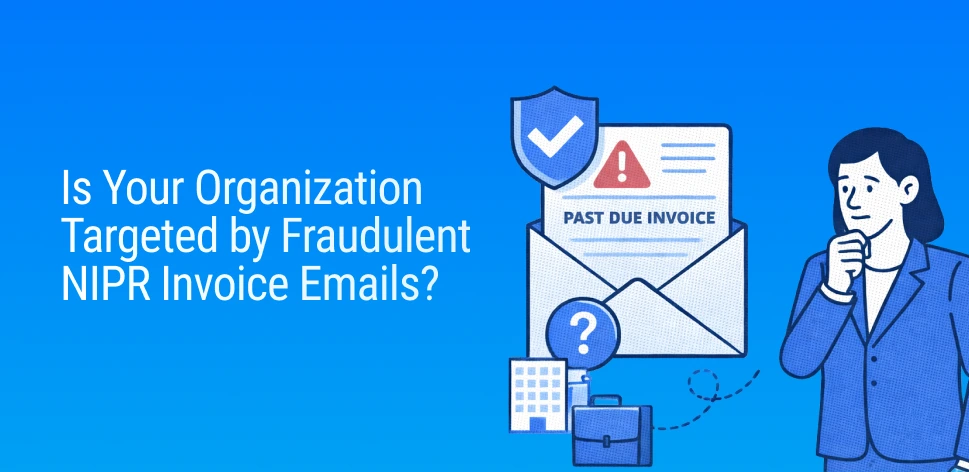
The National Insurance Producer Registry (NIPR) has alerted insurance organizations to a phishing campaign involving fraudulent past due invoice emails. These emails are designed to impersonate legitimate billing communications and may appear to come from trusted domains such as @nipr.com, @naic.org, or @stripe. Insurance agencies, MGAs, FMOs, and carriers should exercise caution when reviewing unexpected invoice notices. Strengthening email verification protocols and reinforcing internal payment procedures can significantly reduce the risk of financial loss and data compromise.
Growing Phishing Threat Targeting Insurance Organizations
On February 6, 2026, NIPR announced awareness of a phishing campaign targeting insurance organizations with fraudulent past due invoice emails. The messages are crafted to resemble legitimate billing communications and may display familiar domains such as @nipr.com, @naic.org, or @stripe.
However, NIPR has confirmed that these emails may not originate from their organization. The goal of the phishing attempt is to prompt recipients to click malicious links, open attachments, or submit fraudulent payments. Given the volume of billing transactions processed across the insurance industry, these emails present a significant operational and financial risk.
How to Identify a Fraudulent Invoice Email
Insurance organizations should train staff to recognize common phishing indicators. Warning signs include:
- Sender email addresses that closely resemble legitimate domains but contain subtle variations. Clicking on the domain name can reveal the true underlying sender.
- Generic greetings such as “Dear Customer” rather than referencing a specific contact name or customer ID.
- Spelling errors, awkward phrasing, or urgent language pressuring immediate payment.
- Hyperlinks that redirect to suspicious or mismatched URLs when hovered over (without clicking).
These characteristics are frequently associated with phishing campaigns and should trigger additional verification steps before any action is taken.
Immediate Steps to Take if You Receive a Suspicious Email
If an insurance organization receives an unexpected invoice claiming to be from NIPR, employees should not open attachments, click on links, or submit payment. Instead, they should verify the request directly with the official NIPR billing department at niprbillingdept@nipr.com.
Establishing a formal internal verification policy, requiring finance or compliance teams to confirm unexpected invoices through known contact channels, can significantly reduce exposure to fraudulent payment schemes.
Strengthening Internal Controls and Compliance Procedures
Phishing attempts targeting financial transactions underscore the importance of strong internal controls. Insurance organizations should consider implementing:
- Multi-person approval processes for invoice payments
- Standardized vendor verification procedures
- Routine employee cybersecurity awareness training
- Clear escalation protocols for suspicious communication
Proactive compliance governance not only protects financial assets but also safeguards sensitive licensing and regulatory data frequently handled within insurance operations.
Summary
The recent phishing alert from NIPR serves as a reminder that insurance organizations remain high-value targets for financial cybercrime. Agencies, MGAs, FMOs, and carriers must remain vigilant when processing invoice communications that appear legitimate but contain subtle warning signs. By reinforcing email verification practices, strengthening internal payment controls, and educating staff on phishing indicators, insurance organizations can reduce risk and maintain operational security.
Laura Crowell is a seasoned insurance professional with over 25 years of experience specializing in agency contracting, licensing, and appointment management. In her role as Insurance Licensing Administrator at Agenzee, Laura helps streamline processes, enhance customer engagement, and support innovation in licensing and appointment management technology.
With a background in education, a P&C license, and a CPSR designation, Laura brings a strong understanding of the importance of training, communication, and organized data management. She is dedicated to delivering an easy-to-use SaaS platform that simplifies licensing operations and enables administrators to focus on higher-value work.
Disclaimer: This post is for informational purposes only and does not constitute legal or compliance advice. Agenzee does not warrant the accuracy of and assumes no liability for reliance. Please consult regulators or professional advisors as needed. See our full disclaimer for details.
Subscribe
Stay Ahead with Agenzee Insights
Join our community to stay up-to-date on the latest news and strategies for license and appointment management
INDUSTRY INSIGHTS FOR INSURANCE AGENCIES, CARRIERS, AND MGAS
Similar Blogs
Read our blog to discover the latest industry insights and trends in license and appointment management.

let's catch up!
Schedule a Live 1-On-1
Demo of Agenzee!
Our insurtech experts would be thrilled to give you a personalized demo of how Agenzee can transform your compliance management processes.
Customers Opinions on Our Services and Products
What Our Customers Say
Find out why our customers are happy they chose Agenzee.