

Published On: February 12, 2026
Updated On: February 24, 2026
How to Verify an Insurance Agent License in 2026: Step-by-Step Guide
Whether you’re an insurance consumer, an agent, or an agency owner, one requirement never changes: insurance agents must be properly licensed in every state and for every line of authority they sell.
Yet every year, agents lose commissions, carriers face compliance issues, and consumers end up exposed to risk because a license expired or overlooked, an appointment lapsed.
This 2026 guide explains how insurance agent license verification works in the U.S. and walks you through the process. It also highlights the latest compliance challenges and technological trends affecting license management today.
What This Guide Covers
- Why insurance agent license verification matters in 2026
- How insurance licensing works in the United States
- What a National Producer Number (NPN) is
- How to verify an insurance agent license step by step
- Common red flags and compliance mistakes
- Why license management is becoming a business requirement
Why Insurance Agent License Verification Matters
An insurance license legally authorizes an individual or agency to sell, solicit, or negotiate insurance products in a specific state and for specific product lines (life, health, property & casualty, etc.).
Every U.S. state requires agents to hold active licenses for each line of authority they sell. Selling insurance without proper licensing can result in:
- Fines and regulatory penalties
- Loss or commissions
- Carrier contract termination
- Lawsuits and reputational damage
Unlicensed activity can also invalidate policies, expose consumers to fraud, and create long-term compliance issues for agents, agencies and carriers.
How Insurance Agent License Verification Works in the U.S.
Insurance regulation happens at the state level, not federally. That means:
- Each state has its own Department of Insurance (DOI)
- Agents must be licensed in every state where they sell
- Non-resident licenses are required for cross-state sales
- Renewal cycles, CE requirements, and rules vary by state
Because of this fragmentation, verifying licensing correctly requires checking both state and national systems, especially for agents operating in multiple states.
What Is a National Producer Number (NPN)?
The National Producer Number (NPN) is a unique identifier issued by the National Insurance Producer Registry (NIPR).
It allows regulators, carriers, and agencies to track:
- Resident and non-resident licenses
- Active and inactive license status
- Appointments with carriers
- Regulatory or disciplinary actions
While license numbers are state-specific, the NPN stays with the agent for life, making it one of the most reliable identifiers for verification.
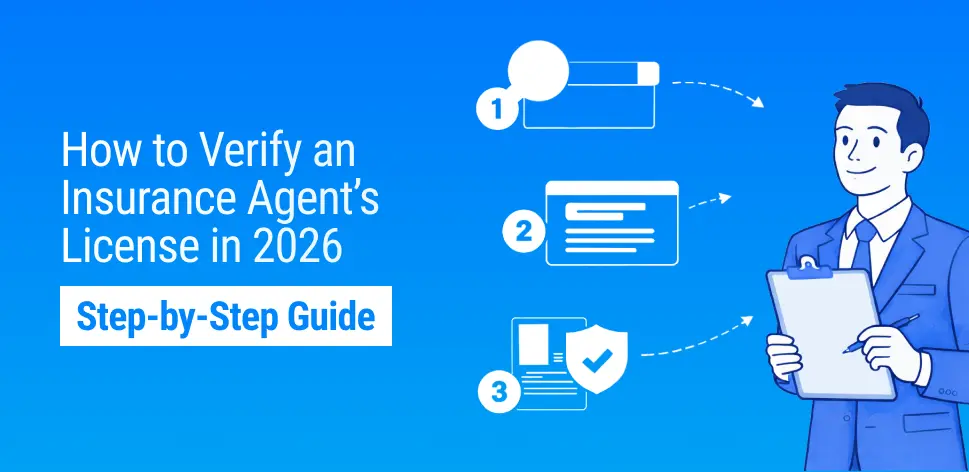
How to Verify an Insurance Agent License (Step by Step)
Whether you’re checking your own credentials or verifying another agent, this is the same process used by regulators, carriers, and agencies.
Step 1: Collect the Agent’s License Information
A licensed insurance agent should be able to provide this information easily:
- Full legal name (as listed on the license)
- State license number or National Producer Number (NPN)
- State(s) where they are licensed
- Lines of authority (life, health, P&C, etc.)
If an agent hesitates or provides incomplete details, that’s a potential red flag.
Step 2: Check the State Department of Insurance (DOI) License Lookup
Every state maintains a free, public license lookup tool through its Department of Insurance. This is the most authoritative source for verifying license status in a specific state.
State DOI license lookups typically show:
- Active, inactive, or expired status
- License issue and renewal dates
- Approved lines of authority
- Carrier appointments
Search tip: Google: “[State] insurance license lookup”
Examples:
- California: insurance.ca.gov/license-status
- Florida: licenseesearch.fldfs.com
- Texas: Texas Department of Insurance Agent Lookup
Step 3: Use the National Insurance Producer Registry (NIPR)
If an agent is licensed in multiple states, the National Insurance Producer Registry (NIPR) provides a consolidated nationwide view.
Using the NIPR Producer Database, you can:
- Verify resident and non-resident licenses
- Confirm active carrier appointments
- Review regulatory actions
- See license history across states
Some reports may require a fee, but NIPR data is sourced directly from state insurance departments and is widely trusted across the industry.
Step 4: Confirm Lines of Authority and Carrier Appointments
An active license does not automatically mean an agent can sell every type of insurance.
Always confirm:
- The agent holds the correct line of authority for the product being sold
- The agent has an active appointment with the carrier
Appointments can lapse even when a license remains active—one of the most common compliance failures in the industry.
Step 5: Contact the State DOI if Information Is Missing
If an agent cannot be found through a state lookup or NIPR search:
- Contact the state Department of Insurance directly
- Ask about name variations, recent renewals, or reporting delays
DOI licensing staff can clarify discrepancies and confirm official status.
Insurance Agent License Management Is a Growing Priority in 2026
Although tools like the National Insurance Producer Registry (NIPR) improve portability, true uniformity in insurance agent licensing still does not exist. Non-resident licensing remains one of the most common sources of compliance gaps, particularly for producers expanding into new states.
State-specific variations continue to create risk. States such as California, Florida, Alabama, and Michigan have introduced frequent regulatory updates in recent years, especially in property and casualty lines, requiring agents to stay current on changing rules around licensing, appointments, and disclosures. These inconsistencies mean that a license strategy that works in one state may create exposure in another.
Continuing education requirements are also becoming more demanding. In addition to ethics training, many states are emphasizing cybersecurity and data protection education, shifting CE management from a periodic task to an ongoing operational responsibility. For adjusters, the challenge is amplified. Many hold licenses in ten or more states, and the lack of standardization, particularly for workers’ compensation, makes compliance significantly harder to manage at scale.
Why License Management Software Matters
Agencies that automate compliance:
- Prevent missed renewals
- Ensure only licensed agents are selling
- Reduce audit risk
- Scale into new states faster
- Protect revenue and carrier relationships
Agencies that proactively manage licenses, appointments, and CE requirements are better positioned to expand into new states, onboard agents faster, and protect revenue streams. Those relying on outdated processes face higher compliance risk, slower growth, and greater exposure to enforcement actions.
How Insurance Agencies Maintain Compliance with License Management Software
Unlike general agency management systems or CRM tools, insurance license management software is focused exclusively on the lifecycle of producer licensing from initial application and renewals to appointment tracking and continuing education.
Agenzee is built specifically for agencies, carriers, MGAs, and producers who need accuracy, scalability, and real‑time compliance insights. For many agencies, the biggest value comes from replacing fragmented, manual tracking with a cohesive, automated environment that reduces risk and frees up time
FAQs: Insurance Agent Licensing in 2026
Q.1 How can I quickly verify my own insurance agent license across multiple states?
You can use the NIPR Producer Database (PDB) for a consolidated view of your resident and non-resident licenses. Enter your NPN or state license number to review active licenses, appointments, and any regulatory actions. For single-state verification, check your Department of Insurance’s online lookup tool.
Q.2 What are the biggest license management risks for 2026?
The main risks include:
- Missing renewal deadlines, especially with stricter timelines and higher late fees
- Lapsed or incomplete non-resident licenses
- Errors in CE tracking, including new ethics and cybersecurity modules
- Data security breaches in digital license management systems
Q.3 Do I need separate licenses for every state I sell in?
Yes. Agents must hold a valid resident license in their home state and non-resident licenses for any additional states where they sell insurance. Multi-state compliance is one of the leading reasons for license management software adoption in 2026.
Q.4 What should I do if my license or appointment shows as inactive?
Act quickly: contact the state DOI to clarify status and resolve any lapses, and notify your carrier if appointments are affected. Delays can impact your ability to sell and receive commissions. Automated reminders and centralized tracking help prevent these situations.
Q.5 How does technology help with insurance agent license management in 2026?
Insurance license management software automates renewal tracking, CE compliance, appointment management, and multi-state reporting. AI tools can flag potential lapses, provide audit-ready reports, and reduce administrative burden.
Q.6 Can I rely on spreadsheets to track licenses in 2026?
Spreadsheets alone are increasingly risky. With multi-state licenses, strict deadlines, and CE updates, manual tracking can lead to missed renewals, fines, or lost commissions. Agencies and solo producers are moving toward automated, centralized systems for reliability and efficiency.
Final Checklist: How to Verify an Insurance Agent License
- Collect license details (state, license number, NPN)
- Check state DOI license status
- Use NIPR for multi-state verification
- Confirm carrier appointments
- Agencies: use license management tools
Ready to Simplify Insurance Agent License Management?
By following the step-by-step verification process, monitoring lines of authority, and leveraging insurance license management software like Agenzee, organizations can:
- Prevent costly compliance lapses and lost commissions
- Reduce administrative burden and manual errors
- Stay audit-ready across multiple states
- Scale operations efficiently while protecting revenue and reputation
Whether you’re a solo producer, agency owner, or compliance officer, the right tools and disciplined processes transform license management from a liability into a strategic advantage.
Subscribe for compliance updates
Request a demo to see automated license management in action
Disclaimer: This post is for informational purposes only and does not constitute legal or compliance advice. Agenzee does not warrant the accuracy of and assumes no liability for reliance. Please consult regulators or professional advisors as needed. See our full disclaimer for details.
Subscribe
Stay Ahead with Agenzee Insights
Join our community to stay up-to-date on the latest news and strategies for license and appointment management
INDUSTRY INSIGHTS FOR INSURANCE AGENCIES, CARRIERS, AND MGAS
Similar Blogs
Read our blog to discover the latest industry insights and trends in license and appointment management.

let's catch up!
Schedule a Live 1-On-1
Demo of Agenzee!
Our insurtech experts would be thrilled to give you a personalized demo of how Agenzee can transform your compliance management processes.
Customers Opinions on Our Services and Products
What Our Customers Say
Find out why our customers are happy they chose Agenzee.