

Published On: August 27, 2025
Updated On: February 26, 2026
What Are the Key Differences Between Insurance Compliance and Insurance License Management Software?
The U.S. insurance industry is among the most heavily regulated sectors in the country. For insurers, brokers, managing general agents (MGAs), and third-party administrators (TPAs) operating across multiple states, maintaining compliance requires rigorous oversight of both enterprise regulations levels and producer licensing obligations.
Although insurance compliance software and insurance license management solutions are often mentioned together, they mitigate different types of operational risk. As regulatory scrutiny continues to intensify, organizations are investing in both technologies to enhance automation, strengthen governance, and reduce exposure to compliance gaps.
In this in-depth guide, we’ll explore:
- What is insurance compliance software?
- What is insurance license management software?
- Feature-by-feature comparison: how each operates
- Business impacts and risk management capabilities
- When to use each, and who benefits most
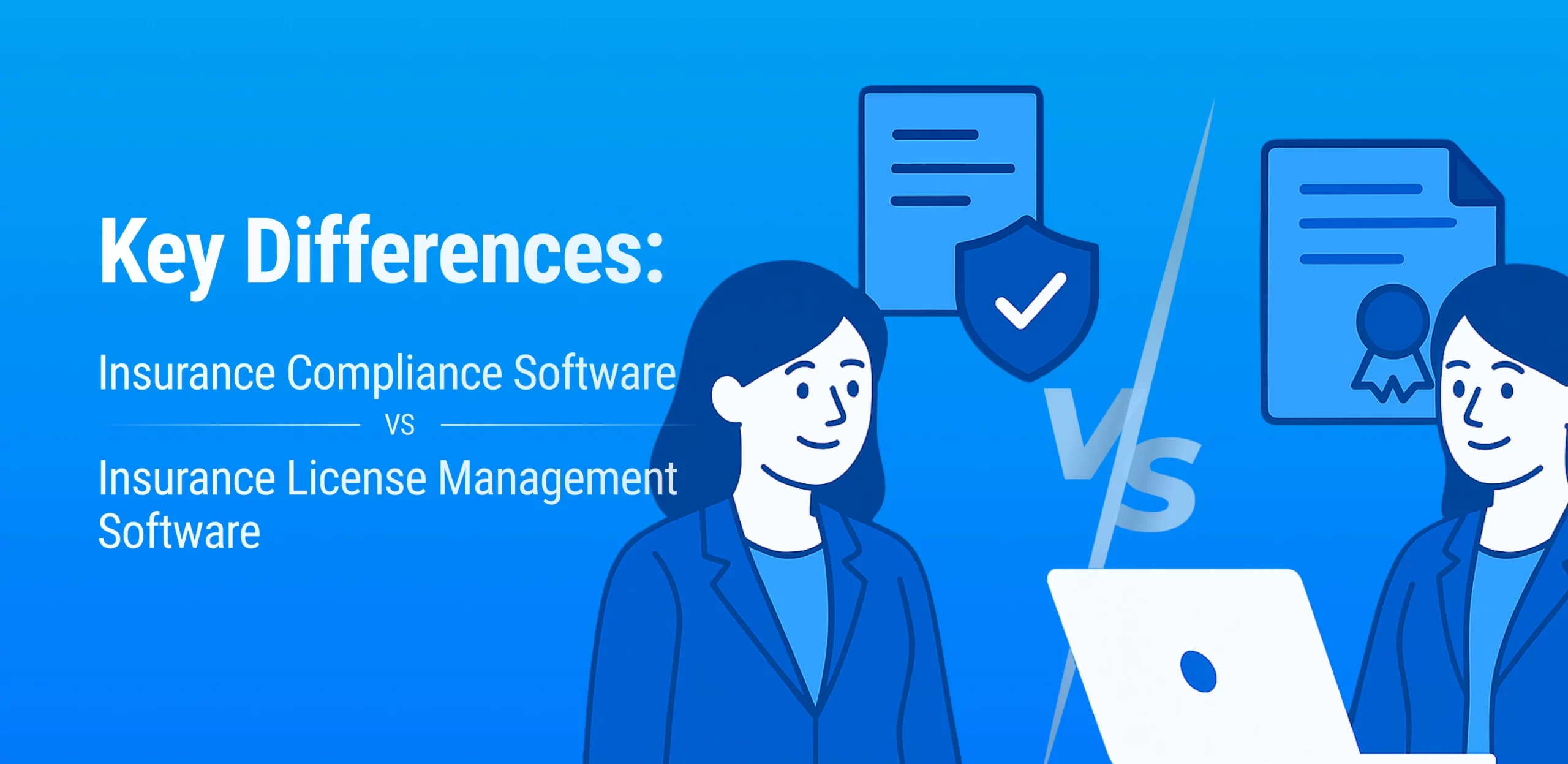
What is Insurance Compliance Software?
Insurance compliance software is an enterprise-level platform designed to help insurers and agencies adhere to federal, state, and local regulatory requirements.
Rather than focusing on licensing alone, compliance software manges broader organization risk, including anti-money laundering (AML) requirements, privacy and data-protection mandates, market conduct rules, audits processes, and internal policy controls.
These platforms centralize compliance oversight for companies operating across multiple jurisdictions and maintain structured documentation, audit readiness, and consistent regulatory adherence.
Core Capabilities:
- Compliance Monitoring: Tracks regulatory changes and internal processes to identify risk exposures related to fraud, privacy, or sales practices.
- Regulatory Intelligence: Collects and consolidates updates from regulators such as NAIC (National Association of Insurance Commissioners), CMS (Center for Medicare and Medicaid Services, and state DOIs, (Departments of Insurance), providing compliance teams with actionable regulatory insights.
- Document Management & Reporting: Centralizes policies, audit documentation, and regulatory filings while generating structured reports for leadership and regulators.
- Policy & Governance Controls: Aligns internal procedures with external requirements and tracks attestations and internal training completion.
- Incident & Complaint Management: Captures complaints, investigations, corrective actions, and remediation activities while maintaining defensible audit-ready records.
- Enterprise Risk & Audit Support: Supports formal risk assessments and maintains documentation required for regulatory or internal audits.
- Staff Training Modules: Ensures all staff are up to date on laws and procedures with modules for tracking completion, managing quizzes, and role-based learning.
- AML Program Oversight: Monitor AML training, suspicious activity reports (SARs) documentation, and manage all required reporting obligations.
- Training & Attestation Tracking: Monitors compliance training completion across employees and roles.
In short, insurance compliance software provides organization-wide regulatory governance that extends well beyond producer licensing.
What is Insurance License Management Software?
Insurance license management software (iLMS) focuses on one critical function: managing the full lifecycle of licenses, appointments, and continuing education (CE) requirements for producers, agents, brokers, agencies, and carrier entities.
Its primary objective is operational precision.
A robust iLMS maintains proper licensing and appointments for all producers, safeguarding the organization from revenue interruptions due to lapsed credentials or overlooked renewals.
For organizations overseeing multiple producers and/or national operations, iLMS replace reliance on manual spreadsheets and tracking, significantly reducing the risk of human error.
Core Capabilities:
- Centralized License Repository: Stores licenses, appointments, and jurisdictional records in a structured digital system.
- Real-Time License Validation: Integrates with NIPR (National Insurance Producer Registry) to verify license status, expirations, disciplinary actions, and appointment eligibility across states.
- Expiration & Renewal Tracking: Automated alerts for renewals, CE deadlines, and appointment maintenance.
- Bulk Filing & Appointment Processing: Streamlines high-volume license renewals and appointment submissions.
- Audit-Ready Reporting: Maintains time-stamped records of licensing actions to support audits and reduce regulatory risk.
- Onboarding & HR Integration: Supports credential verification during hiring and automates appointment workflows.
Insurance license management software does not replace organization-wide or enterprise compliance platforms, nor does it manage broader regulatory risks. Its focus is protecting producer authorization and commission eligibility.
Key Differences
Although both systems support regulatory obligations, their scope and impact differ significantly.
|
Feature |
Insurance Compliance Software |
Insurance License Management Software |
|
Purpose |
Enterprise-wide regulatory governance |
Lifecycle management of licenses & appointments |
|
Regulatory Monitoring |
AML, privacy, market conduct, reporting |
License status & renewal tracking |
|
License Tracking |
May include |
Core function |
|
Document Management |
Policies, audits, complaints |
Licenses, CE, appointments |
|
Training Tracking |
Enterprise compliance training |
CE & licensing training |
|
Automation |
Risk alerts, reporting, escalation |
Renewal alerts, NIPR validation |
|
Risk Focus |
Legal, operational, reputational |
Lapsed licenses & invalid appointments |
|
Primary Users |
Compliance & legal teams |
Licensing, HR, onboarding teams |
The distinction is not overlap; it is specialization.
Why This Distinction Matters
Insurance compliance software and insurance license management software are often mistaken for the same thing, but they address entirely different risks. Compliance platforms safeguard the enterprise from regulatory scrutiny, while licensing systems keep producers authorized and commissions valid. Misunderstanding this distinction can lead to costly compliance gaps.
When Do Organizations Need Both?
For growing insurers and multi-state agencies, regulatory exposure is multi-directional:
- Enterprise compliance complexity increases • Producer licensing volume demands multiply
Most organizations of scale ultimately need both platforms to stay compliant and operational.
You likely need compliance software if:
- You operate across multiple jurisdictions
- You manage AML programs or compliance workflows
- You require centralized enterprise-risk oversight
You likely need license management software if:
- You manage large volumes of producers
- You operate nationally with multiple renewal cycles
- You want to eliminate manual NIPR checks and spreadsheets
- Revenue depends on fast onboarding
Together, these systems create a coordinated compliance framework.
Final Thoughts: Choosing the Right Tool for Your U.S. Insurance Organization
Selecting between insurance compliance software and insurance license management software is a strategic decision not just a technology choice.
Each platform addresses a different dimension of regulatory exposure:
- Compliance software governs enterprise regulatory risk
- License management software governs producer authorization and revenue protection
For insurers and agencies operating at scale, both are often required to build sustainable infrastructure.
When these platforms aligned properly, they reduce regulatory exposure, improve accountability, and support scalable growth.
Key takeaway:
- Insurance compliance software manages enterprise-wide regulatory risk.
- Insurance license management software manages licenses, appointments, and CE lifecycle.
- The platforms serve different operational functions with limited overlap.
- Multi-state insurers typically require both.
- Automation reduces fines, administrative burden, and revenue disruption.
Next Steps
If your organization is still relying on spreadsheets for producer licensing or fragmented tools for broader compliance oversight, it may be time to reassess your infrastructure.
Modern insurance organizations treat licensing and compliance as coordinated, but separate pillars of risk management. The right combination of insurance compliance software and insurance license management software ensures you remain authorized to operate, prepared for audits, and positioned for long-term growth.
Disclaimer: This post is for informational purposes only and does not constitute legal or compliance advice. Agenzee does not warrant the accuracy of and assumes no liability for reliance. Please consult regulators or professional advisors as needed. See our full disclaimer for details.
Subscribe
Subscribe to Receive Cutting-Edge Insights From Agenzee
Join our community to stay up-to-date on the latest strategies for license and appointment management
INDUSTRY INSIGHTS FOR INSURANCE AGENCIES, CARRIERS, AND MGAS
Similar Blogs
Read our blog to discover the latest industry insights and trends in license and appointment management.

let's catch up!
Schedule a Live 1-On-1
Demo of Agenzee!
Our insurtech experts would be thrilled to give you a personalized demo of how Agenzee can transform your compliance management processes.
Customers Opinions on Our Services and Products
What Our Customers Say
Find out why our customers are happy they chose Agenzee.