

Published On: February 4, 2026
Updated On: February 27, 2026
Missouri Issues Guidance on Insurance Data Security Act Implementation Understanding Cybersecurity Reporting Obligations for Licensees

The Missouri Department of Commerce and Insurance has released Insurance Bulletin 26-01 to help regulated entities understand their responsibilities under the Insurance Data Security Act. Effective January 1, 2026, the Act establishes cybersecurity event reporting requirements for insurance licensees and clarifies how incidents involving third-party service providers must be handled. This guidance outlines who qualifies as a licensee, how and when cybersecurity events must be reported, and which entities fall outside the Act’s scope.
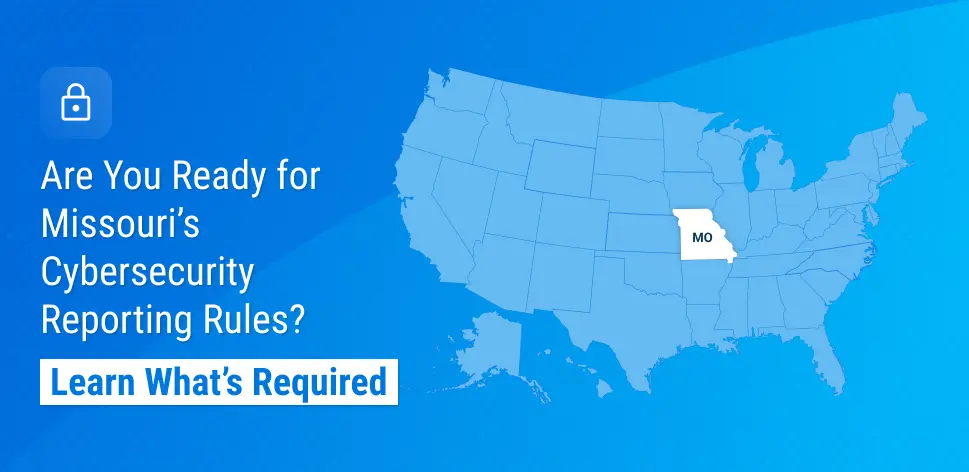
Missouri’s Insurance Data Security Act: Overview and Effective Date
The Missouri General Assembly enacted the Insurance Data Security Act during the 2025 First Regular Session, with an effective date of January 1, 2026. Codified in sections 375.1400 to 375.1427 RSMo, the Act is based on the NAIC Insurance Data Security Model Law and is designed to strengthen cybersecurity standards across the insurance industry.
While the Act is now in effect, certain provisions allow licensees additional time to implement specific requirements. Insurance Bulletin 26-01 was issued to educate regulated entities and provide practical guidance on how the Department interprets and will administer the Act.
Cybersecurity Event Reporting Requirements
Under section 375.1410.1 RSMo, a licensee must notify the Director when a cybersecurity event has occurred, and specific statutory criteria are met. To support compliance, the Department has created a mandatory electronic notification form (Missouri Cybersecurity Event Notification Form), which must be used for all cybersecurity event reports.
Initial notifications, as well as updates related to material changes in previously reported information, must be submitted through this electronic form. The Department strongly encourages licensees to review statutory definitions and exclusions before reporting to ensure the event meets the reporting threshold under the Act.
Third-Party Service Provider Cybersecurity Events
The Act explicitly addresses cybersecurity events involving third-party service providers. If a cybersecurity event occurs within a system maintained by a third-party service provider—and the license becomes aware of the event, the license is required to report it as though the event occurred within its own systems.
This requirement reinforces the importance of vendor oversight and incident awareness. Licensees should review their third-party contracts, cybersecurity policies, and monitoring procedures to ensure timely detection and reporting of qualifying events.
Who Is and Is Not Considered a “Licensee”
The bulletin provides important clarification regarding which regulated entities are considered “licensees” under the Act. While the statutory definition is broad, the Department confirms that certain entities are excluded, including:
- Health services corporations (HCSCs), HMOs, and prepaid dental plan corporations
- Captive insurance companies and special purpose life insurance captives
- Missouri mutual insurance companies
- Associations licensed under Chapter 383
- Certain providers registered under Chapter 385
These exclusions are based on statutory provisions stating that general insurance laws do not apply unless expressly made applicable.
Clarifying “Home State” and Reporting Scope
The Department also clarified how the terms “home state” and “producer” are applied for reporting purposes. Specifically, the phrase “those terms” in section 375.1410.1 refers only to “home state” and “producer,” as defined in section 375.012, and does not apply to the term “insurer.” This interpretation aligns Missouri’s approach with how other states have implemented the NAIC Model Law.
Conclusion
Insurance Bulletin 26-01 provides critical clarity on how Missouri expects licensees to comply with the Insurance Data Security Act. With cybersecurity event reporting now governed by a standardized electronic process and expanded to include third-party incidents, licensees should review internal controls, vendor relationships, and response procedures. Early preparation and clear documentation will be key to maintaining compliance as enforcement expectations evolve.
Johnelee serves as the Senior Marketing Manager at Agenzee, orchestrating strategic growth initiatives and maintaining brand consistency across all marketing touchpoints for Agenzee solutions. Johnelee has created or edited over 100 content pieces on insurance licensing, carrier appointment management, and regulatory compliance. This work helps agencies, carriers, MGAs (Managing General Agents), FMOs (Field Marketing Organizations, TPA (Third Party Administrators), and holding companies navigate the complexities of insurance operations and stay ahead of industry changes.
Johnelee excels at distilling complex insurance processes into accessible content that resonates with insurance professionals. Johnelee collaborates closely with product, sales, customer success, and executive leadership to ensure marketing strategies align with business objectives and customer needs, positioning Agenzee as a trusted partner in modernizing insurance distribution workflows.
Disclaimer: This post is for informational purposes only and does not constitute legal or compliance advice. Agenzee does not warrant the accuracy of and assumes no liability for reliance. Please consult regulators or professional advisors as needed. See our full disclaimer for details.
Subscribe
Stay Ahead with Agenzee Insights
Join our community to stay up-to-date on the latest news and strategies for license and appointment management
INDUSTRY INSIGHTS FOR INSURANCE AGENCIES, CARRIERS, AND MGAS
Similar Blogs
Read our blog to discover the latest industry insights and trends in license and appointment management.


let's catch up!
Schedule a Live 1-On-1
Demo of Agenzee!
Our insurtech experts would be thrilled to give you a personalized demo of how Agenzee can transform your compliance management processes.
Customers Opinions on Our Services and Products
What Our Customers Say
Find out why our customers are happy they chose Agenzee.