

Published On: January 9, 2024
Updated On: September 22, 2026
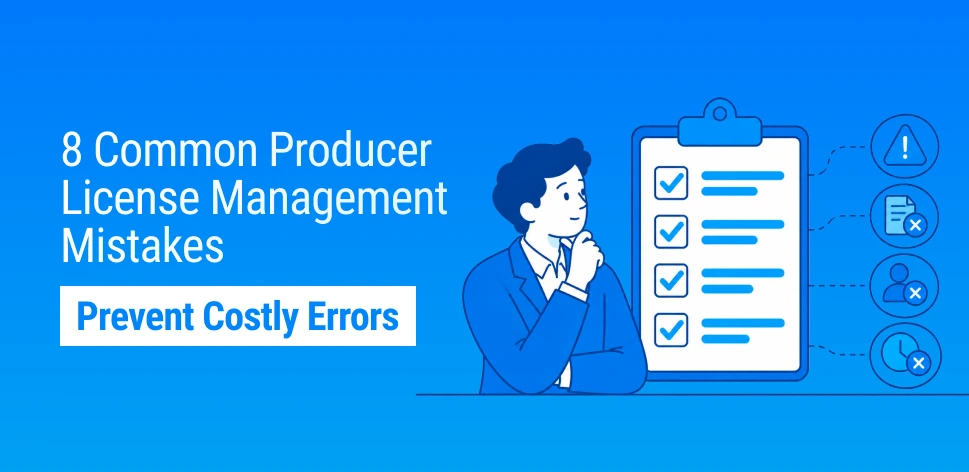
8 Common Mistakes to Avoid in Producer Compliance Management

Managing producer compliance is a critical responsibility for insurance agencies, carriers, and managing general agencies (MGAs). As organizations expand, manually tracking licenses, appointments, continuing education requirements, and regulatory obligations for all producers becomes increasingly difficult, increasing the risk of compliance errors.
To help strengthen compliance operations, this blog examines eight of the most common producer compliance mistakes and explores practical ways licensing management teams can avoid them.
Producer Compliance
Producer compliance involves managing license renewals, carrier appointments, continuing education requirements, producer records, and state-specific regulations across multiple jurisdictions.
Key Takeaways
- Missed license renewals and invalid appointments can prevent producers from conducting business.
- Continuing education requirements are often required for license renewals.
- Outdated producer records can create filing errors and regulatory exposure.
- State-specific regulations and non-resident licensing may increase compliance complexity for multi-state license management.
- Improving centralized systems, automation, and lifecycle visibility can help reduce compliance risk.
1. Missed License Renewals
License renewals are a foundational aspect of producer compliance. In most states, producer licenses must be renewed periodically to remain active and compliant. However, because renewal requirements vary by state and license type, keeping track of renewal timelines becomes increasingly challenging as organizations expand and producer headcount increases.
Without a reliable renewal process, producer licenses can lapse, creating compliance gaps and administrative disruptions.
What Causes Missed License Renewals?
- Inconsistent Renewal Processes: Inconsistent processes across departments or compliance team members can make renewal deadlines and requirements easier to miss.
- Manual Tracking Methods: Tracking renewal cycles using spreadsheets and manual reminders increases the likelihood of data entry mistakes, missed deadlines, and outdated information.
- Limited Visibility into Renewal Deadlines: Storing licensing information across multiple systems or spreadsheets limits visibility into upcoming deadlines and requirements.
What Happens if a License Renewal is Missed?
Lapsed producer licenses can prevent producers from conducting business and increase the risk of unlicensed selling, delayed producer onboarding, and additional administrative work.
How to Avoid Missed License Renewals?
Licensing teams can avoid missed license renewals by automating renewal tracking, centralizing licensing data, improving deadline visibility, and implementing automatic renewal alerts. Accurate reporting can also help support compliance oversight and provide insight into the efficiency of licensing operations.
2. Failed Appointment Validation
Maintaining required carrier appointments is an important aspect of producer compliance. Appointment requirements vary by state, product, and carrier, so compliance teams must be able to identify when an appointment is required and verify that it remains active. However, validating appointment status across multiple carriers, producers, and jurisdictions introduces operational complexity that strains compliance.
Where an appointment is required, an invalid or missing appointment may prevent a producer from conducting certain insurance business on behalf of a carrier.
What Causes Failed Appointment Validation?
- Incomplete appointment records make it difficult to confirm active carrier relationships.
- Manual tracking processes introduce delays and inconsistencies in appointment updates.
- Limited visibility across carrier systems prevents compliance teams from identifying appointment gaps early.
What Happens When Appointment Validation Fails?
Invalid or missing appointments can delay producer activation and, where an appointment is required, prevent a producer from conducting certain business on behalf of a carrier.
How to Reduce Appointment Validation Risk
Compliance teams can improve appointment validation by centralizing appointment records, standardizing tracking processes, and automating status monitoring across carriers.
3. Missed Continuing Education Requirements
Many states require producers to complete continuing education (CE) before renewing certain licenses. Renewals must be completed within specific renewal cycles, but these vary by jurisdiction and must be carefully tracked to ensure no deadlines are missed.
Missing required CE can delay or prevent license renewal and may result in an inactive license, depending on state requirements.
What Causes Missed Continuing Education Requirements?
- Inconsistent CE Tracking Processes: Unclear responsibilities for monitoring CE requirements across teams may cause gaps in accountability.
- Manual CE Tracking Methods: Tracking CE completion through spreadsheets, emails, or manual reminders increases the risk of administrative errors and missed deadlines.
- Limited Visibility Into CE Progress: Lacking a centralized overview of completed courses, outstanding credits, and approaching deadlines makes it difficult to identify compliance gaps.
- Multi-State Licensing Complexity: Satisfying different CE requirements across multiple states increases compliance complexity.
What Happens When Continuing Education Requirements Are Missed?
Missed CE requirements can delay license renewal, resulting in inactive producers, interrupted business activity, and increased compliance exposure.
How to Improve Continuing Education Compliance?
Producer license management teams should track CE progress continuously, centralize CE credit data, and automate reminders for upcoming deadlines.
4. Outdated Producer Records
Accurate producer records are important for producer licensing, appointment, and state filing compliance. When key producer details such as address, legal name, or other licensing information change, states may require the producer or organization to report or update that information with the appropriate department of insurance.
Outdated records can lead to filing errors, putting organizations in jeopardy of non-compliance.
What Causes Outdated Producer Records?
| Decentralized Record Management | Spreading information across multiple spreadsheets, departments, or offices leads to fragmented, inconsistent data. |
| Manual Data Entry and Maintenance | Data entry errors, duplicate records, and other inconsistencies limit the reliability of manual updates. |
| Failure to Track & Validate Producer Changes | Failure to capture changes to address, names, or other producer information can result in outdated records. |
What Happens When Producer Records Become Outdated?
- Delayed license applications and renewals
- Delayed or rejected filings or appointments, where applicable
- Inaccurate state filings
- Increased regulatory scrutiny
How to Maintain Accurate Producer Records?
Licensing teams can maintain accurate producer records by regularly updating information, centralizing producer information in a single system, periodically validating records, and implementing processes to automatically synchronize and validate data.
5. Overlooking State-Specific Regulations
Compliance with state-specific regulations is another crucial aspect of producer compliance management. Each state has its unique set of laws and regulations concerning insurance, presenting a challenge for agencies, carriers, and MGAs that operate in multiple states.
Failure to account for these differences can lead to compliance gaps, audit findings, filing deficiencies, and regulatory penalties.
What Causes State Compliance to be Overlooked?
- Lack of clarity around state-specific licensing rules leads to inconsistent compliance practices.
- Regulatory updates are not always monitored or applied consistently across teams.
- Internal processes may not reflect differences in state renewal, CE, or reporting requirements.
- Compliance responsibilities are often decentralized across departments or locations.
What Happens When State Compliance is Overlooked?
State regulators may flag inconsistencies in licensing records, missing filings, or outdated compliance documentation. These issues may surface during audits, renewal reviews, or other regulatory interactions.
How to Strengthen State-Level Compliance?
Compliance teams can reduce risk by centralizing regulatory tracking, maintaining updated state requirement libraries, and assigning clear ownership for compliance monitoring across jurisdictions.
6. Manual Producer License Management
As the number of producers increases, manual license tracking systems become harder to maintain. Without a centralized system to manage licensing data, organizations may struggle to maintain visibility into licensing status, renewals, and compliance requirements, creating operational inefficiencies and increasing the risk of producer compliance gaps.
What Causes Manual License Management to Fail?
- Licensing data is stored across spreadsheets or disconnected systems.
- Renewal and appointment tracking rely heavily on manual updates.
- Teams spend significant time on administrative tracking instead of compliance oversight.
What Happens When Manual License Management Fails?
Without a centralized system, organizations may experience renewal delays, onboarding inefficiency, and increased administrative workload.
How to Improve License Management?
Licensing teams can improve license management by implementing centralized systems that provide centralized visibility, automated tracking, and structured compliance workflows.
7. Ineffective Non-Resident License Management
Non-resident licensing introduces additional complexity due to varying multi-state requirements, reciprocity standards, and jurisdictional oversight. Without consistent processes, managing non-resident producer compliance can quickly become fragmented and error-prone.
How Does Non-Resident Licensing Break Down?
- State-specific non-resident licensing requirements are misinterpreted.
- License status and producer updates are not regularly verified and reconciled.
- National Producer Numbers (NPNs) are not consistently used as a primary identifier when tracking licensing activity across systems.
What Happens When Non-Resident Licensing Breaks Down?
Inaccurate or outdated non-resident license data can result in missed renewals, filing discrepancies, and regulatory penalties across multiple jurisdictions.
How to Improve Non-Resident License Management?
Producer compliance teams can improve accuracy by leveraging NPN-based tracking, conducting routine reconciliations with available NIPR and state licensing data, and maintaining structured communication with non-resident producers.
8. Poor Lifecycle Visibility
A lack of comprehensive visibility contributes significantly to producer compliance mistakes. Maintaining compliance requires end-to-end visibility across the producer lifecycle, from initial licensing and appointments to renewals, continuing education requirements, and ongoing record updates.
Without end-to-end visibility across an organization, compliance issues may not be identified in time to prevent operational disruption.
Producer Lifecycle Visibility
Producer lifecycle visibility refers to the ability to leverage comprehensive insight into producer compliance throughout a producer’s time with an organization. This includes visibility into background information, licensing and appointment status, continuing education, renewals, records, and other compliance requirements. Producer lifecycle visibility is essential to identify gaps and ensure producer compliance.
What Causes Poor Lifecycle Visibility?
| Fragmented Systems | Licensing, appointments, CE, and renewals are managed on separate platforms without a unified view. |
| Operational Silos | Compliance, operations, and support teams work independently without shared visibility. |
| Delayed or Inconsistent Status Updates | Changes in CE, license, or appointment status are not reflected consistently across systems. |
| Lack of Consolidated Reporting | There is no single dashboard or source of truth for producer compliance across states and requirements. |
How Does Limited Visibility Impact Operations?
A lack of lifecycle visibility can lead to delayed issue detection, duplicated work across compliance teams, and reactive rather than proactive license management.
How to Improve Lifecycle Visibility?
Compliance teams can improve end-to-end oversight by centralizing compliance data, integrating licensing systems, and implementing unified dashboards that provide current visibility into producer lifecycle status.
The Solution for Producer License Management
Effective producer license management requires organizations to stay on top of license renewals, carrier appointments where applicable, continuing education, producer records, state specific requirements, and nonresident licensing. As organizations grow, managing these responsibilities across multiple producers and jurisdictions becomes increasingly complex. Without consistent processes and clear visibility, manual workflows can create compliance gaps, administrative burden, and operational delays.
A strong producer compliance program combines centralized information, consistent processes, and timely oversight across the producer lifecycle. By reducing manual work, improving visibility into licensing and compliance requirements, and identifying potential issues before they become problems, organizations can strengthen compliance operations, improve efficiency, and better support the producers they manage.
FAQs
Q.1 What is producer compliance?
Producer compliance is how organizations ensure producers maintain the licenses, appointments, education requirements, and regulatory filings needed to legally conduct insurance business.
Q.2 Why are license renewals important for producer compliance?
License renewals help ensure producers maintain active and compliant licenses. Missing renewal deadlines can lead to lapsed licenses, compliance violations, operational delays, and additional administrative work.
Q.3 What is appointment validation?
Appointment validation is the process of confirming that producers maintain the appropriate carrier appointments required to sell, solicit, or service insurance products.
Q.4 How do continuing education requirements affect producer compliance?
In many states, producers must complete continuing education (CE) requirements before renewing their licenses. Failure to meet CE requirements can delay or prevent license renewal.
Q.5 Why is maintaining accurate producer data important for producer compliance?
Accurate producer records support compliant licensing, appointments, and regulatory filings. Outdated information can lead to filing errors, rejected appointments, and increased compliance risk.
Q.6 How can organizations avoid producer compliance mistakes?
Organizations can improve compliance by centralizing producer data, automating tracking and monitoring processes, maintaining accurate records, and increasing visibility into compliance requirements and deadlines.
Allison is a Content Writer at Agenzee, creating blogs, case studies, social media content, and other value-driven materials to support overall marketing strategies and spur brand growth. Her storytelling expertise infuses her work with a clear, captivating voice that successfully drives conversion and engagement.
Educated in anthropology at Princeton University, Allison’s unique background in software solutions, fiction writing, ethnographic research, and tutoring gives her a unique perspective on the insurance licensing world, enabling her to pursue her mission: Making Agenzee the leader of insurance modernization.
Disclaimer: This post is for informational purposes only and does not constitute legal or compliance advice. Agenzee does not warrant the accuracy of and assumes no liability for reliance. Please consult regulators or professional advisors as needed. See our full disclaimer for details.
Subscribe
Stay Ahead with Agenzee Insights
Join our community to stay up-to-date on the latest news and strategies for license and appointment management
INDUSTRY INSIGHTS FOR INSURANCE AGENCIES, CARRIERS, AND MGAS
Similar Blogs
Read our blog to discover the latest industry insights and trends in license and appointment management.

let's catch up!
Schedule a Live 1-On-1
Demo of Agenzee!
Our insurtech experts would be thrilled to give you a personalized demo of how Agenzee can transform your compliance management processes.
Customers Opinions on Our Services and Products
What Our Customers Say
Find out why our customers are happy they chose Agenzee.